CBD labelling in France: 7 mandatory items and the bans
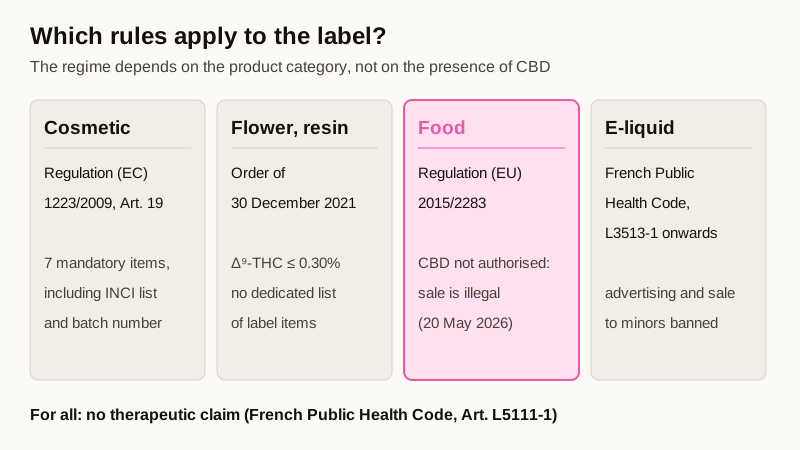
There is no labelling rule specific to CBD: what applies depends on the product category. A cosmetic must carry the 7 items listed in Article 19 of EU Regulation 1223/2009, a flower falls under the hemp framework, an e-liquid under the French Public Health Code, and a CBD food can no longer be sold since May 2026. For all of them, no therapeutic claim is allowed.
Contents
> Key takeaways > > - The product category decides which text applies, and therefore which items are mandatory. > - A CBD cosmetic carries 7 items, including the INCI list and the batch number. > - Foods containing CBD are illegal, according to the French Ministry of Agriculture on 20 May 2026. > - A label that claims to heal turns the product into a medicine under the French Public Health Code. > - In 2023, 46% of the CBD products tested in France carried no composition.
The principle: the category decides the label
A cream, a flower, an e-liquid and a gummy do not fall under the same texts. That is the first thing to establish in front of a pack, because it determines what the maker must write and what it may not write. A statement that is lawful on a cosmetic can be unlawful on a food, and the other way round.
The need is real. In 2023 the French addiction-monitoring centres had 223 products sold as CBD analysed: 46% carried no composition and only 19% contained the stated level, within 20%.
Cosmetics: the 7 items of Article 19
This is the best-defined regime. Article 19 of Regulation (EC) No 1223/2009 requires seven items, in indelible, easily legible and visible lettering, on the container and the packaging.
| Item | What it must contain |
|---|---|
| Responsible person | Name or registered name and address; country of origin for imported products |
| Nominal content | Weight or volume at the time of packaging (except below 5 g or 5 ml) |
| Durability | Date of minimum durability, or period after opening if durability exceeds 30 months |
| Precautions for use | Particular precautions, including those in Annexes III to VI |
| Batch number | Manufacturing batch or identification reference |
| Function | Unless it is clear from the presentation |
| List of ingredients | Preceded by the word "ingredients", in descending order of weight |
The ingredient list, known as INCI, deserves a careful read. Ingredients appear in descending order of weight at the time they are added; those present below 1% may follow in any order. Cannabidiol listed near the end, after the fragrance, is among the least abundant ingredients in the formula. Fragrance compounds appear under the word "parfum": our article on allergens in CBD cosmetics explains what that word covers.
The batch number is the item that links the product to everything else: analysis, any recall, complaints. Our guide to checking a batch in a recall relies on it, and our guide to assessing a cream or balm applies these points when buying.
What a label may not promise
Regulation (EU) No 655/2013 sets six common criteria for cosmetic claims: legal compliance, truthfulness, evidential support, honesty, fairness and informed decision-making. Three bear directly on CBD. Truthfulness forbids attributing to the finished product properties of an ingredient that it does not have. Evidential support requires studies on the product and the claimed benefit. Honesty forbids going beyond the effects demonstrated.
This regulation contains no sentence banning therapeutic claims as such. The ban comes from the boundary with medicines: under Article L5111-1 of the French Public Health Code, any substance "presented as having curative or preventive properties with regard to human diseases" is a medicine. A label claiming to relieve pain moves the product into that regime, without the authorisation that goes with it. Our article on permitted cosmetic claims gives examples of acceptable wording.
Food and supplements: illegal since May 2026
This is the change of the year. On 20 May 2026 the Ministry of Agriculture published a statement titled "Foods containing cannabidiol (CBD): illegal products that must be withdrawn from the market". It rests on Regulation (EU) 2015/2283 on novel foods: CBD is not authorised under it, because its safety has not been demonstrated. The ministry is extending checks everywhere, food supplements and online sales included.
Only two categories remain authorised: hemp seeds and their derivatives, such as seed oil, and leaves intended for an infusion in water. Neither may have any cannabinoid extract added. On these products, the label therefore cannot put CBD forward.
On the science, EFSA set on 9 February 2026 a provisional safe intake level of 0.0275 mg per kilo of body weight per day, about 2 mg for a 70 kg adult. Safety is not established under 25, during pregnancy or breastfeeding, or for people on medication. Our overview of the 2026 rules follows this file.
Flowers and resins: no dedicated list of items
For raw flower or resin, the reference text is the order of 30 December 2021. It only allows varieties listed in the official catalogues, with no more than 0.30% Δ⁹-THC. On 29 December 2022 the Conseil d'État struck down the provision that banned the sale of raw flowers and leaves.
This order sets no list of items for the pack. A serious seller still shows the variety name, the measured Δ⁹-THC level, the CBD level and a batch number linked to an analysis. Our guide to the certificate of analysis shows how to check these figures, and our checklist for choosing a CBD product puts them in order.
E-liquids: the vaping rules
The French Public Health Code defines vaping products, refill bottles included, whether or not they contain nicotine. Two common rules therefore apply to CBD e-liquids: the ban on advertising and on sales to minors, Articles L3513-4 and L3513-5. The detailed rules on presentation and leaflets sit in the section for products containing nicotine, which most CBD e-liquids do not. We therefore do not publish a list of items that would be extrapolated. Our guide to CBD e-liquids helps you read the stated concentration.
Frequently asked questions
Which items are mandatory on a CBD cosmetic?
Seven, set by Article 19 of Regulation (EC) No 1223/2009: the responsible person and address, the nominal content, the date of minimum durability or period after opening, the precautions for use, the batch number, the product's function and the list of ingredients.
Can a label say the product relieves pain?
No. A product presented as having curative or preventive properties is a medicine under Article L5111-1 of the French Public Health Code. The only authorised CBD medicine is Epidyolex.
Can CBD oil to swallow still be sold?
No, neither as food nor as a food supplement. The Ministry of Agriculture statement of 20 May 2026 declares them illegal under Regulation (EU) 2015/2283. Only hemp seeds, their derivatives and leaves for infusion remain authorised, with no added extract.
What does the small open jar with "12M" on a cosmetic mean?
It is the period after opening: 12 months. It replaces the date of minimum durability when the product keeps for more than 30 months unopened.
Why is the CBD level not always on the label?
None of the seven cosmetic items requires a CBD percentage. The INCI list shows its position among the ingredients, not its quantity. The batch certificate of analysis remains the only document with figures.
Written by the Phytogrammes team
Every article in this journal draws on primary sources (ANSM, EFSA, EUR-Lex, peer-reviewed publications) and on the lab's own practice: batch-by-batch HPLC analyses, measured cannabinoid profiles. Our approach.
Article published on . CBD is not a medicine.