Is CBD reimbursed in France? 0%, 65% or 100%
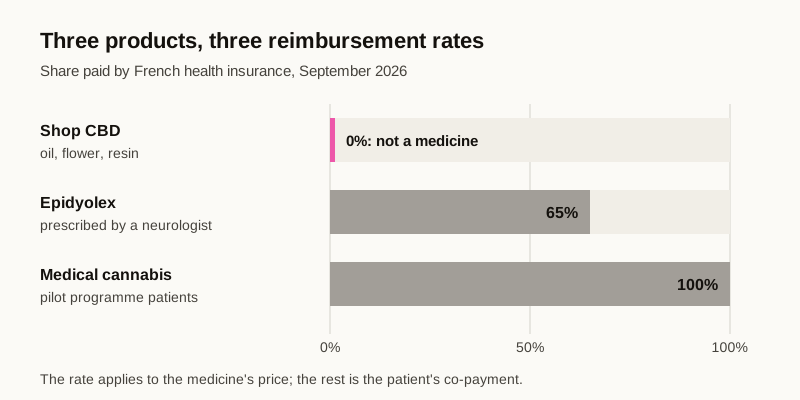
No: a CBD oil, flower or resin bought in a shop is never reimbursed, because it is not a medicine. Two cannabinoid-based products are reimbursed in France. Epidyolex, a cannabidiol medicine, is covered at 65% when prescribed by a neurologist or a paediatric neurologist; the medicines of the medical cannabis pilot programme are covered at 100%, for patients already enrolled only.
Contents
> Key takeaways > > - Reimbursement requires an authorised medicine that is then listed as reimbursable. A shop CBD product has neither. > - A prescription does not make a CBD oil bought in a shop or a pharmacy reimbursable. > - Epidyolex costs €832.71 for a 100 ml bottle, reimbursed at 65%. > - Medical cannabis has not accepted new patients since 27 March 2024. > - A top-up health policy only pays for shop CBD if your contract says so in writing.
Why shop CBD is not reimbursed
To be reimbursed, a product must first be a medicine. It needs a marketing authorisation (AMM in French), granted after its quality, efficacy and safety have been assessed. It must then be put on the list of reimbursable medicines, with a set rate. A CBD oil or flower sold as a consumer product clears neither step.
French health insurance (Assurance Maladie) says as much on its page about non-medical CBD, updated on 19 December 2025: these products "may not, under penalty of criminal sanctions, claim therapeutic properties". The same page adds that no scientific study really confirms the benefits attributed to them. It contains no sentence saying "CBD is not reimbursed": the answer follows from the legal regime, not from a rule specific to CBD.
A prescription changes nothing. A doctor can write "CBD oil" on a prescription, but the product still has no marketing authorisation and no reimbursement rate. Bought in a pharmacy, it remains the same consumer product, sold at a free price: our article on CBD in pharmacies covers that channel.
Epidyolex: the only reimbursed cannabidiol medicine
Epidyolex is an oral solution containing 100 mg of cannabidiol per millilitre. The European Medicines Agency granted it an authorisation valid throughout the EU on 19 September 2019. Its indications are narrow: seizures linked to Lennox-Gastaut syndrome or Dravet syndrome, together with clobazam, and those of tuberous sclerosis complex, always alongside other antiepileptic medicines, from the age of 2.
The French public medicines database gives its conditions in France.
| Item | Value |
|---|---|
| Presentation | 100 ml bottle with an oral syringe |
| Price | €832.71, including a €1.02 dispensing fee |
| Reimbursement rate | 65% |
| Prescription | Restricted to neurologists and paediatric neurologists, list I |
| Declared on the market | 21 December 2022 |
Worked example: on a bottle at €832.71, health insurance reimburses 65%, about €541. The remaining €291 is the co-payment (ticket modérateur), the share left to the patient. Long-term condition status and a top-up policy can cover it, as described below.
Epidyolex is not a "stronger CBD". It is a pharmaceutical product, made and controlled as such, prescribed at a dose based on body weight. Its authorisation says nothing about a shop oil. Our article on Epidyolex and epilepsy goes over the trials that came before it.
And Sativex, which combines THC and CBD? It obtained a French marketing authorisation in January 2014. In 2019, the Health Ministry told a member of parliament that it was still not on the market, for lack of agreement on its price.
Medical cannabis: 100%, for patients already enrolled
The French medical cannabis pilot programme started in March 2021. According to the ANSM file on medical cannabis, updated on 20 April 2026, enrolment stopped on 27 March 2024 and the programme ended on 31 December 2024. Since an order of 27 March 2024, these medicines are billed at the price set by that order and covered at 100% by health insurance.
Patients still on treatment remain covered by way of derogation, on the same terms. This transition phase ends three months after the French National Authority for Health (HAS) publishes its opinion. The HAS was asked for that opinion on 17 March 2025; in September 2026, its page on cannabis-based medicines still announced no published opinion.
The permanent framework was notified to the European Commission on 20 March 2025, as three draft texts. It provides for medicines authorised for five renewable years, reserved for patients who have exhausted other treatments and prescribed in hospital. Nobody can join the scheme today, and it does not cover shop products. Our article on medical cannabis in France follows the timetable.
Long-term condition status and top-up insurance: who pays the rest
Long-term condition status (ALD). Severe epilepsy is on the list of long-term conditions that waive the co-payment. Care linked to the condition is then reimbursed up to the full health insurance tariff. Some costs stay with the patient, such as the medical deductible and the flat-rate contribution.
Top-up health insurance (mutuelle). Article R871-2 of the Social Security Code requires so-called responsible contracts to cover the patient's full co-payment, with the exceptions it lists. For a medicine reimbursed at 65%, the top-up insurer should therefore pay the co-payment, outside ALD status.
Shop CBD. No rule obliges a top-up insurer to pay for a product that health insurance does not reimburse. Some contracts include "wellness" or "alternative medicine" allowances, whose content each insurer sets. We found no official source showing that these allowances cover CBD products. Before buying, read the general terms and ask your insurer for a written answer.
What to tell your doctor
Even when it is not reimbursed, CBD can interfere with a treatment. On 11 March 2025 the ANSM published a warning titled "Mixing CBD and medicines is never trivial". Between 2017 and 2023, French poison control centres recorded 58 cases of interactions between CBD and medicines. The agency names anticoagulants, antiepileptic medicines and an immunosuppressant. Its advice is simple: if you take a treatment, tell your doctor that you use CBD or plan to.
Our article on CBD interactions with medicines explains the mechanism involved. As for the products themselves, the CBD oils in the catalogue are sold as consumer products, at displayed prices, with no reimbursement at all.
Frequently asked questions
Is CBD oil reimbursed with a prescription?
No. A CBD oil sold as a consumer product has no marketing authorisation, which is the precondition for being listed as reimbursable. A prescription does not change that.
Which CBD medicine is reimbursed in France?
Epidyolex, a cannabidiol oral solution authorised in the EU since 19 September 2019. It is reimbursed at 65%, when prescribed by a neurologist or a paediatric neurologist, for rare forms of epilepsy.
Is medical cannabis reimbursed in France?
Yes, at 100%, but only for patients enrolled in the pilot programme before 27 March 2024. Their cover continues until three months after the HAS opinion, still awaited in September 2026.
Can my top-up insurer pay for CBD?
Only if your contract says so explicitly, for example in a wellness allowance. No rule requires it. Ask for a written answer before buying.
Is CBD bought in a pharmacy reimbursed?
No. Where you buy it does not change what the product is: a CBD oil sold in a pharmacy remains a consumer product, with no marketing authorisation and no reimbursement rate.
Written by the Phytogrammes team
Every article in this journal draws on primary sources (ANSM, EFSA, EUR-Lex, peer-reviewed publications) and on the lab's own practice: batch-by-batch HPLC analyses, measured cannabinoid profiles. Our approach.
Article published on . CBD is not a medicine.