CBD cream or balm: 6 things to check before you buy
A CBD cream, balm or gel can be sold legally in France as a cosmetic, provided it promises no effect on any disease. Since 26 March 2026, the EU Scientific Committee on Consumer Safety has considered CBD safe up to 0.19% in a product applied to the skin, and THC up to 0.00025% as an impurity. That benchmark is not yet a legal limit, but it is the best reference point for assessing a product.
Contents
> Key takeaways > > - A CBD cosmetic falls under Regulation (EC) 1223/2009, not the novel food regime: it remains on sale after 15 May 2026. > - The EU benchmark of 0.19% equals 95 mg of CBD in a 50 ml jar. > - The INCI name "Cannabidiol" means CBD; "Cannabis Sativa Seed Oil" is a seed oil with no significant cannabinoid content. > - "Soothes eczema" or "anti-inflammatory" are claims a cosmetic is not allowed to make. > - The same opinion rates CBD as a weak to moderate skin sensitiser: take care with reactive skin.
The framework: a cosmetic, neither food nor medicine
Regulation (EC) 1223/2009 defines a cosmetic by its function: cleaning, perfuming, changing the appearance, protecting or keeping the outer parts of the body in good condition. Its article 20 prohibits attributing to a product "characteristics or functions which it does not have". A product that claims to treat a skin disease therefore falls outside the cosmetic framework.
CBD has had its place there since 2021. As the French interministerial drug agency MILDECA points out, the EU database of cosmetic ingredients (CosIng) was amended in February 2021, after the Kanavape ruling, to include pure CBD. Annex II of the regulation still prohibits the narcotics listed in the 1961 Convention.
The novel food regime does not apply to a product that is not swallowed. That is why CBD creams and balms remain on sale, whereas CBD foods were withdrawn on 15 May 2026; the details are in CBD regulation in 2026. The finished product must still respect the 0.30% Δ⁹-THC threshold set by the decree (arrêté) of 30 December 2021. Article 17 of the cosmetics regulation also tolerates a small, unintended amount of a prohibited substance, if it is technically unavoidable and safe.
The 0.19% benchmark: what the 2026 EU opinion says
The Scientific Committee on Consumer Safety (SCCS) advises the European Commission on cosmetic ingredients. Its final opinion on cannabidiol, adopted on 26 March 2026 (reference SCCS/1685/25), gives two figures:
| Question put to the committee | Answer | What it means |
|---|---|---|
| Safe concentration of CBD | Up to 0.19% in skin or oral products | 1.9 mg of CBD per gram of product |
| THC tolerated as an impurity | Up to 0.00025% | 2.5 mg of THC per kilo of product |
The committee states that its assessment rests on limited data from few respondents, covers pure CBD only and excludes inhaled products. It also notes that CBD crosses the skin poorly: in the human studies cited, absorption through the skin was 48 to 160 times lower than by mouth.
To place a product, convert the stated amount into a percentage. For a cream with a density close to 1, the maths is simple: percentage = mg of CBD ÷ (volume in ml × 10). A 50 ml jar labelled 500 mg of CBD is therefore at 1%, five times the EU benchmark.
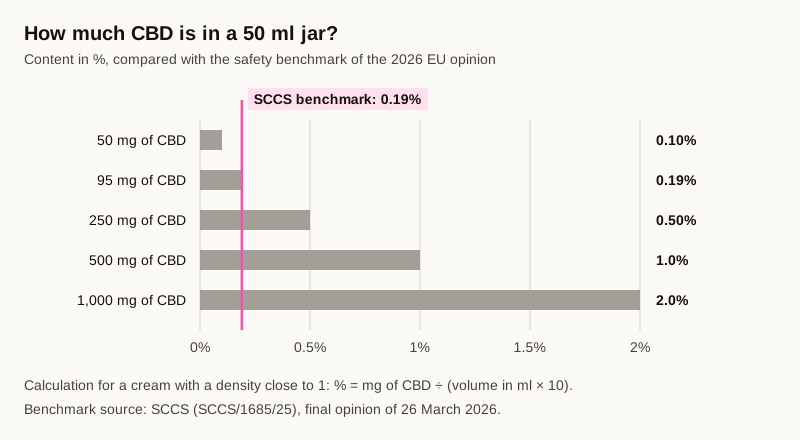
An SCCS opinion bans nothing on its own. The Commission can then set a maximum concentration in the annexes of the regulation. Until then, a product above 0.19% is not illegal, but it goes beyond what the committee could judge safe with the data available.
Cream, balm, gel, stick: what really changes
All four formats have the same legal status. They differ in their base, and therefore in texture and points to watch.
| Format | Base | Texture | Point to watch |
|---|---|---|---|
| Cream | Emulsion of water and oil | Light to rich, absorbs quickly | Usually contains preservatives, since there is water |
| Balm | Waxes and plant butters, no water | Dense, leaves a film | Rich: best for hands, elbows, feet |
| Gel | Gelled water phase | Cool | Often combined with menthol or camphor: test on a small area first |
| Stick | Solid base | Precise application | Small size: check the strength per gram |
CBD is lipophilic: it dissolves in fats, which is why it often appears in balms and massage oils. Oils are covered in CBD massage oil: INCI, dilution, storage.
The 6 things to check on the label
1. The INCI name of CBD. The ingredient list follows the international INCI nomenclature, in descending order of weight; below 1%, the order is free. "Cannabidiol" means CBD. "Cannabis Sativa Seed Oil" is a seed oil, a fat with no significant cannabinoid content. A "hemp" product that lists only this oil contains no CBD; the difference is explained in CBD oil or hemp seed oil.
2. The strength, in mg and in %. No text requires it to be shown. A serious seller gives it in mg per container, which allows the calculation above. Without a figure, there is no way to compare with the 0.19% benchmark.
3. The certificate of analysis. It should show the batch number, the CBD content, the Δ⁹-THC line and, if the laboratory tested for them, the absence of HHC, H4CBD or THCP. Our guide to reading a certificate of analysis goes through each line, and the laboratory page describes the measurement methods.
4. The claims. Regulation (EU) 655/2013 sets six common criteria for any cosmetic claim: legal compliance, truthfulness, evidential support, honesty, fairness and informed decision-making. "Moisturises", "comfortable texture" or "for dry skin" are fine. "Anti-inflammatory", "painkiller", "relieves arthritis" or "soothes eczema" belong to medicines. The exact limits are in six criteria for an authorised claim.
5. The mandatory label details. Article 19 of Regulation 1223/2009 requires on the packaging: the name and address of the responsible person, the nominal content, the date of minimum durability or the period after opening (the open-jar symbol), precautions for use, the batch number, the product's function if not obvious, and the ingredient list. A product without a batch number cannot be traced or recalled.
6. Fragrance and allergens. The word "parfum" can hide several allergenic substances, some of which must be named in the list. Our article on fragrance allergens explains what changes in 2026.
Sensitive skin, pregnancy, drug tests: precautions
Reactive skin. The SCCS opinion classes CBD as a category 1B skin sensitiser, meaning weak to moderate, based on several non-animal test methods and a guinea pig test. On skin that reacts easily, choose a fragrance-free formula and start on a small area. The topic is developed in CBD cosmetics and sensitive skin.
Pregnancy and breastfeeding. In March 2025, ANSES proposed classifying CBD as toxic to reproduction, category 1B. The proposal is still under review at EU level. If adopted, article 15 of the cosmetics regulation would in principle ban CBD in cosmetics, barring an exemption. The full picture is in CBD and reproductive toxicity; as a precaution, ask your doctor or midwife.
Drug tests. Little CBD passes through the skin, and roadside tests look for THC, not CBD. No source, however, guarantees a negative result with a product that contains THC. How the tests work is explained in CBD and saliva tests.
A reaction. If redness, itching or swelling appears, stop the product, inform the responsible person named on the packaging and report the effect to Anses, which runs cosmetovigilance in France. The product remains a cosmetic: it does not replace a dermatologist's advice for a skin condition, as our article on CBD, eczema and psoriasis points out.
Frequently asked questions
Are CBD cosmetics legal in France in 2026?
Yes. They fall under Regulation (EC) 1223/2009, not the novel food regime, and remain on sale after 15 May 2026, with no more than 0.30% Δ⁹-THC and no therapeutic claim.
What concentration of CBD in a cream?
There is no legal limit yet. The EU opinion of 26 March 2026 considers CBD safe up to 0.19%, or 95 mg in a 50 ml jar. Above that, the product is not banned, but it exceeds the benchmark.
Does more CBD make a cream more effective?
Nothing shows that. No dose-effect relationship has been validated for use on the skin, and CBD penetrates the skin poorly. A higher strength mainly increases exposure.
How do I spot CBD in the ingredient list?
Look for "Cannabidiol". "Cannabis Sativa Seed Oil" means hemp seed oil, which contains no significant cannabinoid.
How do I dispose of a CBD cream jar?
Empty it, then follow the Info-tri sorting label printed on the packaging, which says which part goes in which bin. Hemp in the formula does not change the sorting instructions.
Written by the Phytogrammes team
Every article in this journal draws on primary sources (ANSM, EFSA, EUR-Lex, peer-reviewed publications) and on the lab's own practice: batch-by-batch HPLC analyses, measured cannabinoid profiles. Our approach.
Article published on . CBD is not a medicine.