CBD for eczema and psoriasis: what the trials measured
No controlled trial has shown so far that a CBD cream works on eczema or psoriasis. In the only randomised trial that compared CBD on its own with a placebo in atopic dermatitis, published in 2022, both groups changed in a similar way over 14 days. For psoriasis, 60 mg of CBD a day, taken by mouth, did not reduce plaque severity in a trial published at the end of 2025.
Contents
> Key takeaways > > - In 57 patients with atopic dermatitis, the severity score fell by 0.81 point with CBD alone and by 0.71 point with placebo. > - Only a formula combining CBD and aspartame achieved a significant drop, over two weeks. > - In 28 people with psoriasis, 60 mg of oral CBD a day did not improve the PASI score. > - Under French law, a cream presented as acting on a disease becomes a medicine. > - The European scientific committee considers CBD safe up to 0.19% in cosmetics: a safety opinion, not an efficacy one.
The key eczema trial: CBD alone close to placebo
Atopic eczema, or atopic dermatitis, is a chronic inflammatory skin disease that comes and goes in flare-ups. It is the most studied form of eczema, and the only one in which CBD has been tested against a placebo.
The trial was published in 2022 in the Journal of Cosmetic Dermatology. Patients were randomly assigned to one of three creams: a formula combining CBD and aspartame, a cream with CBD alone, and a placebo. Neither the patients nor the investigators knew who got what. The main outcome was the ISGA score, an overall rating given by the doctor, where 0 means clear skin.
After 14 days, the 57 patients analysed showed an ISGA drop of 1.28 points with the combination, 0.81 with CBD alone and 0.71 with the placebo. Only the combination reached a statistically significant difference. The share of patients with "clear or almost clear" skin follows the same order: 50%, 20% and 15%.
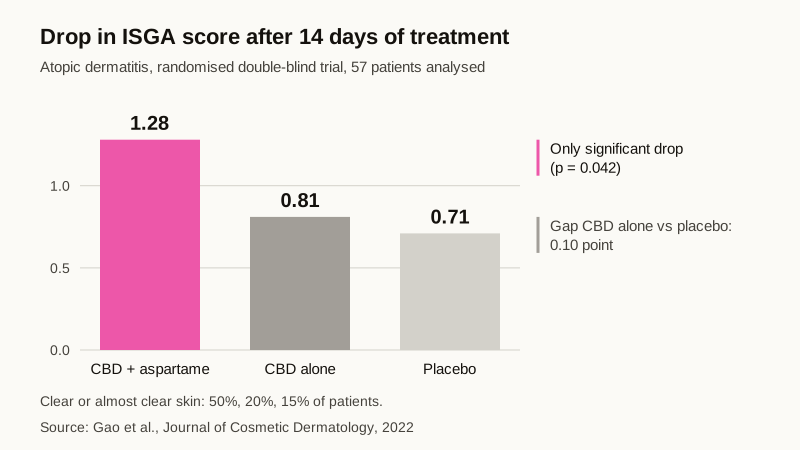
Three limits frame this result. The groups are small, about twenty people each. Follow-up lasts two weeks, for a disease that runs over years. And the formula that stood out contains a second active ingredient, so the result cannot be credited to CBD.
Psoriasis: the 60 mg a day trial missed its goal
Plaque psoriasis is another chronic inflammatory disease, which thickens the skin into red plaques covered with scales. A randomised double-blind trial, posted online on 29 December 2025 in the Journal of Dermatological Treatment, gave 28 participants either an oral CBD oil at 60 mg a day or a placebo.
The main outcome was the PASI score, which measures how widespread and severe the plaques are. The authors conclude that CBD oil did not significantly reduce psoriasis severity. They report less itching at week eight, a secondary outcome, and mild to moderate side effects, similar in both groups. A positive secondary outcome in a negative trial is a lead to test, not a result.
This trial is about swallowed CBD, not a cream. It says nothing about a product applied to the skin.
The other studies: small groups and no control group
The studies often quoted in favour of CBD for skin carry weaker evidence. The table ranks them from the most fragile to the most robust.
| Study | Participants | Length | Control group | What was measured |
|---|---|---|---|---|
| Wilkinson and Williamson, 2007 | Cells in culture | Not applicable | Not applicable | Keratinocyte growth slowed in vitro |
| Maghfour et al., 2020 | 16 people, self-reported eczema | 2 weeks | None | Online questionnaire filled in by participants |
| Palmieri et al., 2019 | 20 people, including 5 with psoriasis and 5 with atopic dermatitis | 3 months | None, retrospective study | Skin measurements and clinical scores |
| Gao et al., 2022 | 57 people | 14 days | Placebo, double-blind | CBD alone close to placebo |
| Roongpisuthipong et al., 2025 | 28 people | 8 weeks or more | Placebo, double-blind | No significant effect on PASI |
The hypothesis started in the lab. In 2007, Wilkinson and Williamson showed that several cannabinoids slow the growth of human keratinocytes in culture, through a mechanism that does not mainly involve the CB1 and CB2 receptors. Keratinocytes are the cells that make up most of the outer skin layer. Cells in a dish are not diseased skin.
The 2020 study followed 16 people who reported their own eczema. They filled in an online questionnaire before and after two weeks of using a cannabinoid gel, with no comparison group. The 2019 study is a retrospective series of 20 patients treated for three months with a commercial ointment. Its CBD content is not given in the paper.
A review published in 2025 in the Journal of Cannabis Research sums it up: topical use of cannabinoids remains limited by insufficient clinical experience and a lack of robust evidence on their efficacy and safety. Our overview of what CBD clinical studies really show reaches the same conclusion for other uses.
What a CBD cream is allowed to claim
The law draws a clear line. Article L. 5111-1 of the French Public Health Code defines a medicine as any substance "presented as having curative or preventive properties with regard to human diseases". A cream sold "for eczema" becomes a medicine through its presentation alone, whatever its formula. Without a marketing authorisation, it is then illegal. The only CBD-based medicine authorised in France, Epidyolex, is an oral solution reserved for certain rare epilepsies: see our article on CBD and epilepsy.
A cosmetic, by contrast, cares for, protects or perfumes healthy skin. Its claims follow Regulation (EU) No 655/2013, which sets six common criteria: legal compliance, truthfulness, evidential support, honesty, fairness and informed decision-making. The Commission's technical document on cosmetic claims draws three rules from them that apply squarely to CBD creams:
- a result obtained in vitro must not be presented as a result on the skin;
- a claim that lends the product the properties of an ingredient must prove that ingredient is present at an effective concentration;
- the presentation of performance must not go beyond the available evidence.
In the European CosIng database, cannabidiol carries declared cosmetic functions: skin conditioning, skin protecting, antioxidant, anti-sebum. None of them is therapeutic. Our article on permitted claims goes through the six criteria one by one.
The European 0.19% benchmark: a safety opinion
The European Scientific Committee on Consumer Safety (SCCS) adopted on 26 March 2026 an opinion on cannabidiol in cosmetic products, published on 24 April 2026. It considers CBD safe up to 0.19% in cosmetics applied to the skin and in those used in the mouth, such as toothpaste. It caps THC present as an impurity at 0.00025%. Products that may be inhaled are outside its scope.
In practice, 0.19% means 1.9 mg of CBD per gram of cream. Three points to keep in mind:
- the opinion only becomes binding if the Commission amends the annexes of the Cosmetics Regulation;
- it covers safety, not efficacy;
- the committee itself notes that data were limited, as it received too few submissions to its call for data.
To read a cream's label, ingredient list and storage advice, see our guide to assessing a CBD cream, balm or gel, and our articles on sensitive skin and oily skin. The known side effects of CBD are covered in the article on side effects. An eczema or psoriasis flare-up is a matter for a doctor, not a shop.
Frequently asked questions
Can a CBD cream work on eczema?
No controlled trial shows it. In the 2022 trial of 57 patients, the CBD-only cream lowered the ISGA score by 0.81 point, against 0.71 point for the placebo. Only a formula combining CBD and aspartame achieved a significant drop, over two weeks.
Has CBD been tested on psoriasis?
Yes, by mouth. A randomised trial published at the end of 2025 gave 60 mg of CBD a day to patients with plaque psoriasis. Plaque severity, measured by the PASI score, did not fall significantly compared with placebo.
How much CBD can a cosmetic contain?
In March 2026 the European scientific committee considered CBD safe up to 0.19% in cosmetics applied to the skin, with no more than 0.00025% THC. This opinion is not yet a rule: it becomes one if the Commission amends the annexes of the Cosmetics Regulation.
Why can't a CBD cream be sold "for psoriasis"?
Because psoriasis is a disease. The French Public Health Code treats any product presented as acting on a disease as a medicine. A cream presented that way would need a marketing authorisation, which no CBD cosmetic has.
Written by the Phytogrammes team
Every article in this journal draws on primary sources (ANSM, EFSA, EUR-Lex, peer-reviewed publications) and on the lab's own practice: batch-by-batch HPLC analyses, measured cannabinoid profiles. Our approach.
Article published on . CBD is not a medicine.