CBD and ADHD: one controlled trial, and it was negative
No controlled trial has yet published results on cannabidiol (CBD) alone in attention deficit hyperactivity disorder (ADHD). The only randomised trial published, in 2017, involved 30 adults and a spray combining THC and CBD: it did not meet its primary outcome. Three trials are under way, two of them on CBG, and none had published results as of September 2026.
Contents
> Key takeaways > > - The only published controlled trial tested Sativex, a medicine that contains THC, not CBD alone. > - In 30 adults, its difference from placebo was not significant (p = 0.16). > - A 2019 meta-analysis found only 3 studies on ADHD, including that single randomised trial. > - France's Haute Autorité de santé mentions neither cannabis nor CBD in its 2024 guideline. > - CBD is not an ADHD medicine; the only authorised CBD medicine, Epidyolex, is for rare forms of epilepsy.
ADHD in a few figures
ADHD combines three types of difficulty: inattention, motor hyperactivity and impulsivity. According to France's national health insurance, it counts as a disorder only when these symptoms last more than 6 months. It affects 5% of under-18s and 3% of adults. It appears to be twice as common in boys and is probably under-recognised in girls.
It is a neurodevelopmental disorder, and its diagnosis and care belong with health professionals. This article reports what research has measured; it does not replace medical advice.
The only published controlled trial: 30 adults, a THC spray
The EMA-C trial, run at King's College London, was published in 2017 in European Neuropsychopharmacology. It is the only randomised controlled trial of cannabinoids in ADHD published to date. The product tested was Sativex, a mouth spray that combines THC and CBD. So it was not CBD alone.
The protocol was as follows:
| Item | Detail |
|---|---|
| Participants | 30 adults with ADHD, 15 on Sativex, 15 on placebo |
| Period | July 2014 to June 2015, with 6 weeks of treatment |
| Primary outcome | Cognitive performance and activity level on the QbTest, a computerised test |
| Main result | Estimate of -0.17 (95% confidence interval -0.40 to 0.07), p = 0.16 |
| Serious adverse events | 1 in the Sativex group (muscle spasms), 1 in the placebo group (cardiovascular problem) |
The primary outcome was not met: the difference from placebo could be due to chance. The analysis also covered only 11 people in the placebo group.
On secondary outcomes, the authors report a "nominally significant" improvement in hyperactivity and impulsivity (p = 0.03). This signal does not survive correction for multiple comparisons, a calculation that accounts for the number of tests run. The authors see it as a preliminary lead that justifies further studies. It is not proof of efficacy.
What the systematic reviews conclude
A meta-analysis published in The Lancet Psychiatry in 2019 pooled 83 studies, including 40 randomised trials, across six psychiatric disorders. For ADHD it found only 3 studies, including a single randomised trial of 30 participants: the EMA-C trial. Its authors conclude that evidence that cannabinoids improve ADHD is scarce.
In 2023, a review in Pharmacology Biochemistry and Behavior examined the 9 published randomised trials of CBD in neurodevelopmental disorders: ADHD, autism, intellectual disability and Tourette syndrome. The results were judged too inconsistent to guide clinical use. According to the authors, CBD's place in these disorders remains "largely undetermined".
Our review of what clinical studies say about CBD shows that this conclusion holds for most proposed uses.
Ongoing trials, and what they really test
The international registry ClinicalTrials.gov, consulted in September 2026, lists five trials of cannabinoids in ADHD. Only one is completed and published. An Israeli trial of cannabis oils was stopped after 8 participants because of poor recruitment.
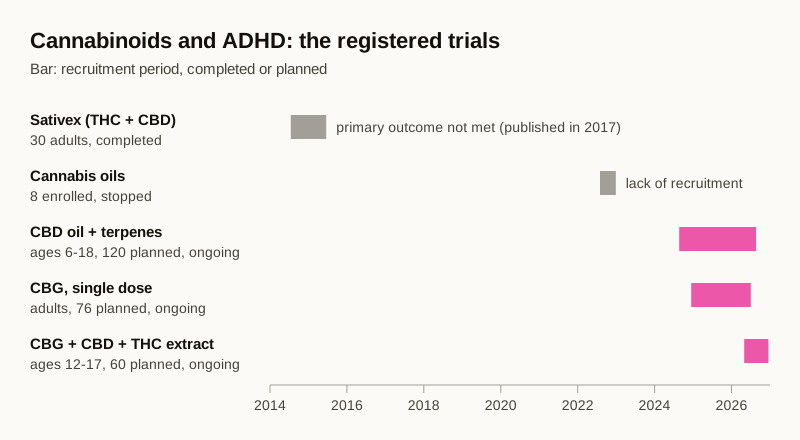
The three ongoing trials do not all test the same thing:
- an Israeli trial in 120 children and adolescents aged 6 to 18, with a terpene-enriched CBD oil, against placebo;
- an American trial in 76 adults that measures the effect of a single 80 mg dose of CBG on attention and memory tests;
- a Brazilian trial in 60 adolescents aged 12 to 17, with an extract that contains CBG, CBD and also THC.
The French framework and points of caution
The Haute Autorité de santé guideline of 23 September 2024 on ADHD in children and adolescents describes multimodal care: psychoeducation, parent programmes and behavioural therapies. When a medicine is indicated, extended-release methylphenidate is the first-line option, always combined with these measures. The text mentions neither cannabis nor CBD.
The only cannabidiol-based medicine authorised in the European Union is Epidyolex, since 19 September 2019. Its indications cover seizures linked to three rare diseases: Lennox-Gastaut syndrome, Dravet syndrome and tuberous sclerosis complex. ADHD is not one of them. Our article on Epidyolex describes those trials.
Three more points matter for anyone concerned:
- Medicines. In a press release of 19 June 2025, the ANSM and Anses point out that CBD taken with certain medicines can reduce their efficacy or increase their side effects. Discuss it with the doctor in charge of the prescription; the mechanism is explained in our article on drug interactions.
- Actual content. The same release cites a 2023 study: 8 CBD products out of 10 did not contain the amount stated on the label. It also reports several hundred poisonings since early 2024, most often caused by undeclared THC or synthetic cannabinoids.
- Cannabis. A 2024 meta-analysis estimates that 26.9% of people with ADHD have a cannabis use disorder at some point in their lives, a risk 2.85 times higher than in the general population. This work concerns THC-rich cannabis, not CBD.
The side effects of CBD and what can be said about concentration are covered in dedicated articles.
Frequently asked questions
Does CBD work for ADHD?
Nothing establishes that it does. No controlled trial of CBD alone has published results, and the only published controlled trial, with a THC and CBD spray in 30 adults, did not meet its primary outcome.
Is there a clinical trial of CBD alone in ADHD?
An Israeli trial in 120 children and adolescents is testing a terpene-enriched CBD oil against placebo. It was still recruiting in September 2026 and has published no results.
What are the 2017 trial's secondary results worth?
They support no conclusion. The signals on hyperactivity and impulsivity disappear after correction for multiple comparisons: given the number of tests, they cannot be told apart from chance.
Are THCV or CBG being studied in ADHD?
CBG, yes: two trials are under way, with no published results. THCV, no: no trial for this indication is registered on ClinicalTrials.gov.
Does the Haute Autorité de santé mention CBD for ADHD?
No. Its September 2024 guideline cites neither cannabis nor CBD, and recommends extended-release methylphenidate when a medicine is indicated.
Written by the Phytogrammes team
Every article in this journal draws on primary sources (ANSM, EFSA, EUR-Lex, peer-reviewed publications) and on the lab's own practice: batch-by-batch HPLC analyses, measured cannabinoid profiles. Our approach.
Article published on . CBD is not a medicine.