CBD and anaesthesia: what to tell your team before surgery
Before an anaesthetic, tell the anaesthetist that you use CBD: type of product, amount, frequency, how you take it and when you last took it. That is what the US society ASRA Pain Medicine has recommended since 2023; it takes no position for or against stopping beforehand, for lack of evidence. Do not stop or carry on without discussing it: the decision belongs to the medical team. This article reports the state of research and does not replace medical advice.
Contents
> Key takeaways > > - In 2023, 13 experts convened by ASRA published 21 recommendations on cannabis and cannabinoids around surgery. > - Their first request: ask every patient about their use before the operation. > - They recommend neither for nor against tapering before surgery. > - Studies on sedation concern cannabis in general, not CBD on its own. > - The Epidyolex product information describes no interaction with an anaesthetic; midazolam exposure does not change.
What US anaesthetists have recommended since 2023
The reference is a consensus text from ASRA Pain Medicine, the American Society of Regional Anesthesia and Pain Medicine, published in 2023 in Regional Anesthesia and Pain Medicine. A committee of 13 experts, including anaesthetists, pain physicians and a patient representative, addressed 9 questions. Each recommendation required at least 75% agreement under a modified Delphi method, in which experts vote over several rounds.
The result is 21 recommendations. The first, according to ASRA's announcement, is to ask every patient about their use before surgery. Other points that matter to a CBD user:
- The experts cannot recommend for or against tapering before the operation, for lack of data.
- Postpone planned surgery if the patient's mental state is impaired by acute cannabis intoxication.
- Delay it by at least two hours after smoking cannabis, because of a higher cardiac risk.
- Regular users may have more pain and nausea after surgery, not less, and need more painkillers, opioids included.
These recommendations cover cannabis and cannabinoids broadly. The two-hour one concerns smoked cannabis, not a CBD oil.
What the anaesthetist needs to know
The experts list five pieces of information to collect. The table translates them for a CBD product. Bringing the packaging or the certificate of analysis to the appointment answers most of the questions.
| Information | Example for a CBD product |
|---|---|
| Type of product | Flower, resin, oil, with the stated CBD and THC content |
| How you take it | Smoked, vaporised, under the tongue, swallowed |
| Amount | Grams per day, or drops and milligrams of CBD |
| Frequency | Daily, weekly, occasional |
| Last use | Date and time |
THC content matters. A compliant flower contains no more than 0.30%, but a mislabelled product may contain more, or synthetic cannabinoids. Our guide to reading a certificate of analysis helps you find those lines.
What studies on sedation show
The available data concern cannabis users, mostly of THC-rich or unknown products. None concerns CBD on its own.
| Study | Patients | Main result |
|---|---|---|
| Twardowski et al., 2019 | 250 records, endoscopy | Higher sedation needs in regular users (p = 0.05) |
| Nasser et al., 2024 | 419 patients, endoscopy | More often 5 mg of midazolam or more during upper endoscopy, not during colonoscopy |
| Smith et al., 2024 | Endoscopy | More propofol, with no difference in recovery time |
| Ekrami et al., 2024 | 34,521 surgical patients, 1,683 of them users | 30% more opioids in the 24 hours after surgery |
The 2019 study came from a single centre and a single endoscopist; its result is at the edge of significance. The gap held after adjusting for age, sex and use of alcohol, benzodiazepines and opiates. The 2024 prospective study of 419 patients found no more adverse events or discomfort in users. The 2024 replication concludes that it matters to talk about use before any sedation.
The largest cohort comes from Cleveland Clinic. Of 34,521 adults operated on between 2010 and 2020, the 1,683 cannabis users received 30% more opioids than non-users in the 24 hours after surgery, with slightly higher pain scores. No link was found with respiratory complications. A 2025 review sums up current knowledge: the association between cannabis and higher propofol doses is repeated, but nothing proves cause and effect.
What the Epidyolex product information says about interactions
The most reliable source on CBD alone is the summary of product characteristics of Epidyolex, the only authorised cannabidiol medicine, published by the European Medicines Agency. It describes what is established at medicinal doses.
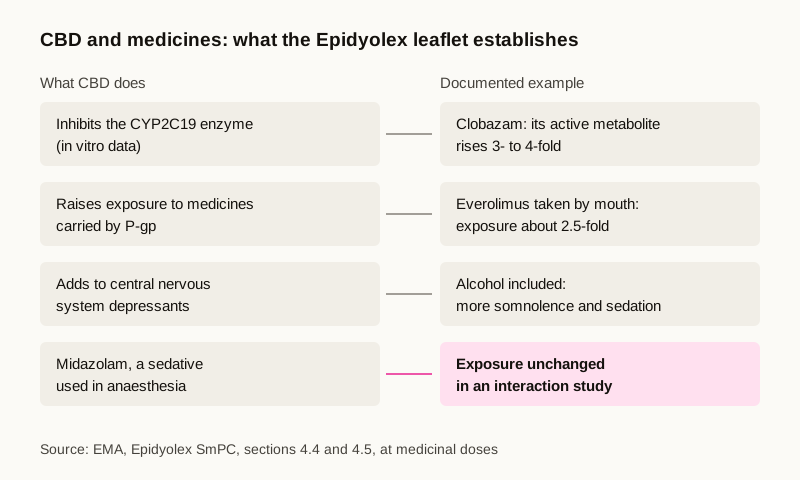
Cannabidiol is processed by, among others, three enzymes of the UGT family (UGT1A7, UGT1A9, UGT2B7). In vitro data show that it inhibits the CYP2C19 enzyme, which can raise the levels of medicines that this enzyme breaks down, such as clobazam or omeprazole. With clobazam, the active metabolite rises 3- to 4-fold. CBD can also raise exposure to medicines taken by mouth and carried by P-glycoprotein, such as everolimus, tacrolimus or digoxin. Finally, alcohol and other central nervous system depressants can add to drowsiness.
The product information does not, however, list any anaesthetic among the interactions. It states that cannabidiol did not change midazolam exposure, a sedative commonly used in anaesthesia, in an interaction study. Claiming that CBD changes how anaesthetics work would therefore be an extrapolation. Our articles on drug interactions and on liver enzymes cover these mechanisms.
And in France?
We found no recommendation from the French Society of Anaesthesia and Intensive Care (SFAR) dedicated to cannabis or CBD around surgery. This is the result of a literature search, not proof that none exists.
In practice, the pre-anaesthetic consultation, held before planned surgery, is the moment to mention everything, including products bought without a prescription. The date of last use matters in the same way as for a drug test: our article on how long CBD stays in the body gives orders of magnitude. For pregnancy, our article on CBD during pregnancy and breastfeeding calls for the same caution.
Frequently asked questions
Should I stop CBD before a general anaesthetic?
The 2023 US guidelines take no position for or against tapering before surgery, for lack of evidence. They ask patients to report their use. The decision belongs to your doctor and your anaesthetist.
What exactly should I tell the anaesthetist?
The type of product, how you take it, the amount, the frequency and the date of your last use. The packaging or the certificate of analysis, with the CBD and THC content, answers most of these questions.
Does CBD interact with anaesthetics?
The EU Epidyolex product information describes no interaction with an anaesthetic, and midazolam exposure does not change. It does establish that CBD inhibits CYP2C19 in vitro and can add to drowsiness with other sedatives. That is why it is worth reporting.
I smoked a CBD flower on the day of surgery: what should I do?
Tell the team before the procedure. The 2023 guidelines advise delaying planned surgery by at least two hours after smoking cannabis, because of the cardiac risk. A compliant flower contains little THC, but it is for the team to judge.
Can CBD replace painkillers after surgery?
No. CBD sold in shops is not a medicine, and the only authorised cannabidiol product, Epidyolex, is prescribed for certain epilepsies. Pain management after surgery is a matter for the medical team.
Written by the Phytogrammes team
Every article in this journal draws on primary sources (ANSM, EFSA, EUR-Lex, peer-reviewed publications) and on the lab's own practice: batch-by-batch HPLC analyses, measured cannabinoid profiles. Our approach.
Article published on . CBD is not a medicine.