CBD side effects: liver, drowsiness and drug interactions
CBD (cannabidiol) is well tolerated in most studies, but it has documented side effects: drowsiness, diarrhoea, reduced appetite and, in some people, raised liver enzymes. How often they occur depends mostly on the dose and on any medicines taken at the same time. In February 2026 EFSA set a provisional safe level of about 2 mg a day for a 70 kg adult.
Contents
> Key takeaways > > - The most frequent effects are drowsiness, diarrhoea and reduced appetite, usually mild to moderate. > - In an FDA trial published in 2025, 5.6% of healthy volunteers taking 5 mg/kg a day had liver enzymes above 3 times the normal limit. > - CBD slows two liver enzymes, CYP3A4 and CYP2C19, which clear many medicines from the body. > - EFSA does not consider safety established under 25, during pregnancy or breastfeeding, or for people on medication.
The most frequent side effects
Cannabidiol does not cause the high associated with THC. In its 2018 critical review, the WHO expert committee describes it as generally well tolerated, with a good safety profile and no sign of abuse or dependence potential in humans. Well tolerated does not mean free of effects.
A systematic review published in 2023 in Current Neuropharmacology went through the published clinical trials. Most adverse effects were mild or moderate. The most common were diarrhoea, drowsiness and sedation. The few serious ones mainly involved patients also taking anti-seizure drugs such as clobazam or valproate.
The most solid figures come from Epidyolex, the only CBD medicine authorised in the European Union. Its official product information (summary of product characteristics) gives these frequencies, at 10 to 25 mg/kg a day:
| Adverse effect | Frequency on Epidyolex |
|---|---|
| Drowsiness | 23% |
| Reduced appetite | 21% |
| Diarrhoea | 20% |
| Fever | 16% |
| Vomiting | 12% |
| Fatigue | 10% |
These patients are children and adults with severe epilepsy, often on several medicines. The percentages do not carry over to a healthy adult taking a few milligrams. They show what kind of effects occur, not how likely they are at low doses. Our summary of what clinical studies on CBD really say puts these trials in context.
The liver: what two trials in healthy volunteers found
The most serious signal concerns the liver. It is tracked with a blood test that measures two enzymes, ALT and AST (the transaminases). When the liver is under stress, their levels rise.
In 2021 a phase I trial gave 1,500 mg of CBD a day to 16 healthy adults for about 3.5 weeks. Seven of them (44%) had ALT above the upper limit of normal, and five (31%) went above 5 times that limit, the threshold that defines drug-induced liver injury. Every rise appeared between the second and the fourth week.
In 2025 researchers at the US FDA tested a dose closer to what consumers take. In this randomised placebo-controlled trial, 201 healthy adults took 5 mg/kg of CBD a day, that is 350 mg for 70 kg, or a placebo for 28 days. Eight participants in the CBD group (5.6%) had transaminases above 3 times the normal limit, against none on placebo. Seven met the withdrawal criteria for possible liver injury. Thyroid hormones and testosterone did not change.
The authors call for studies of long-term effects and of the lower doses consumers often use. Our article on CBD, liver enzymes and interactions explains how to read a blood test.
Interactions with medicines
This is the most important practical point. The liver clears many medicines using enzymes from the cytochrome P450 family. According to the 2023 review, CBD strongly slows two of them, CYP3A4 and CYP2C19. A medicine cleared more slowly builds up, and so do its side effects.
The Epidyolex product information gives measured examples:
- with clobazam, an anti-seizure drug, the level of its active metabolite rises 3 to 4 times, and drowsiness increases;
- with valproate, raised transaminases are more frequent;
- with everolimus, an immunosuppressant, exposure to the drug rises about 2.5 times.
The mechanism resembles that of grapefruit juice, which our article on CBD interactions and the grapefruit effect explains step by step. The rule is simple: if you take a regular treatment, talk to your doctor or pharmacist before using any CBD product.
The dose changes everything: benchmarks in milligrams
Most of the confusion comes from scale. The richest tolerability data cover medicinal doses of several hundred milligrams a day. The EFSA benchmark is several hundred times lower.
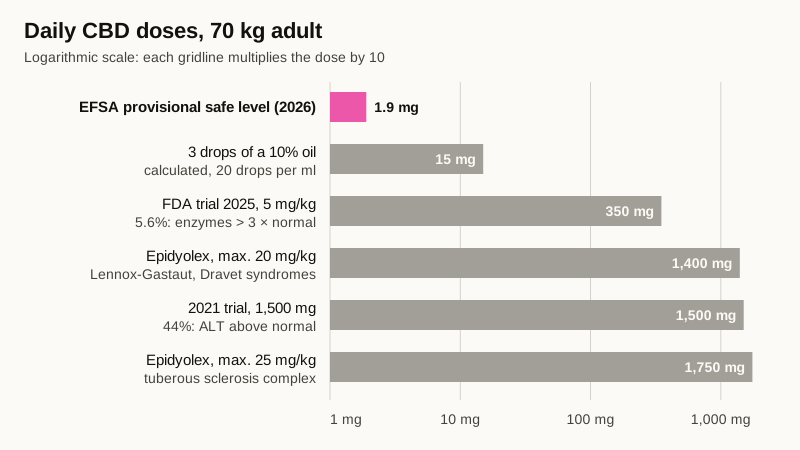
To place a bottle on this scale, do the maths. A 10% oil holds about 100 mg of CBD per millilitre. With a dropper that delivers 20 drops per millilitre, one drop carries roughly 5 mg, and three drops 15 mg. That is already above the EFSA benchmark, and far below the doses in the liver trials. In between, data are missing. Our article on EFSA's reference dose runs the numbers for other strengths.
CBD sold in shops is not a medicine and claims no therapeutic effect. Epidyolex is prescribed for rare forms of epilepsy, with medical follow-up and liver tests. Our feature on Epidyolex and epilepsy summarises its trials.
Who should avoid CBD, according to health agencies
On 9 February 2026 EFSA published a provisional safe level of 0.0275 mg of CBD per kilo of body weight per day, about 2 mg for a 70 kg adult. The figure includes a safety factor for gaps in the data, notably on the liver and on the endocrine, nervous and reproductive systems. It applies only to CBD at least 98% pure. For people under 25, pregnant or breastfeeding women and people on medication, EFSA concludes that safety cannot be established.
Reproduction is the subject of a second file. On 21 March 2025 the French agency Anses proposed classifying CBD as presumed toxic to reproduction (category 1B), based on animal studies showing harm to fertility and development. According to the Belgian Federal Public Service for Health, the risk assessment committee of the European Chemicals Agency adopted an opinion in favour of this classification. The European Commission has yet to decide. Our article on the classification proposed by Anses follows the procedure, and the one on CBD during pregnancy and breastfeeding sums up the precautions.
Driving is the last point. In a joint alert of 19 June 2025, Anses and the French medicines agency ANSM point out that even a compliant product contains a little THC, which can cause drowsiness or lethargy. They therefore advise drivers and workers exposed to risks against using CBD. These traces can also make a saliva test positive, as our guide to saliva drug testing explains.
The most common risk: a mislabelled product
In the same alert, the two agencies report several hundred poisonings recorded since early 2024 after people took products presented as CBD. In most cases CBD was not the cause. The culprits were synthetic cannabinoids added without the buyer's knowledge (HHC, H4CBD, MDMB-PINACA) or THC above 0.3%. A study backed by Mildeca, the French interministerial drug agency, cited in that release found a CBD content different from the label in 8 products out of 10.
Food containing CBD has also changed status. On 20 May 2026 the French Ministry of Agriculture restated that foodstuffs containing CBD are not authorised for sale, since their safety has not been demonstrated, and announced that checks would be extended. Our update on CBD regulation in France in 2026 details what remains on sale.
For a product you do not swallow, the only check within your reach is the batch certificate of analysis: the same batch number as the pouch, Δ⁹-THC at 0.30% or less, and no HHC or H4CBD when the lab tested for them. Our guide to reading a certificate of analysis goes through each line, and the laboratory page describes the measurement methods.
Frequently asked questions
Is CBD dangerous to health?
The WHO describes it as generally well tolerated, with no abuse potential. It is not harmless for all that: it can cause drowsiness and digestive upset, raise liver enzymes in some people and change how certain medicines work. The risk grows with the dose.
What are the most common side effects of CBD?
Drowsiness, diarrhoea and reduced appetite. On Epidyolex, at 10 to 25 mg/kg a day, they affect 23%, 20% and 21% of patients respectively. In healthy adults they are usually mild.
Is CBD bad for the liver?
It can raise transaminases. In the 2025 FDA trial, 5.6% of volunteers on about 350 mg a day went above 3 times the normal limit. At lower doses, data are missing. If you have liver disease or take medication, ask a doctor.
Can you take CBD with medicines?
Only after talking to a doctor or pharmacist. CBD slows the enzymes CYP3A4 and CYP2C19, which clear many medicines, including anti-seizure drugs and immunosuppressants. EFSA considers its safety not established for people on medication.
Does CBD make you sleepy?
Drowsiness is the most frequent adverse effect in the Epidyolex trials. That is a reason not to drive after taking it, not proof of an effect on sleep. CBD does not get you high, as our article does CBD get you high? explains.
Written by the Phytogrammes team
Every article in this journal draws on primary sources (ANSM, EFSA, EUR-Lex, peer-reviewed publications) and on the lab's own practice: batch-by-batch HPLC analyses, measured cannabinoid profiles. Our approach.
Article published on . CBD is not a medicine.