CBD and IBS: what the only published trial shows
Only one placebo-controlled trial has tested cannabidiol (CBD) in irritable bowel syndrome (IBS). Run in 32 women with a chewing gum containing 50 mg, it found no difference from placebo, either on pain or on quality of life. In France, CBD products meant to be swallowed are not authorised for sale, and this article is no substitute for medical advice.

Contents
> Key takeaways > > - Irritable bowel syndrome is thought to affect 5% of adults, three women for every man, according to the SNFGE, the French gastroenterology society. > - The trial published in 2022 measured no difference between CBD and placebo: p = 0.61 on pain, p = 0.74 on quality of life. > - Participants chewed fewer than one gum a day on average: underdosing remains possible. > - Results often quoted for PEA or olorinab do not concern CBD. > - Since February 2026, EFSA has set a provisional level of about 2 mg of CBD a day for a 70 kg adult.
Irritable bowel syndrome in a few figures
Irritable bowel syndrome combines abdominal pain with bowel changes (diarrhoea, constipation or both in turn) that last at least six months. The SNFGE estimates that 5% of adults may be affected, with three women for every man, and a diagnosis usually made between the ages of 30 and 40.
The approaches it lists include antispasmodics, the low-FODMAP diet, which seems to work for about one person in two, and hypnosis for stubborn cases. CBD is not among them.
Severe forms weigh heavily on the health system. A study published in 2019 in BMC Gastroenterology, based on French national health insurance data, identified 29,509 adults hospitalised for the syndrome in 2015 out of 43.7 million insured people. 64% of them had a colonoscopy during that stay.
Why cannabinoids are studied in this disorder
The gut has its own nervous network. According to Inserm, the French national health research institute, this enteric nervous system contains 200 million neurons on its own and is in constant dialogue with the brain: this is known as the gut-brain axis.
The digestive tract also carries cannabinoid receptors, CB1 and CB2, which are part of the endocannabinoid system. A 2023 review in Clinical Gastroenterology and Hepatology notes that cannabinoids generally tend to slow gut motility. That is what led research teams to test CBD in disorders of the gut-brain axis. A hypothesis about mechanism is not a clinical result.
The only controlled trial: 32 women, a chewing gum, no difference
A PubMed search in September 2026 finds only one placebo-controlled trial of CBD in this syndrome. A Dutch team published it in 2022 in Cannabis and Cannabinoid Research: a double-blind crossover trial with a CBD chewing gum. The format is often misreported. It was a chewing gum containing 50 mg, chewed on demand when pain came on, up to six a day.
The trial included 32 women, median age 31, recruited at Gelderse Vallei hospital in the Netherlands. It lasted eight weeks: one observation week, two three-week periods (CBD then placebo, or the reverse) and a one-week break between them. The main outcome was the change in pain, scored from 0 to 10 on a visual scale, thirty minutes after chewing.
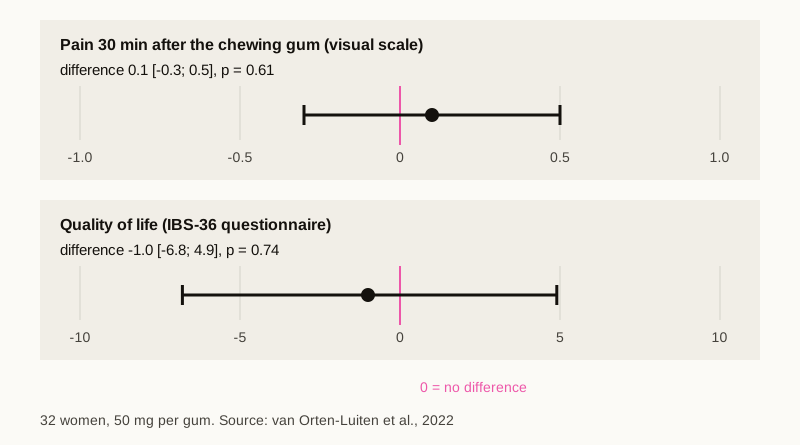
The result is null. The mean difference between CBD and placebo was 0.1 pain point, with a 95% confidence interval from -0.3 to 0.5 (p = 0.61). On quality of life, measured with the IBS-36 questionnaire, the difference was -1.0, with an interval from -6.8 to 4.9 (p = 0.74). Both intervals include zero: the trial cannot tell CBD from placebo.
The authors themselves point out limits that rule out a firm conclusion either way. Participants chewed on average only 0.84 gums a day, thirty minutes of chewing proved impractical, and underdosing is possible. The sample was small and all female. So CBD showed no effect at the single dose and in the single format tested, which is not the same as proven inefficacy. Our article on what clinical studies really say puts this result in the context of other trials.
Three nearby results not to confuse
The first concerns palmitoylethanolamide (PEA). A trial published in 2017 in Alimentary Pharmacology and Therapeutics tested a combination of PEA and polydatin in 54 patients over twelve weeks. Its primary, biological outcome did not change, although abdominal pain improved compared with placebo. But PEA is a molecule the body makes itself, related to anandamide. It is neither a hemp cannabinoid nor CBD.
The second concerns olorinab. The 2023 review cites it for a reduction in abdominal pain in the constipation-predominant form of the syndrome, in a placebo-controlled trial. But olorinab is a synthetic CB2 receptor agonist, not CBD.
The third does concern CBD, but in a neighbouring disorder, functional dyspepsia. The same review states that CBD did not significantly improve pain outcomes there: a second negative result on digestive pain.
What French rules allow
Format is settled by law before science. In a notice dated 20 May 2026, the French Agriculture Ministry states that foods containing CBD are not authorised under the EU novel food regulation. Only hemp seeds and their derivatives, and leaves for infusion, remain lawful, without added cannabinoids. A CBD chewing gum or an oil to swallow therefore has no place on open sale. Our overview of CBD regulation in 2026 covers this regime.
On 9 February 2026, EFSA published a provisional safe level of 0.0275 mg of CBD per kilogram of body weight per day, or about 2 mg a day for a 70 kg adult. That is 25 times less than a single gum from the Dutch trial. The agency states that safety cannot be established for people under 25, pregnant or breastfeeding women and people on medication. That last point directly concerns patients taking antispasmodics or other medicines. Our articles on EFSA's reference dose and on drug interactions go into detail.
When to see a doctor
Recurring digestive discomfort is worth raising with a doctor, because IBS is diagnosed after other causes have been ruled out. The SNFGE lists warning signs that call for prompt advice and often tests: blood in the stools, weight loss, marked fatigue, fever, pain at night, or recent symptoms, especially after 50. They can reveal inflammatory bowel disease or colorectal cancer, which no wellness product should delay.
Frequently asked questions
Does CBD work for irritable bowel syndrome?
Nothing shows that it does. The only published controlled trial, in 32 women with a 50 mg chewing gum, found no difference from placebo, either on pain (p = 0.61) or on quality of life (p = 0.74). Its authors do not rule out underdosing.
Can you buy CBD oils or gummies to swallow in France?
No. The French Agriculture Ministry stated on 20 May 2026 that foods containing CBD are not authorised under the EU novel food regulation. Only hemp seeds, their derivatives and leaves for infusion remain lawful as foods.
Can CBD replace an antispasmodic?
No. CBD is not a medicine and does not replace a prescribed one. EFSA also considers that its safety cannot be established in people on medication: talk to your doctor or pharmacist.
Can cannabinoids affect bowel movements?
The 2023 review in Clinical Gastroenterology and Hepatology notes that cannabinoids generally tend to slow gut motility. That is a question for a doctor, especially when constipation dominates.
Written by the Phytogrammes team
Every article in this journal draws on primary sources (ANSM, EFSA, EUR-Lex, peer-reviewed publications) and on the lab's own practice: batch-by-batch HPLC analyses, measured cannabinoid profiles. Our approach.
Article published on . CBD is not a medicine.