CBD skincare for sensitive skin: 7 checks before you buy
A CBD cosmetic can be sold legally in France, but it may not promise any effect on eczema or any other skin disease. For sensitive skin, no brand is "the best" by default: a product is judged on its INCI name, its content, its fragrance and its claims. The EU opinion of March 2026 gives a useful benchmark: CBD did not irritate the skin in the tests submitted, but it is classed as a weak to moderate skin sensitiser.
Contents
> Key takeaways > > - A CBD cosmetic falls under Regulation (EC) 1223/2009: it may moisturise or protect the skin, not address a skin disease. > - The EU scientific committee considers CBD safe up to 0.19% in a product applied to the skin. > - The same opinion classes CBD as a category 1B sensitiser, meaning it can cause contact allergy in some people. > - On reactive skin, a short, fragrance-free formula lowers the risk. > - A 5-day tolerance test in the crook of the elbow comes before use on a large area.
What a CBD cosmetic is allowed to promise
Regulation (EC) 1223/2009 defines a cosmetic by its function: cleaning, perfuming, changing the appearance, protecting or keeping the skin in good condition. A product "presented as having properties for treating or preventing disease in human beings" becomes a medicine under article L5111-1 of the French Public Health Code. It would then need a marketing authorisation.
CBD has had a place in this framework since 2021. France's drug policy agency, MILDECA, notes that the EU cosmetic ingredients database, CosIng, added pure CBD in February 2021, after the Kanavape ruling of the Court of Justice of the European Union, covered in our article on the Kanavape ruling. The CosIng entry for cannabidiol distinguishes CBD derived from a cannabis extract, tincture or resin from synthetic CBD.
The novel food regime, which governs CBD that is swallowed, does not apply to a product applied to the skin. The situation of ingested products is described in our overview of CBD regulation in 2026.
Regulation (EU) 655/2013 sets six common criteria for cosmetic claims: legal compliance, truthfulness, evidential support, honesty, fairness and informed decision-making. In practice:
| Wording on the pack | Acceptable for a cosmetic? | Why |
|---|---|---|
| "Moisturises the skin", "for dry skin" | Yes, if proven | Effect on the condition of healthy skin |
| "Tested on sensitive skin" | Yes, if the test exists | Verifiable fact |
| "Anti-inflammatory" | No | Pharmacological property |
| "Against eczema", "against psoriasis" | No | Targets a disease: a medicine by presentation |
| "Alternative to topical corticosteroids" | No | Replaces a medicine |
The nuances of each wording are covered in our article on permitted claims.
Irritation or allergy: what the 2026 EU opinion says
Skin can react in two ways. Irritation is a direct, local reaction that depends on the dose and appears quickly. Sensitisation is an allergy: the immune system learns to recognise the substance, then reacts at each new contact, sometimes after weeks of trouble-free use.
The EU Scientific Committee on Consumer Safety (SCCS) issued its final opinion on cannabidiol on 26 March 2026 (reference SCCS/1685/25). On these two questions, it does not say the same thing:
| Question | Data reviewed | SCCS conclusion |
|---|---|---|
| Irritation | Tests on reconstructed epidermis; human studies, including sensitive-skin panels | No irritation observed with leave-on products |
| Sensitisation | Combined non-animal methods, an older guinea pig test | Category 1B sensitiser, weak to moderate |
| Safe concentration | Limited data from few respondents | Up to 0.19% in a product applied to the skin |
| THC as an impurity | Same dossier | Up to 0.00025% in the product |
Two studies cited in the opinion point to a low risk at cosmetic levels. In one, 54 volunteers applied a cream containing 0.3% CBD under a repeated patch-test protocol, with no reaction at all. In the other, CBD patches at 0.1 to 10% caused neither irritation nor sensitisation in volunteers with healthy skin; only a hemp seed oil showed a slight reaction to light after 48 hours.
The 1B classification remains the key fact for reactive skin. A person who is already sensitised can react to a low concentration.
The 7 criteria for choosing a CBD skincare product
- The INCI name. The ingredient list follows the INCI nomenclature, in descending order of weight (the order is free below 1%). Look for "Cannabidiol". "Cannabis Sativa Seed Oil" is a seed oil with no significant cannabinoid content; the difference is explained in our article on CBD oil and hemp seed oil.
- The content. No rule requires it to be displayed. A serious seller gives it in mg per container. For a cream with a density close to 1, 95 mg in a 50 ml jar matches the 0.19% benchmark. The calculation is set out in our checklist for assessing a cream or balm.
- Fragrance. The word "parfum" (or "aroma") can cover dozens of substances, including allergens that must be named above a certain threshold. For reactive skin, choose a fragrance-free formula; our article on fragrance allergens explains the rule.
- A short formula. Each ingredient is one more chance of a reaction. Essential oils, common in balms marketed as natural, can contain allergens that the rules require to be named, such as linalool or limonene.
- THC. The finished product must stay at or below 0.30% Δ⁹-THC. The SCCS considers THC safe as a cosmetic impurity only up to 0.00025%: a benchmark 1,200 times lower. A certificate of analysis tied to the batch number lets you check the Δ⁹-THC line.
- Mandatory information. Name and address of the responsible person in the EU, batch number, period after opening, precautions for use and the ingredient list. Without a batch number, no follow-up is possible if you react.
- Honest claims. A product that promises to act on eczema or psoriasis breaks the law. It is also a clue about how serious the manufacturer is.
The tolerance test before adopting a product
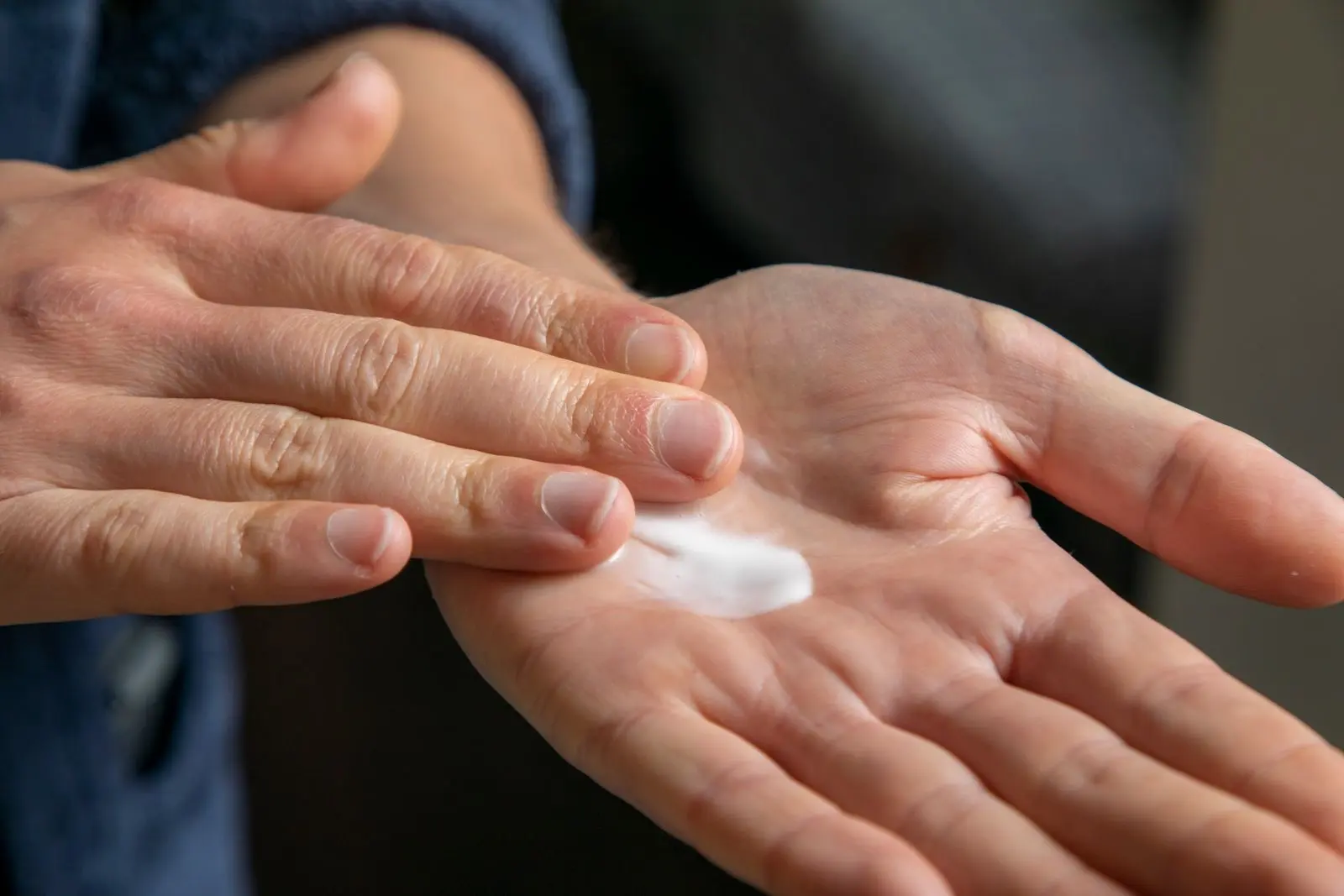
The French eczema association, the Association française de l'eczéma, suggests a simple test. Apply a small amount in the crook of the elbow, if that area is healthy. Bend the arm without squeezing for 15 minutes, straighten it, then check after 15 minutes. Repeat every day for 5 days.
Redness, tingling or itching means poor tolerance. A negative test guarantees nothing for the future: a contact allergy can appear after prolonged use.
If you have eczema or psoriasis followed by a doctor, ask them before adding a product on affected areas. Our article on CBD, eczema and psoriasis reviews the research, without promises.
Skin reaction: who to tell
Stop the product at the first signs. See a doctor if the reaction spreads, lasts or affects the face.
Then report it. Since 1 January 2024, cosmetovigilance has been handled by Anses, no longer by the ANSM. Consumers report on the national portal for adverse health events. Also inform the responsible person whose address appears on the pack, giving the batch number. These reports help identify a product or ingredient that causes problems.
Frequently asked questions
What is the best CBD skincare brand for sensitive skin?
No independent study compares brands with each other. Judge each product on facts: "Cannabidiol" in the INCI list, a stated content close to 0.19%, no fragrance, a batch number, a certificate of analysis and no promise about a skin disease.
Can a CBD cosmetic act on eczema?
It is not allowed to claim so. A product that claims an effect on a disease is a medicine by presentation. A cosmetic can moisturise and protect dry skin, without replacing medical care.
Can CBD cause an allergy?
Yes, it can. The 2026 EU opinion classes it as a category 1B skin sensitiser, weak to moderate. The tests submitted showed no irritation, but contact allergy remains possible in some people.
Can a CBD cosmetic make a saliva test positive?
CBD passes poorly through the skin: the SCCS opinion cites skin absorption 48 to 160 times lower than by mouth. Roadside tests look for THC. No source, however, guarantees a negative result with a product that contains THC; how the tests work is explained in our guide to drug testing.
Can I use a CBD cosmetic during pregnancy?
As a precaution, ask your doctor or midwife. In March 2025, Anses proposed classifying CBD as toxic for reproduction; the EU procedure is described in our article on this classification.
Written by the Phytogrammes team
Every article in this journal draws on primary sources (ANSM, EFSA, EUR-Lex, peer-reviewed publications) and on the lab's own practice: batch-by-batch HPLC analyses, measured cannabinoid profiles. Our approach.
Article published on . CBD is not a medicine.