CBD and multiple sclerosis: what 25 trials actually tested
In multiple sclerosis, the positive published results concern nabiximols (Sativex), a spray that combines THC and CBD, authorised in France since 2014 but never marketed there. The 2022 Cochrane review pools 25 trials and none of them tests cannabidiol alone. The only randomised trial of purified CBD we found, in 49 patients, did not reduce spasticity.
Contents
- 01Three products that must not be confused
- 02Sativex: authorised since 2014, absent from pharmacies
- 03The HAS opinion: a clear gain for 10 to 20% of patients
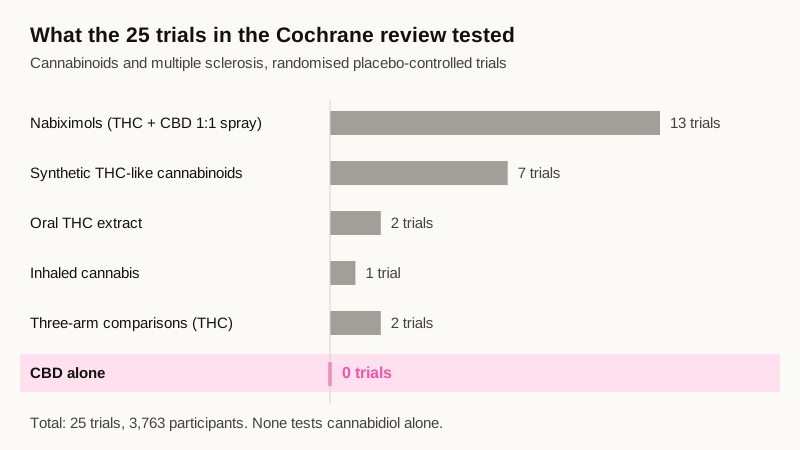
- 04The 2022 Cochrane review: 25 trials, none on CBD alone
- 05A randomised trial of purified CBD: no effect on spasticity
- 06Two negative results that are rarely quoted
- 07Medical cannabis in France: spasticity is one of the indications
- 08What this means for someone living with MS
- 09Frequently asked questions
> Key takeaways > > - Sativex delivers 2.7 mg of THC and 2.5 mg of CBD per spray: it is a controlled narcotic medicine, not a CBD product. > - In 2014 France's health technology body (HAS) rated its medical benefit as low, with a clear gain in 10 to 20% of patients. > - Of the 25 Cochrane trials (3,763 participants), 13 test nabiximols, 12 test THC alone or cannabis, 0 test CBD alone. > - A 2025 Iranian trial (49 patients, 80 mg of CBD a day) found no effect on spasticity. > - CBD sold in shops is not a medicine. Any treatment question belongs with your neurologist.
Three products that must not be confused
Research on multiple sclerosis mixes three families of products, and that is where most misunderstandings start.
| Product | What it contains | Status in France |
|---|---|---|
| Nabiximols (Sativex) | 2.7 mg of THC and 2.5 mg of CBD per spray | Controlled medicine, authorised in 2014, never marketed |
| Dronabinol, nabilone | Synthetic THC or an analogue | Medicines, outside the CBD framework |
| CBD sold in shops | Cannabidiol, THC ≤ 0.30% | Consumer product, no medical indication |
Cannabidiol (CBD) does not produce the psychoactive effect of THC, as our article on the differences between THC and CBD explains. A result obtained with a spray that contains THC therefore says nothing, on its own, about a CBD oil.
The disease itself is common. Inserm, the French medical research institute, counts about 110,000 people affected in France, 4,000 to 6,000 new cases a year, and an average onset around age 30. It is the leading cause of severe non-traumatic disability in young adults. Spasticity, an involuntary stiffness of the muscles, is a frequent complication.
Sativex: authorised since 2014, absent from pharmacies
The French marketing authorisation for Sativex dates from 8 January 2014. It covers moderate to severe spasticity caused by multiple sclerosis, in adults who have not responded well enough to other antispastic drugs, as an add-on to their usual treatment.
Yet the medicine has never been sold in France. In an answer to a written parliamentary question published on 28 February 2023, the government explains that price negotiations have failed since 2015, while the product is authorised in 17 other European countries. It estimates that 5,000 patients could benefit from it.
The HAS opinion: a clear gain for 10 to 20% of patients
The Transparency Committee of the Haute Autorité de santé issued its opinion of 22 October 2014 after hearing the manufacturer. It rated the medical benefit as low and the added benefit as non-existent (level V). The impact on quality of life was not demonstrated.
The three pivotal trials explain that verdict:
- Trial GWMS 0106, 189 patients. A gap of 0.52 points on a 0 to 10 spasticity scale at six weeks, smaller than the gap the protocol had planned.
- Trial GWCL 0403, 337 patients. No difference from placebo on the main outcome at fourteen weeks.
- Trial GWSP 0604. Of 572 patients first treated openly, only the 241 who had responded were randomised. That initial sorting favours the product.
In these trials, spasticity was scored by the patients themselves. The Ashworth scale, scored by the doctor, was originally the main outcome of the first trial before being replaced. In the results reported by the HAS, it does not differ from placebo. The committee judged the benefit clinically relevant in 10 to 20% of patients who respond poorly to their usual treatment.
The 2022 Cochrane review: 25 trials, none on CBD alone
The Cochrane review published on 5 May 2022 on cannabinoids in multiple sclerosis pools 25 randomised trials and 3,763 participants, 2,290 of whom received a cannabinoid. The trials last from 3 to 48 weeks.
On perceived spasticity, nabiximols probably increases the number of people who report a clear improvement: odds ratio 2.51 (95% confidence interval 1.56 to 4.04), moderate certainty. In absolute terms, that is 216 more people per 1,000 than on placebo.
On quality of life, the effect is small or nil: standardised difference of -0.08 (-0.17 to 0.02), low certainty. Adverse effects probably increase. Withdrawals due to an adverse effect have an odds ratio of 2.41, nervous system disorders 2.61 and psychiatric disorders 1.94. The authors stress that most trials were short.
A randomised trial of purified CBD: no effect on spasticity
Published in 2025 in Naunyn-Schmiedeberg's Archives of Pharmacology, a trial run in Mashhad, Iran split 49 patients between CBD drops (24 patients) and a placebo (25). The dose rose from 5 mg to 70 mg a day over two weeks, then to 80 mg until the fourth week.
Result on the target outcome: no difference in spasticity between the groups, at 4 or at 8 weeks. The authors report a slightly faster 7.6-metre walking test and slightly lower peak pain scores in the CBD group. These are secondary outcomes, measured at a single centre, in 49 people over one month. They raise a question without answering it.
Two negative results that are rarely quoted
On disease progression. The CUPID trial, published in 2013 in The Lancet Neurology, split 498 patients with a progressive form between dronabinol, a synthetic THC, and a placebo for 36 months. Hazard ratio for progression: 0.92 (0.68 to 1.23), p = 0.57. The authors conclude there was no overall effect on progression.
On stiffness measured by the doctor. The RELEASE MSS1 trial, published in 2024, tested nabiximols in 68 patients using the lower-limb Ashworth scale. Difference from placebo: 0.04, p = 0.7152. The main outcome was not met.
Medical cannabis in France: spasticity is one of the indications
The French medical cannabis experiment, launched in 2021, covered five indications, including painful spasticity in multiple sclerosis or other central nervous system diseases. On 27 February 2025, 246 patients were followed for spasticity linked to multiple sclerosis, out of 1,683 still treated, according to the minutes of the ANSM scientific committee.
No new patient has been enrolled since 27 March 2024, and the permanent framework is still waiting for the HAS opinion. Our article on medical cannabis in France in 2026 follows that timetable.
What this means for someone living with MS
CBD sold freely is not a medicine and may not claim any effect on a disease. The only authorised medicine based on cannabidiol, Epidyolex, is for rare forms of epilepsy (Lennox-Gastaut and Dravet syndromes, tuberous sclerosis complex), not multiple sclerosis.
If you are followed for multiple sclerosis and use CBD, tell your neurologist. CBD goes through the same liver enzymes as many medicines, as described in our article on interactions between CBD and medicines. For an overview of the evidence, see also what clinical studies say about CBD.
Frequently asked questions
Does shop-bought CBD act on spasticity?
No data support that claim. The 25 trials in the 2022 Cochrane review include no trial of CBD alone, and the only randomised trial of purified CBD we found, in 49 patients, showed no difference in spasticity from placebo.
Is Sativex available in France?
No. It has been authorised since 8 January 2014 but has never been marketed, for lack of a price agreement. The government answer of 28 February 2023 confirms this, while it is sold in 17 other European countries.
Is Sativex a CBD product?
No. Each spray contains 2.7 mg of THC and 2.5 mg of CBD. It is a prescription medicine classified as a narcotic, and its results do not apply to a CBD oil.
Do cannabinoids slow down the disease?
The available data say no. The CUPID trial, in 498 patients over 36 months, showed no overall effect of dronabinol on the progression of disability (hazard ratio 0.92, p = 0.57).
Written by the Phytogrammes team
Every article in this journal draws on primary sources (ANSM, EFSA, EUR-Lex, peer-reviewed publications) and on the lab's own practice: batch-by-batch HPLC analyses, measured cannabinoid profiles. Our approach.
Article published on . CBD is not a medicine.