THC vs CBD: the differences, and the THC allowed in CBD
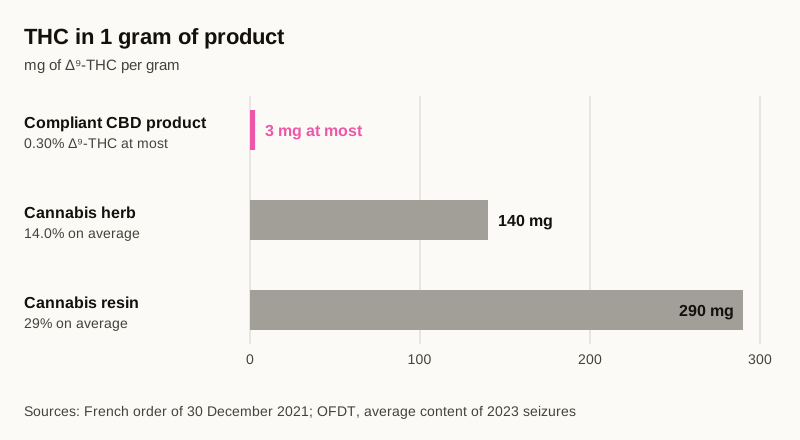
THC and CBD are two hemp cannabinoids with the same molecular formula, C21H30O2, but only THC activates the brain's CB1 receptor and produces the psychoactive effect. In France, a CBD product may contain no more than 0.30% Δ⁹-THC, which is 3 mg per gram. Cannabis herb analysed in 2023 contained 14% on average, or 140 mg per gram.
Contents
- 01Same formula, two different architectures
- 02Why THC alters perception and CBD does not
- 03How much THC a CBD product contains
- 04What the law says: a limit for the product, not for the driver
- 05Medical cannabis and Epidyolex: two separate cases
- 06Five common beliefs, checked against the texts
- 07Frequently asked questions
> Key takeaways > > - THC and CBD share the formula C21H30O2; their atoms are arranged differently. > - At the CB1 receptor, THC binds at nanomolar concentrations, CBD only above the micromolar range. > - The legal limit is 0.30% Δ⁹-THC in the finished product: 3 mg at most in 1 g of flower or resin. > - That limit allows the sale, not the driving: a positive THC test is enough to establish the offence. > - In the lab, a CBD oil placed in synthetic gastric fluid converted to THC at less than 0.0006%.
Same formula, two different architectures
Hemp (Cannabis sativa L.) builds its cannabinoids from a common precursor, CBGA. Depending on the enzyme a variety carries, that precursor becomes mostly THCA or mostly CBDA, the acidic forms found in the fresh plant. Heat then strips off a carboxyl group: this is decarboxylation, which yields THC and CBD. Our article on THCA, the raw form of THC explains that step.
The two final molecules share the formula C21H30O2, as the PubChem entry for cannabidiol and the one for dronabinol, the pharmaceutical name of Δ⁹-THC, both show. The difference is one ring: closed in THC, open in CBD. That detail of shape changes how each molecule fits the receptors.
| Criterion | THC (Δ⁹-THC) | CBD |
|---|---|---|
| Molecular formula | C21H30O2 | C21H30O2 |
| Form in the fresh plant | THCA | CBDA |
| Binding to the CB1 receptor | Strong (nanomolar) | Weak (micromolar) |
| Psychoactive effect | Yes | No |
| Status in France | Controlled drug | Sale allowed below 0.30% THC |
| Targeted by the roadside saliva test | Yes | No |
Why THC alters perception and CBD does not
The CB1 receptor, abundant in the brain, belongs to the endocannabinoid system. THC binds to it and activates it: that is what produces the cannabis high, the distorted sense of time and the loss of coordination.
A review by Roger Pertwee published in 2008 in the British Journal of Pharmacology compiles the affinity measurements. For THC at the CB1 receptor, binding constants range from 5 to 80 nanomolar depending on the study. For CBD they exceed 4,350 nanomolar, and some measurements find no binding below 10,000. In other words, it takes at least 50 times more CBD than THC to occupy the same receptor, and CBD does not activate it the same way. The review concludes that CBD only displaces CB1 and CB2 ligands at micromolar concentrations.
This difference explains the effect, not a benefit. The CBD sold in shops is not a medicine, and no health claim is authorised for it.
How much THC a CBD product contains
The French order of 30 December 2021 sets the limit at 0.30% Δ⁹-THC, for cultivated varieties as well as hemp extracts and the products that contain them. The arithmetic is simple: 0.30% of 1,000 mg is 3 mg. A gram of compliant flower therefore holds 3 mg of THC at most. A 2 g bag of hash measured at 0.2% holds 4 mg.
To gauge the gap with illicit cannabis, the French Monitoring Centre for Drugs and Drug Addiction (OFDT) publishes the average potency of seized products. In 2023 it stood at 14.0% for herb and 29% for resin, which is 140 and 290 mg of THC per gram.
Not every product sold as CBD stays under that ceiling. A study backed by MILDECA, run with Lille University Hospital on 223 samples bought in 2022 and 2023, found 87% of products below 0.3% Δ⁹-THC. It also found 6% of samples containing neo-cannabinoids such as HHC or H4-CBD that were missing from the label. Only the batch analysis settles it: our guide to reading a certificate of analysis shows where to find the Δ⁹-THC line.
The type of extract also changes how much THC is possible. A full-spectrum extract keeps the hemp cannabinoids, THC included, below the limit. A broad-spectrum extract removes the THC. An isolate is purified CBD, with no THC and no terpenes. Our comparison of full spectrum and isolate covers that choice, and the full legal benchmark is in our article on the authorised THC level.
What the law says: a limit for the product, not for the driver
Two court rulings and one order frame CBD in France. In 2020, the Court of Justice of the European Union ruled in the Kanavape case (C-663/18) that a member state may not ban CBD lawfully produced in another member state when it is extracted from the whole plant; its press release of 19 November 2020 summarises the judgment. On 29 December 2022, the Conseil d'État annulled the ban on selling raw flowers and leaves. The 0.30% limit stayed.
THC remains a controlled drug, as do several molecules once sold as "stronger CBD". HHC has been one since 13 June 2023. H4-CBD and THCP joined it on 3 June 2024, under the ANSM decision that bans their production, sale and use.
Behind the wheel, the logic changes. The Cour de cassation ruled on 21 June 2023 that driving after using a controlled drug is an offence as soon as use is established, whatever the dose, and that the authorisation to sell hemp below 0.30% changes nothing. Since the law of 9 July 2025, the penalty is up to three years in prison and a €9,000 fine. The practical consequences are covered in our articles on CBD and driving and on the saliva test.
Medical cannabis and Epidyolex: two separate cases
Two products containing these molecules are medicines, not shop items. Epidyolex, an oral solution of cannabidiol, is the only authorised CBD medicine. The European Medicines Agency authorised it on 19 September 2019 for seizures linked to Lennox-Gastaut and Dravet syndromes, alongside clobazam, and later for tuberous sclerosis complex, from 2 years of age and on prescription.
Medical cannabis, which contains THC, follows a different path. According to the ANSM page, the French pilot programme ended on 31 December 2024 and patients already enrolled continue to be followed during a transition period. On 20 March 2025, France notified the European Commission of the texts for the framework meant to replace it. Progress is tracked in our article on the rollout of medical cannabis.
Five common beliefs, checked against the texts
| Belief | What the sources say |
|---|---|
| "CBD gets you high like THC." | No: its affinity for CB1 is at least 50 times weaker (Pertwee, 2008). |
| "Every cannabinoid is banned." | No: classification is molecule by molecule; CBD is not a controlled drug (CJEU, 2020). |
| "France bans CBD flowers." | Not since 29 December 2022: the Conseil d'État annulled that ban. |
| "A legal product cannot make you test positive." | Wrong: THC traces in a full-spectrum product can be detected, and the dose does not matter (Cass. crim., 2023). |
| "Marijuana and CBD are the same thing." | Same species, opposite breeding: marijuana is grown for THC, CBD hemp to stay below 0.30%. |
If you are looking for flowers with a measured content, the CBD flowers category shows the recorded levels, and the laboratory page explains how they are read.
Frequently asked questions
Can CBD turn into THC in the stomach?
Not in measurable amounts under the conditions tested. In 2023, a team placed three products in synthetic gastric fluid for three hours at 37 °C; the Journal of Analytical Toxicology study measured a conversion below 0.0006% for the oil. Only the addition of a laboratory surfactant pushed it up, which has no equivalent in the stomach.
Can a CBD product make a saliva test positive?
Yes, if it contains THC, even below 0.30%. The test looks for THC, not CBD. An isolate contains no THC; a full-spectrum product contains traces. The Cour de cassation holds that the offence exists whatever the dose.
What is the difference between marijuana and CBD?
Marijuana is cannabis bred for its high THC content: 14% on average for herb seized in 2023. CBD hemp comes from catalogued varieties that must stay at 0.30% Δ⁹-THC or less. The first is a controlled drug, the second is sold legally.
Why do some websites still show 0.2% THC?
That figure belongs to an earlier framework. The text in force, the order of 30 December 2021, sets the limit at 0.30% Δ⁹-THC for varieties, extracts and finished products. A seller still showing 0.2% simply has not updated the page.
Written by the Phytogrammes team
Every article in this journal draws on primary sources (ANSM, EFSA, EUR-Lex, peer-reviewed publications) and on the lab's own practice: batch-by-batch HPLC analyses, measured cannabinoid profiles. Our approach.
Article published on . CBD is not a medicine.