Stopped by French police with CBD: what the test can't tell
If you are stopped on foot in France with CBD flowers or resin, officers may test your product on the spot, then seize it and send it to a laboratory if they are in doubt. Their colour test cannot read the legal limit of 0.30% THC: only a lab analysis measures it. The 500 € fine in force since 20 August 2026 targets drug use, not compliant CBD.
Contents
> Key takeaways > > - A hemp flower or resin is legal in France if it contains no more than 0.30% Δ⁹-THC. > - Colour tests react to cannabinoids in general. The most refined one compares THC with CBD, without measuring the 0.30%. > - If in doubt, the product can be seized and analysed. If it complies, you ask the prosecutor to return it. > - The fixed fine for drug use rises from 200 to 500 €. Paying it rules out any challenge and leaves an entry on your criminal record. > - Keep the original packaging and proof of purchase. In a dispute, see a lawyer.
20 August 2026: 500 € for drug use, nothing new for CBD
Law no. 2026-798 of 18 August 2026, known as the RIPOST law, was published in the Journal officiel no. 192 on 19 August. Its article 25 raises the fixed criminal fine (amende forfaitaire délictuelle, AFD) for drug use from 200 to 500 €. According to the service-public.fr page updated on 21 August 2026, it drops to 400 € if you pay within 15 days and rises to 1,000 € if nothing is paid after 45 days. You can challenge it within those 45 days. Paying ends the prosecution, closes any challenge and leaves an entry on your criminal record.
In court, drug use is still punishable by one year in prison and a 3,750 € fine. The same article 25 adds a possible penalty: suspension of your driving licence for up to 3 years, even when driving has nothing to do with it.
What does not change: the hemp threshold. The decree of 30 December 2021 authorises hemp varieties whose Δ⁹-THC content does not exceed 0.30%, along with their extracts and the products that contain them. A CBD flower or CBD resin under that limit is not a narcotic, and the fixed fine does not apply to it. Where the figure comes from is explained in our article on the legal THC level.
Can an on-the-spot test tell CBD from cannabis?
Not at the level that matters. By sight and smell, a CBD flower and a cannabis flower look alike. And colour tests react to cannabinoids, not to THC alone.
The forensic science department of the US state of Virginia puts it plainly: the Duquenois-Levine test, a classic, cannot distinguish marijuana from industrial hemp. A newer test, called 4-AP, gives an indication: pink when CBD dominates, blue when THC dominates.
Its validation, published in 2021 in the Journal of Forensic Sciences, sets out its limit. Pink appears when THC is about three times less abundant than CBD, blue when it is about three times more. In between, the result is inconclusive. The test compares two molecules. It does not measure a percentage.
A worked example shows the problem. A flower with 10% CBD and 0.2% THC turns pink. So does a flower with 10% CBD and 0.6% THC, although it is twice the legal limit. Even after a pink result, the Virginia laboratory calls for a lab analysis whenever the case depends on the 0.3% threshold. We do not know which kits each French police unit uses, but the chemistry is the same.
Step by step: what happens, what you can do
The table follows a stop on foot, in the street, with a CBD product on you. Not every step necessarily takes place.
| Step | What may happen | What the rules say | What you can do |
|---|---|---|---|
| 1. Identity check | You are asked who you are | Proof by any means; verification at the station for 4 hours at most | Show an identity document |
| 2. Pat-down | Search for dangerous objects | Over the clothes, by an officer of the same sex, without searching pockets | Stay calm |
| 3. Search, bag | Pockets or bag opened | Search reserved for a judicial police officer; your express consent is required, except in flagrante delicto or police custody | Ask under what legal framework it takes place |
| 4. The product | You say it is CBD | No rule requires you to prove it on the spot | Show the original packaging and proof of purchase |
| 5. Colour test | Reaction with a reagent | An indication, not a measure of the 0.30% | Note the time and the announced result |
| 6. Seizure | Product placed in judicial custody | Seized by a judicial police officer, kept with the prosecutor's agreement | Note the quantity seized and the unit |
| 7. Analysis | A laboratory measures THC | Only the measured level decides whether it is a narcotic | Keep any documents you are given |
| 8. Outcome | 0.30% or less: not a narcotic. Above: drug use | Return to be requested from the prosecutor, or 500 € fixed fine or court | Before paying, know that paying ends any challenge |
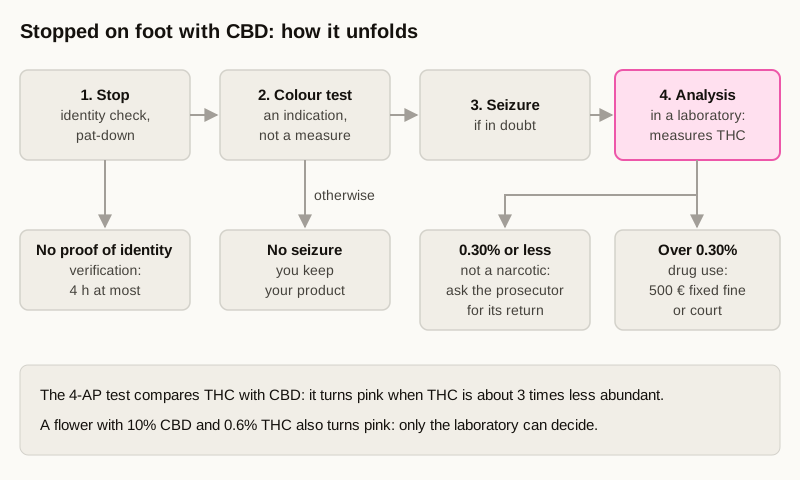
Seizure rests on article 56 of the Code of Criminal Procedure, which covers objects useful for establishing the truth. Return falls under article 41-4 of the same code: the prosecutor decides, on their own initiative or on request. They may refuse, for example if returning the item would create a danger, and that refusal can be challenged within one month of notification.
The fixed fine is issued through an electronic report, without going before a judge. If you receive one for a product you know complies, do not pay it by reflex: you have 45 days to challenge it. A lawyer can tell you whether that is the right route in your case.
Your rights if the stop goes further
The rules in the table come from the service-public.fr pages on identity checks and on pat-downs and searches. If you are held for an identity verification, you can have the prosecutor and a person of your choice informed.
Drug use is punishable by imprisonment, so police custody (garde à vue) is legally possible under article 62-2 of the Code of Criminal Procedure. It lasts 24 hours and can be renewed. According to the police custody page, you are entitled to a lawyer from the start, a doctor, an interpreter, and to have a relative informed. You may also remain silent; only your identity must be declared.
The fixed fine does not apply to minors or to legal reoffending: article 495-17 of the Code of Criminal Procedure excludes it.
What is worth carrying with you
No rule requires you to go out with proof. But a product in its original packaging is easier to discuss than an unlabelled bag.
- The original packaging, with the product name, the seller and, if shown, the batch number.
- Proof of purchase: invoice, receipt or order confirmation email, on paper or on your phone.
- A small quantity. If the product is found to be a narcotic, a large quantity rules out the fixed fine, service-public.fr states, and the case goes to court.
An invoice proves you bought a product sold as CBD. It does not prove its THC level. An analysis published by a seller describes a batch, not the sample seized: in a dispute, the official analysis is what counts. Our laboratory page explains how to read an analysis.
Watch out too for "CBD" products enriched with HHC, H4CBD or THCP: they are narcotics, whatever their THC level. Our article is CBD a drug? traces these classifications.
On foot or at the wheel: two different checks
On foot, the question is the product you are carrying. At the wheel, it is also what is in your body. Saliva screening looks for THC, never CBD, and a full-spectrum product legally contains a little.
The Court of Cassation ruled on 21 June 2023 that the authorisation to sell certain hemp derivatives has no bearing on the offence of driving after drug use. That offence carries 3 years in prison and a 9,000 € fine, as our article on CBD and driving explains. Detection windows are covered in the guide CBD and saliva tests.
Frequently asked questions
Can the police confiscate my CBD?
Yes, if they suspect a narcotic. A judicial police officer can seize the product to have it analysed. If the analysis shows 0.30% THC or less, you can ask the prosecutor to return it, and the prosecutor decides.
Can I get the 500 € fine with legal CBD?
In principle, no: the fine penalises drug use, and compliant CBD is not a narcotic. If you receive one anyway, you have 45 days to challenge it. Paying closes that option and leaves an entry on your criminal record.
Does the police test detect CBD?
Colour tests react to cannabinoids in general, CBD included. The 4-AP test indicates whether CBD or THC dominates, without measuring the 0.30% threshold. Only a laboratory measures it.
Is CBD hash more of a problem than flower?
The threshold is the same: 0.30% Δ⁹-THC for flower, resin and the products that contain them. By sight, a hemp resin looks like a cannabis resin, and the colour test does not separate them any better. The conditions are set out in our article on whether CBD hash is legal.
Written by the Phytogrammes team
Every article in this journal draws on primary sources (ANSM, EFSA, EUR-Lex, peer-reviewed publications) and on the lab's own practice: batch-by-batch HPLC analyses, measured cannabinoid profiles. Our approach.
Article published on . CBD is not a medicine.