Is CBD a banned substance? What the 2026 WADA list says
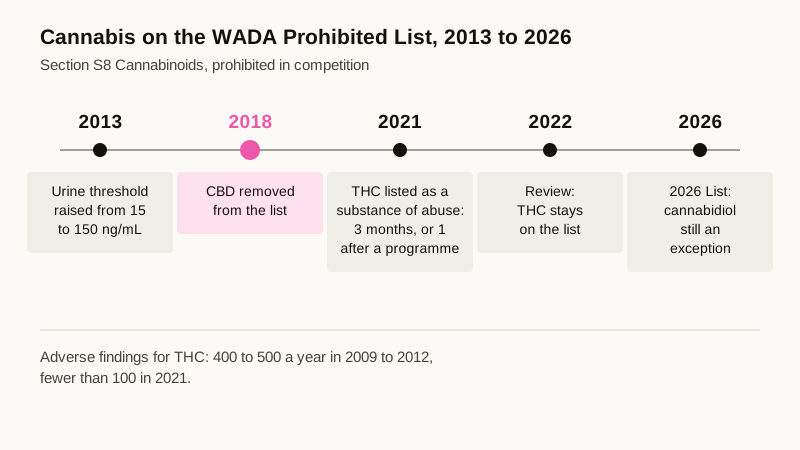
No, CBD is not a doping substance: the World Anti-Doping Agency (WADA) removed it from its Prohibited List on 1 January 2018, and the 2026 List still names it as an exception. THC, on the other hand, remains banned in competition. For an athlete, the risk therefore lies in the traces of THC a CBD product may contain, not in CBD itself.
Contents
> Key takeaways > > - Cannabidiol is listed as an exception in section S8 "Cannabinoids" of the 2026 List; all other cannabinoids are prohibited in competition. > - A test is positive when urine contains more than 150 ng/mL of carboxy-THC, a THC metabolite. Laboratories apply a decision limit of 180 ng/mL. > - The French 0.30% THC limit governs the sale of a product. It says nothing about the outcome of a urine test. > - Since 2021, out-of-competition use unrelated to performance carries a 3-month suspension, reduced to 1 month after a treatment programme.
What the 2026 Prohibited List says
WADA's list is an international standard updated every year. In France it is published in the Official Journal: the version in force since 1 January 2026 appears in decree no. 2025-1226 of 15 December 2025. Its section S8 bans in competition "all natural and synthetic cannabinoids", whether in cannabis, hashish, natural or synthetic THC, or molecules that mimic THC. There is one exception: cannabidiol.
The change dates from 2018. The summary published by the US Anti-Doping Agency puts it plainly: starting in 2018, cannabidiol is no longer prohibited under the S8 category. The same text adds a caveat that still matters: CBD extracted from the plant may contain varying amounts of THC.
"In competition" has a precise meaning. The ban covers the competition period, but the test measures what is left in the body on that day, whatever the date of use. The French Anti-Doping Agency (AFLD) puts it this way: what counts is the presence of the substance in the body, not the time it was taken. Because THC is eliminated slowly, use several days before an event can still show up in urine.
The 150 ng/mL threshold, and what it really measures
The laboratory does not look for THC itself in urine but for its main metabolite, carboxy-THC (THC-COOH), which the liver produces as it breaks THC down. According to a WADA explanatory note on section S8, a result is reported as adverse above 150 ng/mL, with a decision limit of 180 ng/mL to allow for measurement uncertainty.
The threshold was 15 ng/mL until 2013. WADA raised it tenfold so that old use, unrelated to competition, would no longer be sanctioned. The same note gives the effect in numbers: 400 to 500 adverse findings a year from 2009 to 2012, fewer than 100 in 2021.
Three thresholds come up when people discuss CBD and sport. They do not measure the same thing:
| Threshold | What it measures | Who applies it |
|---|---|---|
| 0.30% | Δ⁹-THC in the product sold | French law, for placing on the market |
| 150 ng/mL | Carboxy-THC in the athlete's urine | WADA, in competition |
| 50 ng/mL | Urinary carboxy-THC, screening cut-off | Laboratory in the study cited below, outside sport |
A product that meets the 0.30% legal limit therefore offers no anti-doping guarantee. Everything depends on the dose of THC actually swallowed or inhaled, how often, and each person's metabolism.
The trap of trace THC in a CBD product
A pure CBD isolate contains no THC. A full-spectrum product contains some by definition, below the legal ceiling. The difference is explained in our comparison of full spectrum and isolate.
A study published in JAMA Psychiatry in 2021 gives an order of magnitude. Fourteen adults took a full-spectrum extract for four weeks, about 30 mg of CBD and less than 1 mg of THC a day. At the end, 7 of the 14 tested positive for carboxy-THC at the laboratory's 50 ng/mL cut-off. The highest concentration reached 71.5 ng/mL: below the WADA threshold, but above a common screening cut-off. With a higher dose, or a product stronger than its label, the margin shrinks.
The French market adds uncertainty. A report published in December 2023 with MILDECA support analysed 248 products bought in France. 88% contained less than 0.3% THC, but 30 samples showed between 0.4 and 1.2%, mostly flowers, resins, pollens and e-liquids. The AFLD notes that some CBD oils or extracts may contain other, prohibited cannabinoids, and that it cannot vouch for the composition of these products.
For a tested athlete, caution comes down to three points. A CBD isolate carries less risk than a full-spectrum product. A flower or resin, which always contains some THC and THCA, carries more. And a batch analysis is only worth something if it covers the batch you bought: our guide to reading a certificate of analysis shows which lines to check.
Sanctions: what changed in 2021
Since the 2021 World Anti-Doping Code, THC has been one of the "substances of abuse", alongside cocaine, heroin and MDMA. In French law, article L232-23-3-3 of the Sport Code draws the consequence. If the athlete shows that use took place out of competition and was unrelated to performance, the suspension is three months. It can drop to one month if the athlete follows a treatment programme approved by the AFLD. Otherwise, the standard sanctions apply.
The case of American sprinter Sha'Carri Richardson illustrates the rule. After testing positive for carboxy-THC at the US Olympic Trials on 19 June 2021, she accepted a one-month suspension after completing a counselling programme. Her qualifying result was cancelled and she missed the 100 m at the Tokyo Games. Cannabis was legal in the state where she was tested: local law does not protect against a sporting sanction.
In 2022, a WADA expert group reviewed the status of THC at the request of several agencies. It concluded that THC meets the criteria to stay on the list: a health risk, especially for young people, and a breach of the spirit of sport. The same note acknowledges that the data do not show improved physical performance, while not ruling it out at the neuropsychological level.
Who is covered, and the case of horses
These rules apply to any athlete taking part in a competition organised or authorised by a federation that has signed the Code, amateurs included. In France, the AFLD carries out testing. Someone who never enters an official competition is not subject to this regime, but THC remains a controlled drug and the 0.30% limit still applies to products.
Horses fall under a different list. The 2026 list of the International Equestrian Federation classes cannabidiol among its controlled substances, whereas WADA allows it for humans. Our article on CBD and competition horses explains that regime. For human athletes and recovery, see our full article on CBD and the anti-doping framework.
Frequently asked questions
Is CBD considered a doping product?
No. Cannabidiol left the WADA list on 1 January 2018 and is named as an exception in section S8 of the 2026 List. All other cannabinoids, including THC, remain prohibited in competition.
Can you test positive for THC after taking CBD?
Yes, if the product contains enough THC. In a 2021 study, a full-spectrum extract providing less than 1 mg of THC a day made 7 of 14 participants test positive at a 50 ng/mL cut-off. None exceeded WADA's 150 ng/mL, but a stronger product narrows that margin.
What is the difference between the 0.30% legal limit and the anti-doping threshold?
The 0.30% limit applies to Δ⁹-THC in the product sold in France. The 150 ng/mL threshold applies to carboxy-THC in the athlete's urine. A legal product can therefore lead to a positive test.
How long before a competition should you stop a product containing THC?
No waiting period guarantees a negative test: elimination depends on the dose, how often it is used, and the person. WADA advises athletes to refrain from cannabis for a number of days before a competition. Our article on how long CBD stays in the body gives the known orders of magnitude.
Can an amateur athlete be tested?
Yes, as soon as they enter a competition organised or authorised by a federation that applies the World Anti-Doping Code. In France, this testing is carried out by the AFLD.
Written by the Phytogrammes team
Every article in this journal draws on primary sources (ANSM, EFSA, EUR-Lex, peer-reviewed publications) and on the lab's own practice: batch-by-batch HPLC analyses, measured cannabinoid profiles. Our approach.
Article published on . CBD is not a medicine.