THC-free CBD oil: what “not detected” really means
A "THC-free" CBD oil is an isolate or a broad spectrum whose lab report shows THC as "not detected", meaning below the level the lab can measure. That is not an absolute zero, but it is a long way from a full-spectrum oil, which can legally contain up to 0.30% THC, or 3 mg per gram. The difference matters most in drug tests: for drivers, French law sets no tolerated THC level.
Contents
> Key takeaways > > - A legal full-spectrum oil can contain up to 3 mg of Δ⁹-THC per gram; a compliant isolate or broad spectrum shows none on the lab report. > - "THC-free" on a label proves nothing: in 2017, 18 of 84 CBD products bought online contained THC. > - In a 2020 study, 100 mg of pure CBD produced no confirmed positive urine test. > - France's highest court ruled in 2023 that a CBD product being legal does not protect a driver who tests positive. > - The oils in our catalogue are full spectrum: their batches show 0.1 to 0.2% THC.
Three kinds of oil, three THC levels
Every CBD oil starts from a hemp extract. What sets them apart is what has been kept or removed from that extract afterwards.
| Type | What it contains | THC expected on the lab report |
|---|---|---|
| Full spectrum | The whole extract: CBD, minor cannabinoids, terpenes, traces of THC | Up to 0.30% |
| Broad spectrum | The whole extract, with the THC removed | Not detected, if removal worked |
| Isolate | Purified CBD, diluted in a vegetable oil | Not detected |
The 0.30% limit comes from the French order of 30 December 2021, which applies it to hemp varieties, their extracts and products that contain them. By mass, 0.30% is 3 mg of Δ⁹-THC per gram of oil.
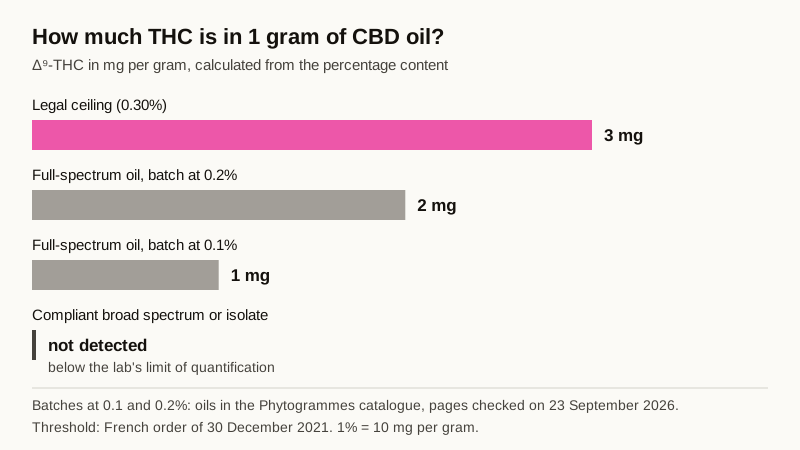
The oils in our catalogue are all full spectrum. On the pages checked on 23 September 2026, their batches show 0.1 to 0.2% Δ⁹-THC, below the legal limit but not zero. If you are looking for a THC-free oil, these are not the right products. Our CBD oils show the measured profile of each batch, and our comparison of full spectrum and isolate details the differences in composition.
How a THC-free oil is made
Hemp is first extracted, most often with supercritical CO2 or ethanol. The crude extract then contains all the plant's cannabinoids, THC included. There are two ways to remove the THC afterwards.
For an isolate, the CBD is purified until it crystallises, then diluted in a carrier oil. The product contains nothing but CBD, with no hemp aroma. Our article on 99% isolate explains how to read its purity on a certificate.
For a broad spectrum, the THC is removed from the extract by chromatography, a technique that separates molecules, while keeping the other cannabinoids and some of the terpenes. How well this works varies from one maker to another: only the batch analysis tells you whether it succeeded. Our definition of broad-spectrum CBD covers the process.
One argument often made for broad spectrum is the "entourage effect", the idea that hemp compounds work better together. It is a research hypothesis, not an effect shown in humans.
"THC-free" on the label, "not detected" on the report
The label is not enough. In 2017, a US team analysed 84 CBD products bought online: THC was detected in 18 of them, or 21%, and only 31% showed an accurate CBD content. In France, the ANSES and ANSM health agencies relayed in June 2025 a study by addiction monitoring centres finding that 8 CBD products out of 10 have a CBD content different from the label.
On a certificate of analysis, four points settle the question:
- The Δ⁹-THC line: "ND" (not detected) means below the method's limit of detection; "< LOQ" means below its limit of quantification, the smallest amount it measures reliably. These limits should appear on the document.
- The THCA line, if measured: when heated, this acid form turns into THC.
- The batch number, which must match the one on the bottle.
- No cannabinoids classified as narcotics. HHC has been on that list since June 2023, and on 3 June 2024 the ANSM added H4CBD and THCP, among others; THCA is excluded when the product's THC meets the 0.3% limit.
Our guide to reading a certificate of analysis goes through each line, and the laboratory page describes the measurement methods.
Drug tests: what a trace of THC changes
For drivers, article L235-1 of the French Highway Code punishes driving after drug use with three years in prison and a 9,000 € fine, with no minimum THC level. On 21 June 2023, the Court of Cassation ruled that permission to sell hemp derivatives under 0.30% THC "has no bearing on the offence of driving after drug use". A driver who tests positive after a legal oil can still be prosecuted. Our guide to saliva, blood and urine testing details detection windows.
Urine test studies show the difference between pure CBD and CBD that comes with THC. In 2020, six adults took 100 mg of pure CBD: none of the 218 urine samples exceeded the confirmation cut-off. In a larger study published in 2022, no conversion of CBD into THC was seen, but vaporised CBD-rich cannabis containing 3.7 mg of THC made three participants out of 18 test positive in urine. These trials looked at a single dose; daily use was not tested.
For athletes, CBD is permitted by the World Anti-Doping Agency, but THC remains banned in competition above 150 ng/mL in urine. The US Anti-Doping Agency warns that it is very difficult to obtain a truly pure CBD extract. Our update on CBD and the 2026 anti-doping list sets out the rules.
The legal framework for CBD oil in 2026
Selling a CBD oil rests on three texts. The 2021 order sets the 0.30% Δ⁹-THC ceiling. On 29 December 2022, the Council of State struck down the ban on selling raw flowers and leaves, without touching the limit. And food law decides whether the product may be swallowed.
On that last point, the French agriculture ministry restated on 20 May 2026 that foods containing CBD are not authorised, food supplements included, for lack of an EU novel food authorisation. On 9 February 2026, EFSA published a provisional safe intake of 2 mg of CBD a day for a 70 kg adult, for CBD at least 98% pure. This benchmark is not an authorisation. Our article on CBD regulation in 2026 covers what remains on sale.
Frequently asked questions
Does THC-free CBD oil really exist?
Yes, as an isolate or a broad spectrum, provided the batch analysis shows THC as not detected. "Not detected" means below the lab's limit, not an absolute zero. Without an analysis tied to the batch, a "THC-free" claim cannot be checked.
Does a THC-free oil guarantee a negative drug test?
No maker can guarantee it. With pure CBD, a 2020 study found no confirmed positive urine test after 100 mg. The risk comes from mislabelled products and from the residual THC in full-spectrum oils.
What is the difference between isolate and broad spectrum?
An isolate contains only CBD. A broad spectrum keeps the other cannabinoids and some terpenes, but not the THC. Both should show THC as not detected on the batch analysis.
Are Phytogrammes oils THC-free?
No. They are full spectrum, and their batches show 0.1 to 0.2% Δ⁹-THC on the pages checked on 23 September 2026, below the 0.30% legal limit. They are not suitable if you need to avoid any trace of THC.
Is THCA banned in France?
Not in compliant hemp. The ANSM decision of 3 June 2024 excludes THCA from the narcotics list when the product's THC meets the 0.3% limit. It is still worth reading on the lab report, because heat turns it into THC.
Written by the Phytogrammes team
Every article in this journal draws on primary sources (ANSM, EFSA, EUR-Lex, peer-reviewed publications) and on the lab's own practice: batch-by-batch HPLC analyses, measured cannabinoid profiles. Our approach.
Article published on . CBD is not a medicine.