Broad-spectrum CBD: what “THC-free” really means
Broad-spectrum CBD is a hemp extract whose THC has been removed by a purification step, while other cannabinoids such as CBG, CBN or CBC and some of the terpenes are kept. No French or EU text defines the term: “THC-free” means “below what the laboratory can measure”, not zero. Of 28 broad-spectrum products tested in the United States in 2024, 3 contained THC.
Contents
> Key takeaways > > - Broad spectrum sits between full spectrum (THC present, up to 0.30% in France) and isolate (purified CBD on its own). > - The THC is removed by chromatography; a 2025 pilot study produced a “broad-spectrum” extract that still held 0.2%. > - Only the certificate of analysis can confirm the label: the minor-cannabinoid profile and the THC quantification limit. > - Broad spectrum lowers THC exposure without protecting you from a drug test, and it contains cannabinoids banned in sports competition. > - In France, a CBD product meant to be swallowed is not authorised, whatever its spectrum.
Definition: the full extract, minus the THC
CBD extracts fall into three families, depending on what they keep from the plant. A 2024 study published in Frontiers in Pharmacology used simple analytical definitions to tell them apart: full spectrum contains CBD, THC and at least one other cannabinoid; broad spectrum contains CBD and at least one other cannabinoid, with no THC; an isolate is more than 95% CBD. These definitions are research tools. They have no regulatory value.
| Family | What it contains | THC | What the analysis should show |
|---|---|---|---|
| Full spectrum | CBD, minor cannabinoids, terpenes, THC | Present, up to 0.30% in France | A quantified Δ⁹-THC line |
| Broad spectrum | CBD, minor cannabinoids, some of the terpenes | Removed, below the quantification limit | CBG, CBN or CBC quantified, THC “ND” or “< LOQ” |
| Isolate | CBD alone, crystallised | Absent in practice | More than 95% CBD, nothing else of note |
Full spectrum keeps everything, and an isolate keeps a single molecule. Broad spectrum tries to keep the diversity of the first without the THC. It is a manufacturing process, not a hemp variety and not a legal category.
How THC is removed from an extract
A broad-spectrum extract starts life as a full-spectrum one. Extraction (with supercritical CO₂ or ethanol) gives a crude extract, which is stripped of its waxes by winterisation, heated to decarboxylate the acidic forms, then distilled. Our article on how a CBD oil is made describes these steps.
THC and CBD share the same molecular formula and have similar properties. Distillation is not enough to separate them. It takes chromatography: the extract passes through a system that holds back molecules at different speeds, and the fraction carrying the THC is set aside.
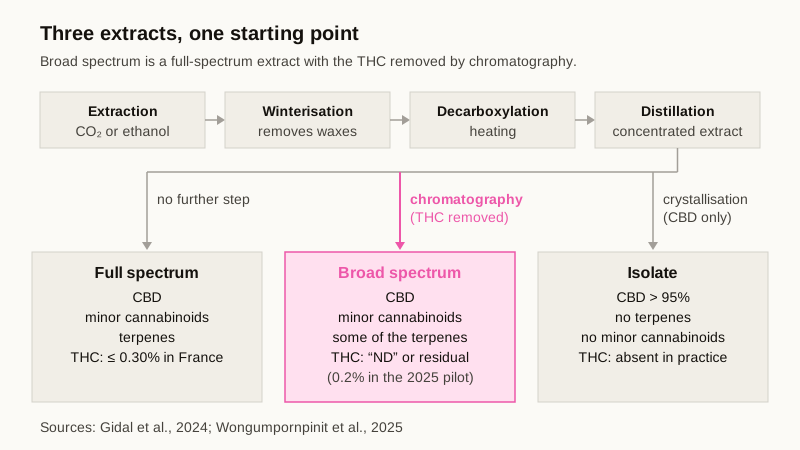
The separation is never perfect. A pilot study published in 2025 in Medical Cannabis and Cannabinoids purified an extract by centrifugal partition chromatography. The authors define broad spectrum as an extract “with minimal or no Δ⁹-THC”. Their final product contained 73.3% CBD and 0.2% THC. The word “minimal” matters: a manufacturer can sell an extract that still holds measurable THC as broad spectrum.
“THC-free”: what product testing shows
The 2024 study mentioned above bought and tested 202 CBD products sold in the United States. Its results show the gap between label and content:
| Measure | Result |
|---|---|
| Products that did not match their claimed type (full, broad, isolate) | 26% |
| Products whose CBD content was at least 10% off the label | 74% |
| Products sold as broad spectrum | 28 |
| Of which containing THC | 3 |
| Of which above 0.3% THC | 2 |
These figures come from the US market and do not transfer as such to the French one. They make one point that holds everywhere: the words “broad spectrum” prove nothing without the batch analysis.
On a certificate, “ND” (not detected) or “< LOQ” (below the limit of quantification) does not mean zero. These notes reflect the sensitivity of the method. A laboratory with a quantification limit of 0.01% and another at 0.001% can both write “< LOQ” for two different products. Ask for the value of that limit. Check too that CBG, CBN or CBC are quantified: a “broad spectrum” whose analysis shows only CBD is an isolate. Our guide to reading a certificate of analysis goes through each line, and the laboratory page describes the measurement methods.
Drug tests and sport: what broad spectrum changes
Behind the wheel, the French rule does not depend on the dose. The Cour de cassation ruled on 21 June 2023 (no. 22-85.530) that the offence of driving after using narcotics is made out “regardless of the dose absorbed”, even when the product was sold legally. A well-purified broad spectrum exposes you to less THC than a full spectrum. It does not guarantee a negative test, because nothing guarantees a total absence of THC.
Repeated exposure counts. In a study published in 2020 in JAMA Psychiatry, 14 adults took a full-spectrum extract containing 0.02% THC for four weeks. Half of them (7 of 14) then had a THC metabolite in their urine. We found no equivalent study on a broad-spectrum product. Our guide to saliva, blood and urine testing details the detection windows.
For athletes, the problem lies elsewhere. The World Anti-Doping Agency removed CBD from its list, but all other cannabinoids, natural or synthetic, remain banned in competition, a 2019 review in Sports points out. The urinary threshold for THC is 150 ng/mL of carboxy-THC. By definition a broad spectrum contains CBG, CBN or CBC, so it is the wrong choice for a tested athlete. An isolate fits that rule best.
The entourage effect: a hypothesis, not proof
The sales pitch for broad spectrum is the “entourage effect”: the idea that minor cannabinoids and terpenes would strengthen the action of CBD. This idea remains a research hypothesis. Our article on the entourage effect reviews the data, which come mostly from cell and animal models. In France, the MILDECA points out that products containing CBD may not make any therapeutic claim, on pain of criminal penalties. A seller therefore cannot present a broad spectrum as “more effective” than an isolate.
The real choice is simpler: do you want the aromas and minor cannabinoids of hemp, with THC reduced but not guaranteed at zero, or a single, predictable molecule?
Broad-spectrum CBD and the law in France
Broad spectrum is not a legal category. It follows the common rule: the order of 30 December 2021 sets 0.30% as the maximum Δ⁹-THC content of hemp varieties, hemp extracts and the products that contain them.
For ingestion, the spectrum changes nothing. On 20 May 2026, the French Ministry of Agriculture restated that foods containing CBD, food supplements included, are not authorised under the novel food regulation and must be withdrawn from the market. Our update on CBD regulation in 2026 explains the situation.
One benchmark is often quoted: on 9 February 2026 EFSA set a provisional safe level of 0.0275 mg/kg/day, about 2 mg a day for a 70 kg adult. That level applies only to supplements made with CBD of at least 98% purity, in other words isolates. It does not apply to a broad spectrum. EFSA also states that the safety of CBD cannot be established under 25, during pregnancy and breastfeeding, or for people on medication.
Finally, on 21 March 2025 ANSES proposed classifying CBD as a “presumed human reproductive toxicant” (category 1B), based on animal studies. The proposal follows the European classification procedure. It concerns CBD itself, whatever the spectrum.
The oils in the Phytogrammes catalogue are full-spectrum extracts, sold for external use, with Δ⁹-THC below 0.30%: the CBD oils page lists no broad spectrum (checked on 23 September 2026).
Frequently asked questions
Broad spectrum or isolate before a drug test?
An isolate gives the lowest THC exposure. Broad spectrum reduces the amount compared with full spectrum without guaranteeing zero, and French case law penalises driving after use whatever the dose. If you drive, the only safe precaution is not to take a product that may contain THC.
Is broad-spectrum CBD legal in France?
Yes, under the conditions common to all hemp products: an authorised variety and no more than 0.30% Δ⁹-THC in the finished product. A broad spectrum meant to be swallowed remains banned, like any CBD food.
How can I tell whether a product is really broad spectrum?
Read the batch certificate of analysis. It should quantify at least one minor cannabinoid (CBG, CBN, CBC) and show THC as “ND” or “< LOQ”, with the value of the quantification limit. With no minor cannabinoid, it is an isolate.
How much THC separates full spectrum from broad spectrum?
Full spectrum keeps its original THC, up to 0.30% in France. Broad spectrum goes through a chromatography step that removes most of it. The result varies by manufacturer: from undetectable to 0.2% in the 2025 pilot study.
Can an athlete use broad-spectrum CBD?
Not in competition. The World Anti-Doping Agency allows only CBD: the CBG, CBN and CBC in a broad spectrum remain on the list of banned substances.
Written by the Phytogrammes team
Every article in this journal draws on primary sources (ANSM, EFSA, EUR-Lex, peer-reviewed publications) and on the lab's own practice: batch-by-batch HPLC analyses, measured cannabinoid profiles. Our approach.
Article published on . CBD is not a medicine.