CBD recalls: 164 notices read, check your batch in 5 steps
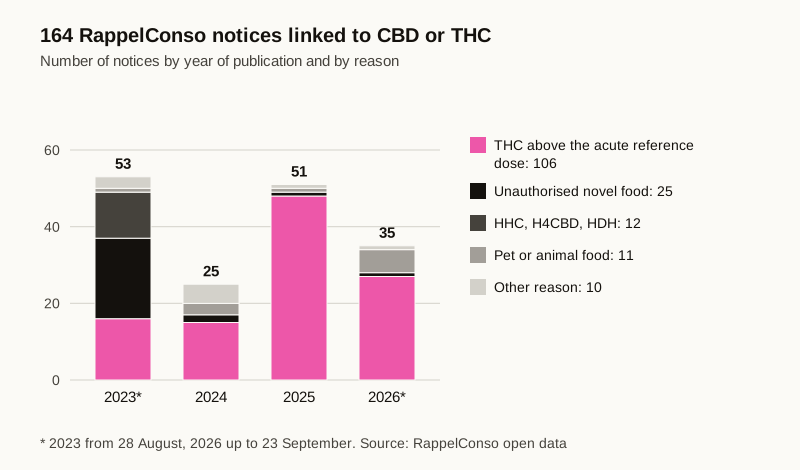
To check whether your CBD product has been recalled in France, open the official RappelConso notice, compare its reference, batch and dates with your packaging, and follow its instructions. The public data queried on 23 September 2026 contain 164 notices about CBD or THC products. Every one covers a swallowed product or animal feed, and 106 concern excess THC.
Key takeaways
- Only the RappelConso notice confirms a recall. A screenshot or a photo of a similar product does not.
- Three items need comparing: the reference, the batch and the dates.
- Of the 164 notices linked to CBD or THC, 73 cover "all batches", and then your batch code cannot rule your product out.
- Not one of the 164 notices concerns a flower or a resin.
- When the batch cannot be read, put the product aside and write to the contact named in the notice.
What 164 CBD-related recall notices show
RappelConso, the French public website for product recalls, opened on 1 April 2021 under an order of 20 January 2021. Any business recalling a product must declare the recall there, a step that is mandatory under the Consumer Code. The Ministry of the Economy publishes the notices as open data.
We searched this dataset on 23 September 2026 for the words CBD, cannabidiol, cannabis, THC, HHC and H4CBD. Once the results were sorted by hand, 164 notices concerned a CBD or THC product, the first dated 28 August 2023 and the latest 11 September 2026.
| Reason for the recall | Notices | Share |
|---|---|---|
| THC above the acute reference dose | 106 | 65% |
| CBD sold as a food without authorisation | 25 | 15% |
| Semi-synthetic cannabinoids (HHC, H4CBD, HDH) | 12 | 7% |
| Unauthorised animal feed | 11 | 7% |
| Other (suspected poisoning, labelling) | 10 | 6% |
THC tops the list. For Δ⁹-THC, EFSA has set an acute reference dose of 1 µg per kilo of body weight, which is 70 µg for a 70 kg adult. A sweet labelled 5 mg of THC holds about 71 times that amount. The recalled products include gummies, syrups, cookies and oils, often sold with a suggested dose above this threshold.
The second reason comes from the legal status of CBD foods. A notice from the French Ministry of Agriculture dated 20 May 2026 restates that foods containing CBD are not authorised under Regulation (EU) 2015/2283 on novel foods. Our overview of CBD regulation in 2026 describes this framework, and the article on the withdrawal of CBD gummies shows what it has led to.
Three more figures are useful when you check your product. The 164 notices name 65 different brands. Of the recalls, 35 were imposed by prefectoral order and the other 129 were voluntary. Finally, 73 notices, or 45%, cover every batch of the reference.
Step 1: find the official notice
Search first for the brand and the exact product name, and widen to the word CBD if nothing comes up. The RappelConso FAQ describes two ways in: a search field and lists of categories. Next, try a shorter form of the name, then the retailer's name, since a product may be listed under a name that differs from the one on your order confirmation.
Open every result that could match. An oil, a sweet and a cosmetic may share a range name, and the category and packaging let you rule out false matches. When a seller or a friend forwards an alert, ask them for the link to the notice, because a cropped image is not enough. Write down the notice's address and the date you read it.
Step 2: record the identifiers on the packaging
Note the product reference, the batch and the dates at the same time. A notice may also give a GTIN, the barcode number, which identifies the reference and says nothing about the batch. Take a photo of the whole label, then of the characters printed on the base, the cap or the sachet seal, keeping punctuation and leading zeros. Our guide to mandatory labelling shows where this information usually appears.
| Item | What to compare | Mistake to avoid |
|---|---|---|
| Reference | Name, size, variant, concentration | Relying on the colour of the pack |
| GTIN | Code given in the notice | Taking it for a batch number |
| Batch | Full code, or the words "all batches" | Looking for a code when the notice covers all batches |
| Dates | Type of date and sales period | Confusing purchase date and production date |
| Sale | Retailer and geographic area | Inferring where it was sold from the manufacturer |
Several packs of the same reference need checking one at a time. An invoice proves the purchase, but it may not show the batch.
Step 3: compare your product with the notice
Here is a real case. Notice 23495, published on 11 September 2026, recalls Novaloa red-fruit pastilles sold in 10 g sachets and labelled 3% CBD, 2% CBN and 0.05% THC. They were recalled because their THC level leads to exceeding the acute reference dose. The notice covers all batches sold in one shop in the Ardèche from 24 May 2025 to 9 September 2026.
Read carefully, this notice tells you three things. With every batch covered, the batch code is irrelevant. The sales area counts, because a sachet bought elsewhere falls outside this notice even if it looks identical. So does the sales period. When a notice lists specific batches, copy out each code before you compare.
If the notice may apply but you cannot read the batch, put the product aside and stop using it until you have an answer. A certificate of analysis cannot settle the matter, since it describes one analysed sample and the notice is what defines the recall.
Step 4: follow the notice's instructions
Every notice says what to do. Notice 23495 gives six instructions, with a refund: stop consuming, stop using, return the product, contact the shop, contact customer service or destroy the product. Across the 164 notices, 105 offer a refund and 58 an exchange, and some offer both.
Check the arrangements before you throw anything away, because the notice may ask you to return the product or to keep proof of it. If two instructions seem to contradict each other, call the number given and ask. A short message helps, with the product name, the batch copied out, the date and place of purchase, the notice number and photos attached. Never pass a recalled product on to someone else.
Step 5: keep records and follow updates
Notices can change. According to the RappelConso FAQ, each update replaces the previous version, which can then no longer be viewed. Keep a copy of the notice as you read it, along with its link, and reopen the link before taking any further step. RappelConso also publishes its notices as RSS feeds that a feed reader can follow.
A recalled product still on sale can be reported on SignalConso, the French public reporting service. Give the shop or web page, the reference and the notice number. For your next purchase, our grid for choosing CBD on verifiable criteria lists the documents to request from the seller.
Frequently asked questions
No. An empty search only tells you that no notice matches the words you typed. Try the brand, the exact name and the retailer, and ask whoever flagged the alert for the link to the notice.
None of the 164 notices linked to CBD or THC published between August 2023 and September 2026 concerns a flower or a resin. They all cover swallowed products, such as sweets, oils or syrups, or animal feed. That could change, so check the notice for your own product.
Yes. You compare the notice with the packaging, looking at the reference, batch and dates. The receipt only matters for the refund or exchange, so ask the contact on the notice which documents they accept.
No. When a notice is updated, the new version replaces the old one, which disappears from the site. Reopen the official link before you act, particularly if what the seller tells you differs from your screenshot.
Written by the Phytogrammes team
Each journal article draws on cited primary sources: ANSM, EFSA, EUR-Lex and peer-reviewed publications. Product profiles are distinguished from documented laboratory results. Our approach.
Article published on . CBD is not a medicine.