CBD price per gram in 2026, and the gap with cannabis
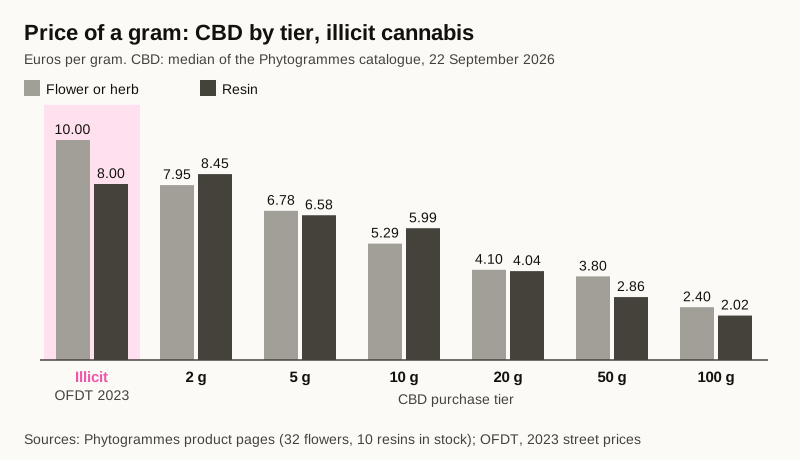
No official index tracks CBD prices in France. On the Phytogrammes catalogue recorded on 22 September 2026, a CBD flower is listed at €4.95 to €12.95 per gram at the 2 g tier, and €1.50 to €3.70 at the 100 g tier. For illicit cannabis, the latest public figure from the OFDT dates from 2023: about €10 per gram of herb and €8 per gram of resin.
Contents
> Key takeaways > > - Across 32 flowers in stock, the median price falls from €7.95 per gram at 2 g to €2.40 at 100 g, 70% less. > - Across 10 resins, it falls from €8.45 to €2.02 per gram, 76% less. > - The purchase tier weighs more than the variety; to compare two products, work out the price of 100 mg of CBD. > - In 2023, illicit cannabis cost around €10 per gram of herb and €8 for resin, at 14 and 29% THC on average. > - A low price says nothing about compliance: only the batch analysis establishes it.
How much a gram of CBD costs in 2026
The table gives the prices listed on 22 September 2026 for products in stock, by weight tier. The median is the middle price: half the products cost less, half cost more.
| Tier | Flowers: median | Flowers: range | Resins: median | Resins: range |
|---|---|---|---|---|
| 2 g | €7.95/g | €4.95 to €12.95 | €8.45/g | €7.95 to €9.95 |
| 10 g | €5.29/g | €3.49 to €8.99 | €5.99/g | €4.99 to €6.49 |
| 100 g | €2.40/g | €1.50 to €3.70 | €2.02/g | €1.90 to €2.38 |
The highest prices, above €11 per gram at 2 g, are the two moonrocks, flowers coated in extract. Without them, flowers at 2 g range from €4.95 to €8.95. These figures cover flowers and resins only. Since mid-May 2026, oils to swallow, gummies and other CBD foods can no longer be sold as food, as the French Ministry of Agriculture confirmed in a parliamentary answer published on 1 September 2026.
The purchase tier weighs more than the variety
At the 2 g tier, leaving out the moonrocks, two flowers differ by €4 per gram at most. Between the 2 g and the 100 g tier, the median flower price drops by €5.55 per gram. NYC Diesel costs €9.90 for 2 g, or €4.95 per gram, and €199.90 for 100 g, or €2.00 per gram: 60% less. The 120u hash goes from €7.95 to €1.90 per gram, 76% less.
The price per gram of a large tier only makes sense if you use the quantity before it loses its aroma. Our article on expired CBD and best-before dates helps you judge. The two guides 100 g of flowers: the price per gram and hash price per gram go through these tiers product by product.
Compare per milligram of CBD, not per gram
Price per gram only compares products with the same potency. For the others, divide the price of a gram by the milligrams of CBD it contains, then multiply by 100: that gives the price of 100 mg of CBD. A potency of 11.7% means 117 mg of CBD per gram.
| Product | Listed potency | Price per gram (2 g) | 100 mg at 2 g | 100 mg at 100 g |
|---|---|---|---|---|
| NYC Diesel, flower | CBD 11.7% | €4.95 | €4.23 | €1.71 |
| 120u, hash | CBD 15.9% | €7.95 | €5.00 | €1.19 |
The result changes with the tier. At 2 g, the flower is cheaper per milligram of CBD than the hash, despite its lower potency. At 100 g, it is the other way round: the hash drops to €1.19 per 100 mg, the flower to €1.71. This calculation assumes the potency comes from an analysis, not a label promise. Our guide to reading a certificate of analysis shows where to find it, and the flowers and resins categories show the recorded potencies. Potency and prices can change from one batch to the next.
And illicit cannabis in 2026?
Many searches are about "the price of cannabis in 2026". There is no official figure for 2026. The latest public data is the OFDT report on street prices of drugs, published on 10 February 2025: in 2023, about €10 per gram of herb, within a range of €8 to €12, and €8 per gram of resin, between €6 and €11. The observatory combines two sources, an annual questionnaire from the French anti-narcotics office and its own field monitoring system, TREND.
The comparison ends at the price. The OFDT summary on cannabis measures an average THC content of 14.0% for herb and 29% for resin in 2023. These products are controlled drugs: buying and possessing them are criminal offences. A compliant CBD product contains 0.30% THC at most, and our article on the differences between THC and CBD explains what that limit means.
A very low price: what the checks found
Looking for cheap CBD is legitimate. Price alone, however, cannot tell you whether a product is sound. The study backed by MILDECA on 223 samples bought in 2022 and 2023 found 69% of products with less CBD than stated, 87% below the 0.3% Δ⁹-THC limit and 6% containing undeclared neo-cannabinoids. On 19 June 2025, ANSM and Anses reported several hundred poisonings since early 2024 linked to products sold as CBD that contained synthetic cannabinoids or more than 0.3% THC.
A very low price does not prove a product is adulterated, and a high price does not prove it is compliant. What settles it is an analysis of the batch sold: CBD content, Δ⁹-THC at 0.30% or less, no synthetic cannabinoids. The laboratory page describes what an analysis should contain.
What has shaped these prices since 2020
Today's market is young. Before 2020, French regulations only allowed the use of hemp fibres and seeds. On 19 November 2020, the Court of Justice of the European Union ruled in the Kanavape case that a member state may not ban CBD lawfully produced elsewhere in the Union from the whole plant; its press release summarises the judgment. On 29 December 2022, the Conseil d'État annulled the ban on selling raw flowers.
The research firm Xerfi estimates that this CBD market in France generated €600 million in revenue in 2023. Since mid-May 2026, products to swallow can no longer be sold as food; flowers, resins, e-liquids and cosmetics remain on sale. The details of the framework are in our article on CBD regulation in 2026.
Frequently asked questions
What does a gram of CBD flower cost in 2026?
On the Phytogrammes catalogue as of 22 September 2026, the median flower price is €7.95 per gram at the 2 g tier, €5.29 at 10 g and €2.40 at 100 g. No national index tracks these prices: each shop sets its own.
How much does a gram of cannabis cost in France?
According to the OFDT, the street price in 2023 was about €10 per gram of herb and €8 per gram of resin. No more recent official figure has been published. This cannabis contains 14 to 29% THC on average and remains a controlled drug.
Why is CBD cheaper in large quantities?
Because shops use tiered pricing: on this catalogue, the median price per gram of flower falls by 70% between the 2 g and the 100 g tiers. Buy a quantity you will use before it loses its aroma.
Is very cheap CBD necessarily poor quality?
No, and an expensive product is not necessarily compliant. Published checks show labels that are often wrong at every price. Check the CBD and Δ⁹-THC content on the batch analysis, not on the label.
Written by the Phytogrammes team
Every article in this journal draws on primary sources (ANSM, EFSA, EUR-Lex, peer-reviewed publications) and on the lab's own practice: batch-by-batch HPLC analyses, measured cannabinoid profiles. Our approach.
Article published on . CBD is not a medicine.