CBD wax: a concentrate that concentrates THC too
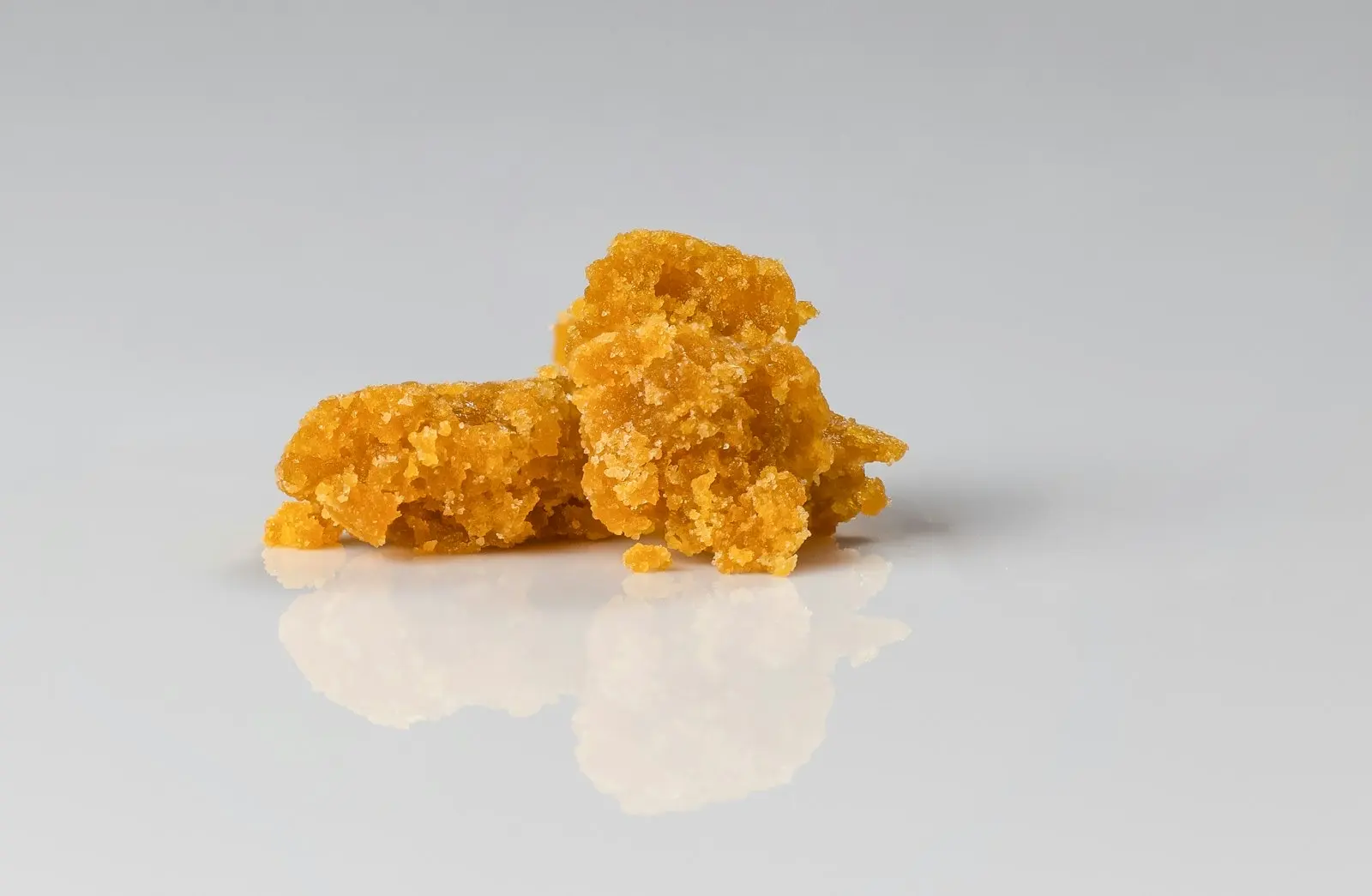
Wax is a hemp extract with a wax-like texture, made by separating cannabinoids and terpenes from the plant with a solvent or with heat and pressure. In 57 concentrates tested in 2015, the main cannabinoid reached up to 76%, while most CBD flowers in our catalogue list 4 to 18%. In France, CBD wax is legal if the finished product contains no more than 0.30% Δ⁹-THC, and that is the catch: concentrating CBD also concentrates THC.
Contents
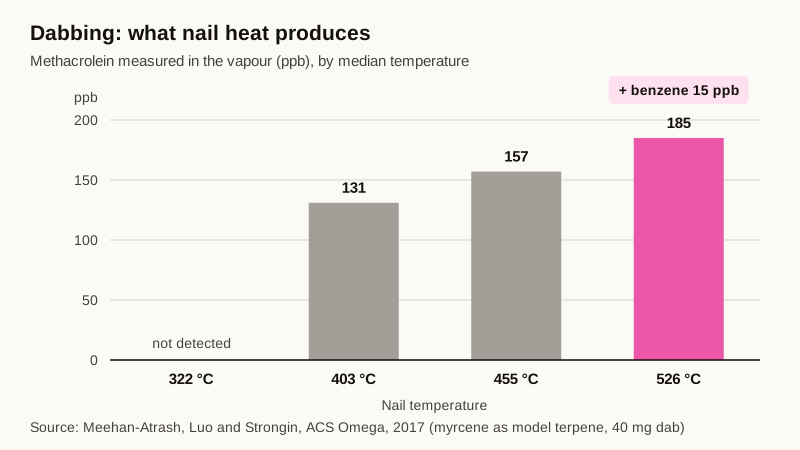
> Key takeaways > > - Wax, shatter, crumble and budder are the same kind of extract, worked into different textures. > - A flower with 0.2% THC concentrated tenfold gives an extract near 2% THC, almost seven times the legal limit. > - Of 57 concentrates tested in California in 2015, more than 80% contained residual solvents or pesticides. > - On a dab nail, a terpene's vapour forms methacrolein from 403 °C, and benzene at 526 °C. > - Home butane extraction is a documented cause of severe burns.
Wax, shatter, crumble: one extract, several textures
Wax is not a strain or a molecule. It is an extract: the producer dissolves the plant's resin in a solvent (butane, propane, ethanol, CO₂), filters it, then evaporates the solvent. There is also a solventless route, rosin, pressed between two hot plates. The final name only describes the look obtained during the purge, the step that drives off the remaining solvent.
| Texture | Look | What produces it |
|---|---|---|
| Shatter | Glassy, brittle slab | Extract left undisturbed during the purge |
| Wax | Opaque, waxy paste | Extract whipped during the purge |
| Crumble | Dry pieces that break apart | Longer purge, drier extract |
| Budder | Smooth cream | Extract whipped to a butter-like consistency |
The cannabinoid content can be very similar from one texture to another. Our page on CBD crumble covers the purge, and our page on rosin describes the pressing method.
The threshold trap: THC follows CBD
An extract concentrates everything the resin contains, residual THC included. The French decree of 30 December 2021 sets a limit of 0.30% Δ⁹-THC for hemp extracts and the products that contain them. A simple calculation shows why that limit is hard to hold for a concentrate.
| Step | CBD | Δ⁹-THC | Compliant in France? |
|---|---|---|---|
| Starting flower | 7% | 0.2% | Yes |
| Extract concentrated tenfold | 70% | 2% | No, 6.7 times the limit |
| Extract with THC removed | 70% | 0.2% | Yes |
This table is a worked example, not a measurement. It is still enough to set a rule: a compliant CBD wax means THC removed after extraction, or a CBD isolate base with terpenes added back. Only the Δ⁹-THC line of the certificate of analysis tells you which applies to a given batch. The limit is explained in our article on the legal THC level.
One more point: HHC, H4CBD and THCP are classified as narcotics. The French medicines agency (ANSM) added H4CBD, THCP and other derivatives to the list from 3 June 2024. A wax texture tells you nothing about the molecule inside.
What lab tests on concentrates have found
Most published data comes from the United States. In 2015, a team tested 57 concentrates sold on the California medical market. THC ranged from 23.7 to 75.9%, and more than 80% of samples were contaminated with residual solvents or pesticides. In inhalation tests, up to 40% of the theoretically available THC ended up in the vapour.
These figures concern THC cannabis extracts, not CBD wax. They still show what a certificate should cover for a concentrate: cannabinoids, residual solvents and pesticides. Our article on solvents in a certificate shows where to find those lines, and our laboratory page describes the measurement methods.
Vape or dab: temperature changes the vapour
Wax is used in two ways. A concentrate vaporiser heats to a set temperature. A dab rig uses a metal or quartz "nail" heated with a torch, onto which the extract is placed. With a torch, the actual temperature is rarely measured.
A 2017 study in ACS Omega heated myrcene, a common terpene in extracts, at several nail temperatures. It reports that users often aim for around 378 °C, within a range of 340 to 482 °C. At a median temperature of 322 °C, the authors detected no methacrolein, an irritant compound. At 403 °C they measured 131 ppb for a 40 mg dab, and 185 ppb at 526 °C, with benzene as well.
For dosing, keep the order of magnitude in mind. At 70% CBD, 0.1 g of wax contains 70 mg of CBD, as much as a whole gram of flower at 7%. Our CBD dab guide covers equipment and settings.
Butane: why extraction is not a home project
Butane is a gas heavier than air, highly flammable, that pools at floor level in a closed room. One spark is enough. In Colorado, where butane hash oil can reach 90% THC, the local burn centre admitted 29 patients burned during butane extractions between 2008 and August 2014, 19 of whom needed skin grafts. Another US burn centre recorded 101 patients between 2007 and 2014, with an average of 26.8% of body surface burned and three deaths.
Professional labs work in closed loops, recover the solvent and purge under vacuum. The "residual solvents" line of the certificate then shows what remains in the finished product. A solvent-extracted concentrate without that line is not documented.
What to check before buying CBD wax
- Batch certificate: full cannabinoid profile, Δ⁹-THC at 0.30% or less, and no HHC, H4CBD or THCP when the lab tested for them.
- Residual solvents and pesticides: two essential lines for a solvent extract.
- Declared extraction method: CO₂, ethanol, closed-loop hydrocarbons, or solventless rosin.
- Appearance: an oily wax can point to an incomplete purge, a blackened one to degraded material.
For a line-by-line reading, see our guide to the certificate of analysis. For storage, cold and silicone are covered in our dedicated page. Solventless resins are in our CBD resin category.
Frequently asked questions
Is CBD wax legal in France?
Yes, if it is extracted from approved hemp varieties and the finished product contains no more than 0.30% Δ⁹-THC. Wax made from THC cannabis, or containing HHC, H4CBD or THCP, falls under narcotics law.
What is the difference between wax, shatter and crumble?
Texture, not nature. Shatter is glassy, wax is waxy, crumble is dry and brittle, depending on how the extract is worked during the purge.
Does CBD wax get you high?
CBD does not produce the intoxication of THC. The risk lies in residual THC: a poorly controlled extract can exceed the limit by a wide margin. Even a compliant wax can be enough to trigger a positive roadside saliva test.
How much CBD is in a small dose of wax?
Do the maths with the figure on the certificate. A wax at 70% CBD contains 700 mg per gram, so 35 mg in a 50 mg dose.
Why not do your own butane extraction?
Because the gas pools and explodes on contact with a flame or spark. Two US burn centres documented 29 and 101 cases between 2007 and 2014, three of them fatal.
Written by the Phytogrammes team
Every article in this journal draws on primary sources (ANSM, EFSA, EUR-Lex, peer-reviewed publications) and on the lab's own practice: batch-by-batch HPLC analyses, measured cannabinoid profiles. Our approach.
Article published on . CBD is not a medicine.