CBD crumble: texture, purge and 4 certificate checks
CBD crumble is a dry, friable hemp concentrate: an extraction, then a long low-temperature purge that removes the solvent and aerates the mass. Wax is waxy, shatter is glassy; crumble breaks into crumbs. Its compliance cannot be seen, it is read on the batch certificate: residual solvents and Δ⁹-THC.
Contents
- 011. Definition: a texture, not a method
- 022. Where the texture comes from: extraction, then purge
- 033. Crumble, wax, shatter, rosin: the table
- 044. The 4 certificate checks
- 055. The French framework: finished product at 0.30%, non-food
- 066. What Phytogrammes sells, and what it does not
- 07Frequently asked questions
- 08Sources
This guide defines crumble, explains where its texture comes from without describing any working method, compares it with the other concentrates and sets out the four certificate lines that say whether a batch is compliant. A point of honesty first: Phytogrammes sells no crumble at all; its 15 resins are separated in ice water or dry, with no solvent. This article is a definition, not a product sheet.
> Key points > > - Crumble means "that crumbles": the name describes a texture, not a method and not a plant. > - The texture comes from the purge: long, under vacuum, at low temperature, with air worked in. > - Crumble, wax and shatter have a similar composition; only the finish changes. > - A rosin has no "residual solvents" line to show; a crumble does. > - The finished product tests at no more than 0.30% Δ⁹-THC and is not a foodstuff.
1. Definition: a texture, not a method
A concentrate gathers the cannabinoids and terpenes of a hemp flower once the plant matter has been set aside. Our guide to CBD wax describes that family: an extract obtained with a solvent (butane, propane, ethanol) or without one (heat and pressure for rosin), whose members differ only in consistency: waxy opaque wax, glassy shatter, creamy budder, friable crumble.
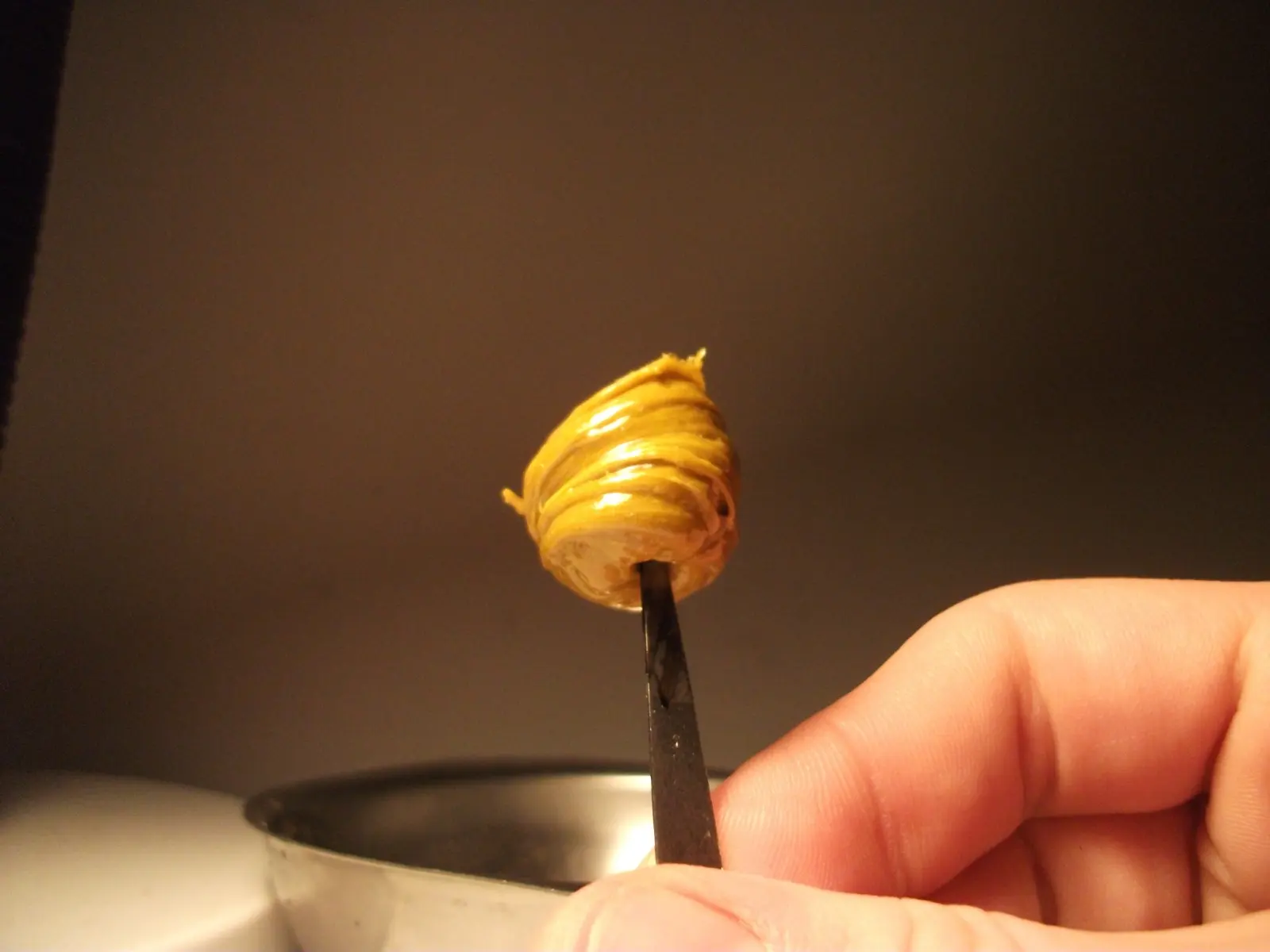
Wikipedia, under "Hash oil", describes crumble as a solidified oil that breaks into small crumbs. Leafly defines it by a dry, powdery consistency that crumbles easily, notes its "honeycomb" nickname for its cell-like look, and places its colour from pale yellow to deep yellow, turning amber with age.
Crumble is neither a variety, nor a cannabinoid, nor a process: the same starting extract becomes shatter, wax or crumble depending on how it is finished. "CBD crumble" therefore denotes a hemp concentrate that meets the French limit and has been finished towards that texture.
2. Where the texture comes from: extraction, then purge
2.1 The extraction
The first step is common to the whole family. A solvent (butane or propane in a closed loop, ethanol) or a fluid (supercritical CO2) dissolves cannabinoids and terpenes, then the solution is separated from the plant matter. The extract is at that point a viscous mass that still holds solvent. The wax guide is a reminder of why this step remains the business of closed-loop laboratories: butane is a flammable gas, and home extractions are a documented cause of accidents. Rosin, heat and pressure with no solvent, follows another route; that is what sets it apart from crumble on the certificate.
2.2 The vacuum purge and the aeration
The purge makes the crumble. The extract is placed in a vacuum oven: the reduced pressure lowers the boiling point of the solvent, which evaporates without strong heat. Leafly describes the process as the one used for shatter, but run at a lower temperature and for longer, with some extractors whipping the mass under gentle heat before the oven. Newsweed puts forward benchmarks, a purge of 24 to 72 hours between 40 and 60 °C; those are its values, and they vary from one workshop to another. CBUD describes the same logic: slow purge, periodic stirring, final drying.
The result has a physical explanation. A short, hot purge gives a wax that is still damp, notes Exodus CBD; a long, cold purge on an extract spread in a thin layer leaves a dry, aerated mass that crumbles. The air worked in by whipping and the bubbles the solvent forms as it escapes give it that cell-like look. Hotter and without stirring, the purge leads to shatter; short and with whipping, to wax.
Two consequences for whoever reads the certificate. A purge at 40-60 °C stays below the 80 to 145 °C window in which the study quoted in our rosin article measured decarboxylation: a crumble may keep part of its cannabinoids in acid form (CBDA), which is why a certificate that separates CBDA from CBD is worth having. That is a deduction, not a measurement. And the purge also serves to remove the solvent: its success cannot be seen, it is measured.
3. Crumble, wax, shatter, rosin: the table
| Criterion | Crumble | Wax | Shatter | Rosin |
|---|---|---|---|---|
| Process | Extraction, then a long, cold, aerated purge | Extraction, then a short purge with whipping | Extraction, then a hotter purge, without stirring | Heat and pressure, no solvent |
| Texture | Dry, friable, cell-like | Waxy, opaque, malleable | Glassy, translucent, brittle | Varies with press temperature |
| Stated content | 60 to 90% (Newsweed, Exodus CBD) | 60 to 80% (wax guide) | Comparable to wax | 50 to 95% for commercial concentrates (review quoted in the rosin article) |
| "Residual solvents" line | To be read | To be read | To be read | Not applicable |
| In the Phytogrammes catalogue | No | No | No | No; 15 washed or sifted resins, solvent-free |
The starting composition is similar, the finish makes the texture, and the extraction process decides what the certificate has to prove. For scale, a resin from the catalogue, the Rosift CBG/CBD, tests at 20.2% CBG and 4.6% CBD measured on batch PG-26-3A2B, where the trade quotes 60 to 90% for a crumble.
4. The 4 certificate checks
A certificate of analysis is a dated measurement on a sample from one specific batch, issued by a third-party laboratory; our guide to reading a certificate sets out its sections. For a crumble, four lines count more than the others.
4.1 Residual solvents
This is the line particular to solvent extracts. The laboratory looks for butane, propane, ethanol or hexane by gas chromatography, the technique the ICH Q3C guideline cites for that assay. To our knowledge there is no French or European limit specific to hemp extracts; the available framework is pharmaceutical. ICH Q3C allows, for its class 3 solvents (ethanol, acetone, isopropanol), 50 mg a day, that is 5 000 ppm; butane and propane do not appear in its tables. A readable certificate names each solvent looked for, its limit of quantification and the result, rather than a blanket "compliant" mention.
4.2 Δ⁹-THC
Concentrating CBD also concentrates the THC of the starting flower, the wax guide points out. The finished product must test at no more than 0.30% Δ⁹-THC, a limit that the arrêté du 30 décembre 2021 (French order of 30 December 2021) applies to hemp extracts and to products incorporating them (article 1, III). On the certificate, the value must be quantified by HPLC, with its limit of quantification. A compliant crumble is a matter of raw-material selection and analytical control, not of a declaration on the packaging.
4.3 Total cannabinoids
A figure printed on a pouch is nominal; the certificate gives the measured value, cannabinoid by cannabinoid: CBD, CBDA, CBG, CBC, CBN. The total depends on a convention, a simple sum of neutral and acid forms or a total after decarboxylation, which the document should state. A terpene profile, measured by GC-MS, also says whether the purge preserved the aromas: too hot a purge evaporates them along with the solvent.
4.4 The batch, the laboratory and the date
A certificate with no batch number is attached to nothing. Three mentions are to be found: the batch number printed on the product, the name of the laboratory with its accreditation, the date of analysis. The ISO/IEC 17025 standard sets the general requirements for the competence of testing laboratories; in France, accreditation is granted by the Cofrac. To situate the level expected, the Rosift CBG/CBD listing publishes, for batch PG-26-3A2B, the cannabinoids by HPLC (including 0.2% Δ⁹-THC), heavy metals by ICP-MS, pesticides by LC-MS/MS and terpenes by GC-MS, under ISO 17025 accreditation. A crumble ought to offer the same detail, plus the solvents line. The our laboratory page explains the journey of a sample.
5. The French framework: finished product at 0.30%, non-food
The arrêté du 30 décembre 2021 (French order of 30 December 2021) authorises varieties of Cannabis sativa L. listed in the common catalogue or the French catalogue, with a THC content that is not above 0.30%, and applies the same limit to extracts and to products containing them. On 29 December 2022 the Conseil d'État (France's supreme administrative court, decision no. 444887) annulled the ban on selling raw flowers and leaves as disproportionate, while keeping 0.30% as the criterion for non-narcotic hemp. A crumble falls under the regime for extracts: same limit, measured on the finished product. Our article on the 0.30% limit sets out how to read it.
The MILDECA, the French inter-ministerial drugs body, adds two limits. Products containing CBD "cannot put forward claims of a health benefit, under threat of criminal penalties"; and CBD-based foodstuffs placed on the market in France are placed there without the "novel food" authorisation required. A crumble is therefore neither a medicine nor a food: a product for adults, collected or vaporised, whose only admissible argument is its certificate.
6. What Phytogrammes sells, and what it does not
No crumble, no wax, no shatter. The CBD resin and hash category runs to 15 references, all of them from mechanical separation: in ice water for the ice-o-lator and frozen grades, dry for the dry sift and static ones. No solvent is involved, so there is no residual solvents line to show. The levels are those of a resin, from 15.0% CBD (Frozen Hash, batch PG-26-AA10) to 20.2% CBG (Rosift CBG/CBD, batch PG-26-3A2B), not those of a concentrate. This guide answers a question that was asked, not a product to be sold; its grid holds for a crumble bought elsewhere.
Frequently asked questions
Is CBD crumble legal in France?
Yes, if it comes from an authorised hemp variety and if the finished product tests at no more than 0.30% Δ⁹-THC, the limit the arrêté du 30 décembre 2021 (French order of 30 December 2021) applies to extracts. The proof is the batch certificate: THC quantified by HPLC and, for a solvent extract, the residual solvents line. It is for adults only and is not a foodstuff.
Crumble or wax: what is the difference?
The starting composition is comparable; the purge makes the difference. Long, at low temperature, with air worked in, it gives a dry, friable crumble; shorter, with whipping, a waxy opaque wax. Newsweed puts the crumble purge between 40 and 60 °C for 24 to 72 hours.
Can a CBD crumble contain solvents?
Yes, if the purge is incomplete: that is the risk specific to butane, propane or ethanol extracts, and the reason the "residual solvents" line exists, measured by gas chromatography. A rosin, obtained by heat and pressure, contains none by construction. In the absence of a limit specific to hemp, the available reference is ICH Q3C, which allows 5 000 ppm for its class 3 solvents.
Why is crumble more concentrated than a resin?
Because an extract dissolves the cannabinoids and sets aside most of the plant matter, whereas a sifted or washed resin keeps whole trichome heads. The trade quotes 60 to 90% for a crumble; a solvent-free resin from the catalogue tests at 20.2% CBG and 4.6% CBD on batch PG-26-3A2B. In both cases, only the certificate value counts.
Sources
- Phytogrammes, "CBD wax" (the concentrates family, 60 to 80%)
- Phytogrammes, "CBD rosin" (decarboxylation 80-145 °C, ICH Q3C, 50 to 95%)
- Phytogrammes, Rosift CBG/CBD listing, batch PG-26-3A2B
- Phytogrammes, Frozen Hash listing, batch PG-26-AA10
- Phytogrammes, resin and hash category (15 references)
- Leafly, "Crumble" glossary entry
- Wikipedia (en), "Hash oil"
- Newsweed, "Crumble cannabis" (purge 40-60 °C, 24 to 72 h, 60 to 90%)
- CBUD, "Concentrés CBD: wax, shatter and crumble guide"
- Exodus CBD, "Crumble CBD: extraction, terpenes" (60 to 90%)
- ICH Q3C (R8), residual solvents (class 3: 50 mg/day, 5 000 ppm)
- Wikipedia (fr), "ISO/CEI 17025"
- Légifrance, arrêté du 30 décembre 2021 (French order of 30 December 2021, article 1, I and III)
- Conseil d'État, decision of 29 December 2022, no. 444887
- MILDECA, "Le CBD"
Written by the Phytogrammes team
Every article in this journal draws on primary sources (ANSM, EFSA, EUR-Lex, peer-reviewed publications) and on the lab's own practice: batch-by-batch HPLC analyses, measured cannabinoid profiles. Our approach.
Article published on . CBD is not a medicine.