CBD dabbing: kit, temperatures and the legal framework
Dabbing means volatilising a hemp concentrate placed on a preheated surface, the vapour then being drawn through a water pipe known as a rig. The kit comes down to four parts: the rig, the nail or banger, the cap, the heat source. The temperatures used are far above the published volatilisation points of the cannabinoids. Phytogrammes sells neither concentrates meant for dabbing nor any kit.
Contents
The word circulates in concentrate descriptions and on forums, almost never with a definition. This article gives one, describes the kit part by part, gathers the published temperatures and sets out what French law requires of the finished product. It says nothing about what to do, how much or when: no usage guidance appears here, and every figure quoted points back to its source.
> Key points > > - Dabbing is an inhalation method, not a product nor a family of resin. > - Four parts: rig, nail or banger, cap, torch or e-nail. > - The most widely quoted volatilisation points for cannabinoids run from 157 to 220 °C. > - A 2017 study detects no methacrolein at 322 °C, measures 131 ppb at 403 °C and 185 ppb at 526 °C. > - Framework: Δ⁹-THC below 0.30 % in the finished product, sale to adults, non-food product.
1. What the word "dab" covers
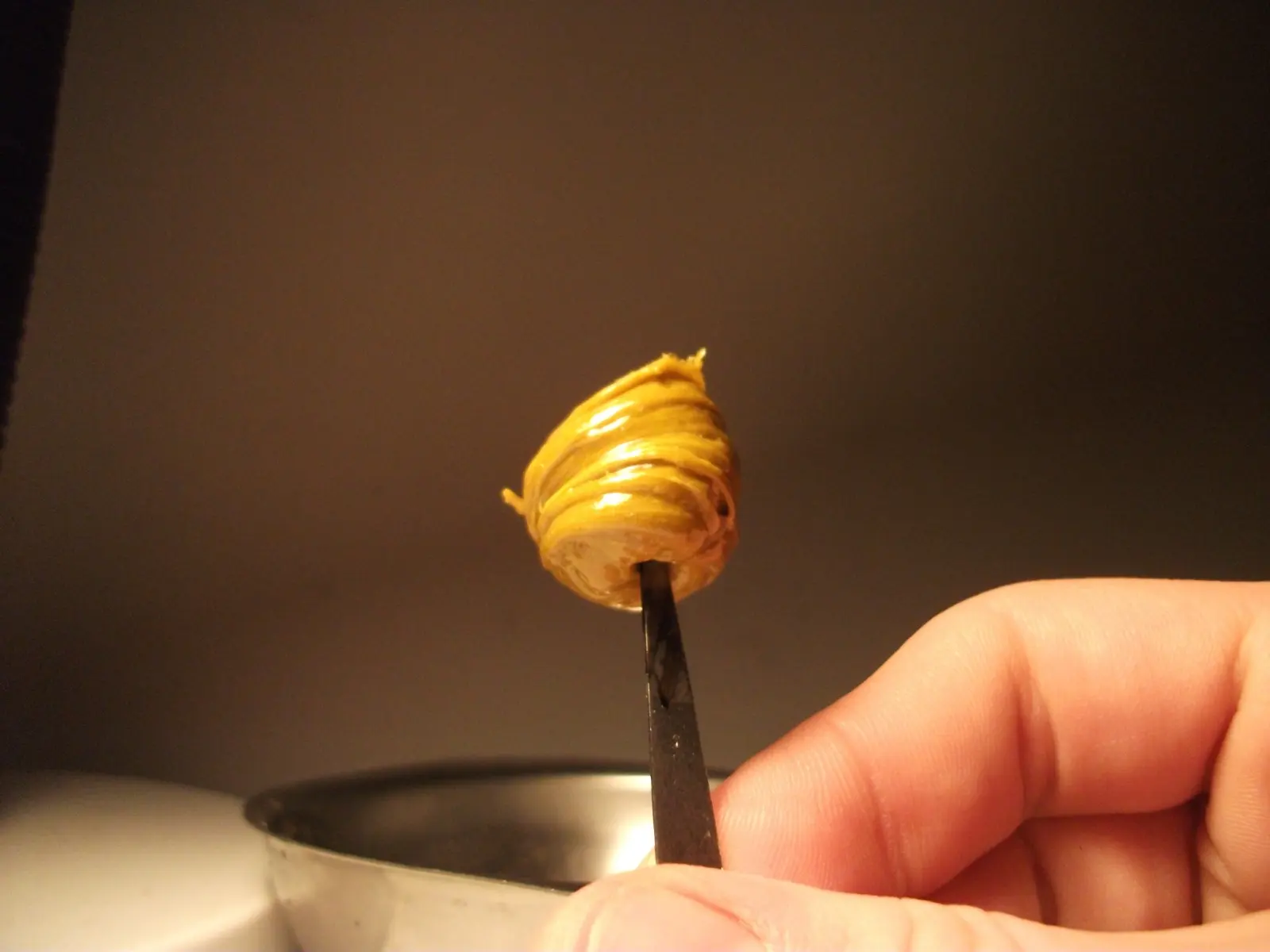
The term comes from the verb to daub, and describes the gesture: placing a small amount of sticky material on a hot surface. The "Hash oil" article on the English Wikipedia defines dabbing as smoking or vaporising hash oil, through a water pipe that everyday vocabulary calls a dab rig.
One point of vocabulary settles the essentials: a dab is not a product category but a way of applying heat. What is heated is a concentrate, butane hash oil, shatter, wax or rosin, and not a dried flower or a pressed hash. Talking about a "CBD dab" therefore describes a gesture applied to a cannabidiol-rich concentrate, not a reference in the catalogue.
The second confusion concerns vaporisation. A flower vaporiser regulates a set point: the device holds a chosen temperature throughout the session. A dab works the other way round, by contact on a preheated surface whose temperature falls as soon as the material is placed on it. The two gestures share neither thermal scale nor mechanics. Our table of volatilisation points documents the second case, that of a set point being held.
2. The kit, part by part
| Part | Role | What varies between models |
|---|---|---|
| Rig | Water pipe that cools and filters the vapour before inhalation | Chamber volume, type of percolation |
| Nail or banger | Heated surface that receives the concentrate | Material: quartz, titanium, ceramic |
| Cap | Covers the surface after placement and directs the airflow | Shape, directional or not |
| Torch | Flame heat source, running on butane | No temperature readout |
| E-nail | Heating element driven by an electronic controller | Displayed set point, regulation |
The same article notes that the quartz banger has largely replaced the traditional nail, and that the cap creates a low-pressure zone above the surface, which lowers the temperature at which the material volatilises.
The decisive distinction separates flame from heating element. A torch gives no reading: the surface temperature depends on how long it is heated, how far the flame is held, the mass of the quartz and the wait before placement, four variables no instrument measures at the moment of the gesture. An e-nail replaces the flame with an element and a controller, and displays a set point. That set point remains a set point: it describes what the device regulates, not necessarily what the material undergoes at the point of contact. None of the sources opened for this article gives a numerical gap between the two, so we put none forward.
3. Published temperatures: two scales not to be confused
3.1 The volatilisation points of the molecules
These values come from our in-house tool, which takes up the points most widely quoted in the published literature. Two caveats go with them: depending on the measurement method, sources spread by roughly ± 10 °C, and volatilisation is gradual rather than binary, a compound beginning to come off below its boiling point. Above roughly 230 °C, combustion begins, along with the tars and carbon monoxide that vaporisation is precisely meant to avoid.
3.2 Temperatures measured on a dab
A study published in ACS Omega in 2017 by Jiries Meehan-Atrash, Wentai Luo and Robert M. Strongin, of Portland State University, reproduced dab conditions in the laboratory and quantified the degradation products formed according to surface temperature. The results for methacrolein:
| Surface temperature | Methacrolein measured |
|---|---|
| 322 °C | not detected |
| 403 °C | 131 ± 9 ppb |
| 455 °C | 157 ± 2 ppb |
| 526 °C | 185 ± 11 ppb |
Benzene appears only at the highest temperatures, at around 15 ± 1.8 ppb per dab. The authors also note the temperatures reported by users themselves: a band of 340 to 482 °C, with a stated preference around 710 °F, that is 378 °C, the majority favouring the higher values in order to volatilise the material completely.
Putting the two tables side by side is the main point of this section. The cannabinoids listed above volatilise between 157 and 220 °C; the surfaces used for a dab work, according to the users questioned in that study, at temperatures twice as high. This is neither a settings tip nor a recommendation: it is a documented gap, which anyone is free to read.
4. Which products are concerned, and what Phytogrammes sells
The concentrates the gesture applies to are those that melt without leaving residue: butane hash oil, shatter, wax, crumble, rosin. Our guide to wax and concentrates describes the first family, and the article on rosin, solvent-free extraction the second. On the mechanical separation side, the vocabulary has its own verdict: the full melt grade describes a hash that melts entirely under heat without leaving plant matter, typically obtained on the 73u to 90u fractions.
The state of the French market deserves a detour. The report funded by MILDECA (the French interministerial mission on drugs) and published in December 2023 had 248 cannabidiol products bought and then analysed. CBD contents there range from trace levels to 90 %, for a median of 3.86 %, and the highest values are found precisely on the concentrated forms, wax, crystals, crumble and oil. Two figures are worth keeping in mind for anyone buying a concentrate: 46 % of the samples carried no composition labelling at all, and 30 products out of 248 exceeded the THC threshold, with contents of 0.4 to 1.2 %. The authors point out that these non-compliant products turn up across every purchasing channel.
Phytogrammes sells neither concentrates meant for dabbing nor any kit: no rig, no nail, no banger, no e-nail. The catalogue stops at flowers and resins obtained by mechanical separation, iced water or dry sifting. This article is a definition page, not a sales page. Compliance questions are gathered in our frequently asked questions.
5. The French framework
Two texts govern the finished product, whatever way it is heated.
The arrêté du 30 décembre 2021 (French ministerial order) reserves cultivation, importation and marketing to varieties of Cannabis sativa L. listed in the official catalogues, whose delta-9-tetrahydrocannabinol content is no higher than 0.30 %. Its article 1, III applies the same ceiling to hemp extracts and to the products that incorporate them: a concentrate falls into that category.
The Conseil d'État (France's supreme administrative court), in its decision of 29 December 2022 no. 444887, annulled paragraph II of article 1 of that order, which prohibited the sale of raw flowers and leaves to consumers. The judges held that this general and absolute ban was disproportionate for varieties whose content stays below 0.30 %. The threshold itself has not moved.
Finally, these products are restricted to adults and are not foodstuffs. The law quoted here concerns the material, not the object that heats it: none of the sources opened here addresses the status of the kit itself.
Frequently asked questions
Is dabbing legal in France?
The question is about the product, not the gesture. A hemp concentrate is lawful if the finished product contains no more than 0.30 % Δ⁹-THC, the threshold set by article 1, III of the arrêté du 30 décembre 2021 for extracts and the products that incorporate them. Checking goes through the batch certificate. The product is restricted to adults and is not a foodstuff.
What is the difference between a dab and vaporising a flower?
The thermal mechanics. A vaporiser regulates a set point throughout the session; a dab places the material on a preheated surface whose temperature then falls. The scales differ too: the published volatilisation points of cannabinoids run from 157 to 220 °C, whereas the users questioned in the 2017 study report surfaces between 340 and 482 °C.
Does Phytogrammes sell dab concentrates or kit?
No, neither one. The catalogue comprises flowers and resins from mechanical separation, iced water or dry sifting. No rig, no nail, no e-nail, no wax, shatter or rosin concentrate appears in it. This article exists to define a term, not to offer a product.
Why do the temperatures quoted vary so much?
Because they do not measure the same thing. Volatilisation points describe the behaviour of a pure molecule, and the published sources already differ by roughly ± 10 °C depending on the method. Dab temperatures, for their part, describe a surface: they depend on the mass of the quartz, the heating time and the delay before placement, and the 2017 study varies them from 322 to 526 °C from one condition to another.
Sources
- Phytogrammes, table of volatilisation points (consulted on 16 September 2026)
- Phytogrammes, glossary "Full melt"
- Phytogrammes, guide to wax and concentrates
- Meehan-Atrash, Luo, Strongin, "Toxicant Formation in Dabbing", ACS Omega, 2017
- English Wikipedia, "Hash oil" (dabbing section, equipment)
- MILDECA, "Cannabidiol : analyse de produits CBD non pharmaceutiques", December 2023
- Légifrance, arrêté du 30 décembre 2021 (article 1, I and III)
- Conseil d'État, decision of 29 December 2022, no. 444887
Written by the Phytogrammes team
Every article in this journal draws on primary sources (ANSM, EFSA, EUR-Lex, peer-reviewed publications) and on the lab's own practice: batch-by-batch HPLC analyses, measured cannabinoid profiles. Our approach.
Article published on . CBD is not a medicine.