CBD moon rock: three layers and a percentage to check
A CBD moon rock is a hemp bud coated in CBD extract, then rolled in kief, a powder of sifted trichomes. Its CBD percentage depends on the proportions of those three layers: with a flower at 10%, showing 60% takes more than 2 g of extract per gram of flower. In France it is sold like other hemp flowers, provided the finished product, extract included, stays at or below 0.3% Δ⁹-THC.
Contents
> Key takeaways > > - A moon rock stacks a flower, a CBD extract and a layer of kief. > - Its percentage is a weighted average based on the mass of each layer. > - Above 50% CBD, the extract weighs more than the flower it covers. > - A 2023 survey by French addiction-monitoring centres found a CBD content different from the label on 8 products out of 10. > - The 0.3% Δ⁹-THC limit applies to the finished product and to the extract used to coat it.
What is a CBD moon rock?
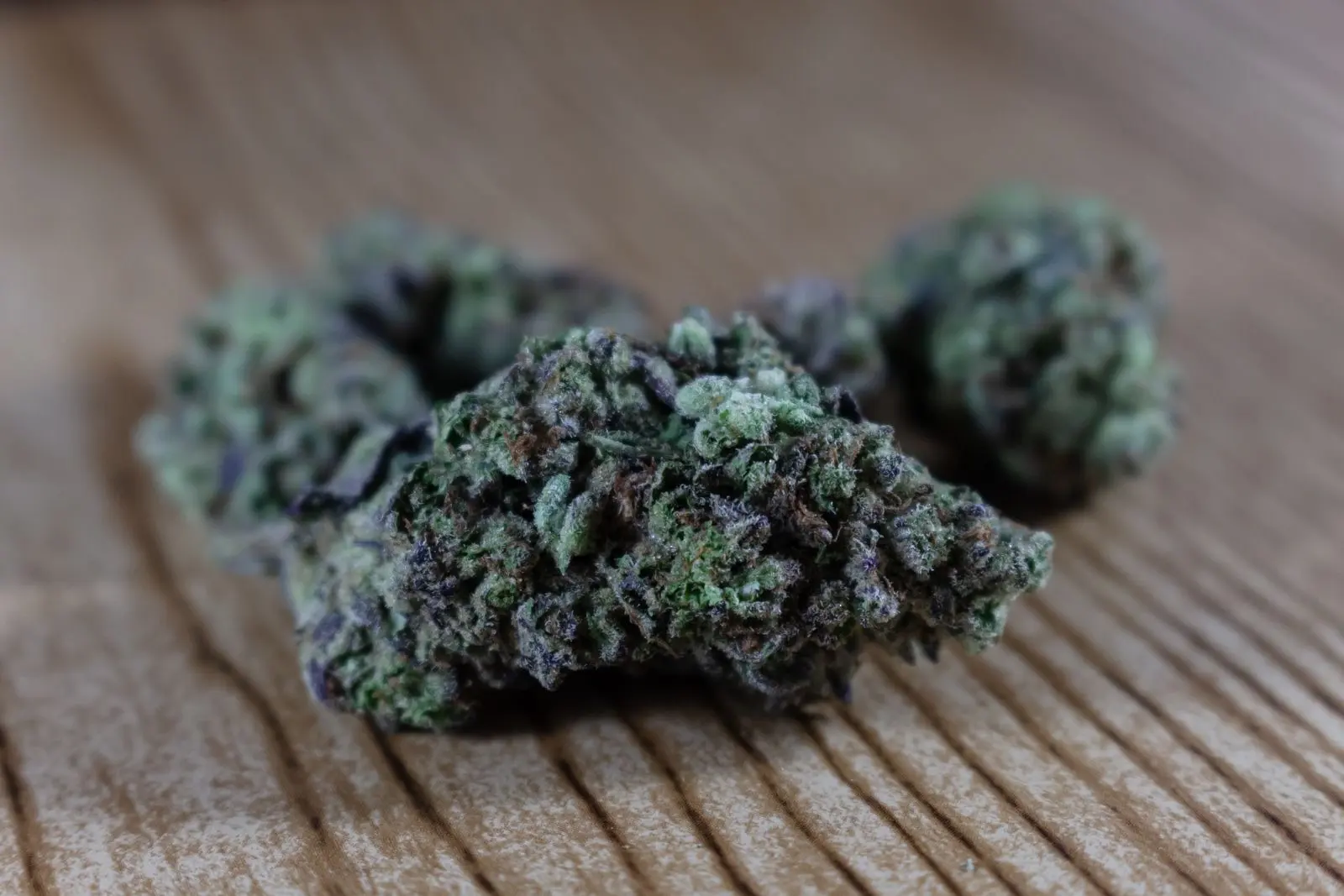
A moon rock (also spelled "moonrock") is an assembled product, not a strain. You start with a dried hemp bud, coat it with a concentrated CBD extract, then roll it in kief. The name describes the result: a grey, powdery ball that looks like a lunar pebble.
In French shops, the kief layer is sold as "pollen", which is confusing. It is not botanical pollen from male flowers but the powder obtained by sifting trichomes, the resin glands that cover the flower. Professionals call it dry sift or kief. Our guide to CBD pollen covers how it is made and graded.
The middle layer can be a distillate or a dissolved isolate. An isolate normally contains 99% CBD or more, as our article on CBD isolate explains. That layer is what pushes the percentage up.
How a moon rock's CBD percentage is calculated
A moon rock's percentage is a weighted average. You add up the milligrams of CBD each layer brings, then divide by the total mass. Take a flower at 10% CBD, an extract at 85% and kief at 25%, three plausible values chosen for the example.
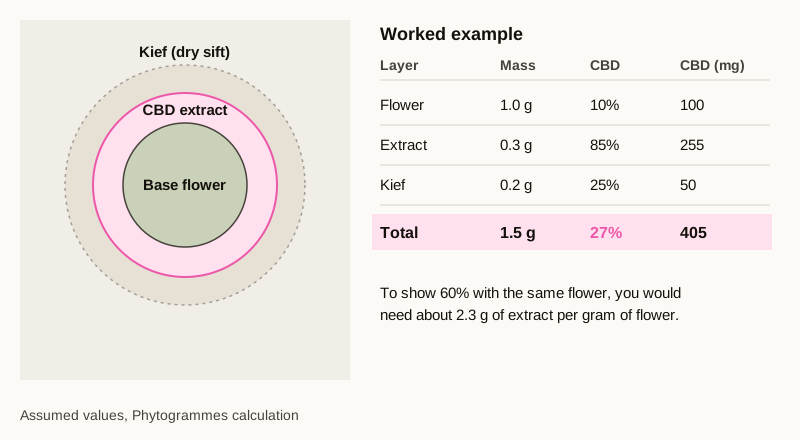
With 1 g of flower, 0.3 g of extract and 0.2 g of kief, you get 1.5 g of product holding 405 mg of CBD, or 27%. That is already nearly three times the starting flower.
To claim 60% with the same flower and kief, you would need about 2.3 g of extract per gram of flower. The coating would then weigh more than twice the bud it covers. Hence a simple rule: above 50% CBD, a moon rock is mostly extract. That is not a flaw in itself, but it changes the nature of the product, and so the question to ask about where that extract comes from and how pure it is.
The calculation also works the other way. A moon rock labelled 10% either has a very light coating or is closer to a flower than to a moon rock.
Are the advertised percentages reliable?
Not always, and public data show it. In 2017, a study in JAMA had 84 CBD extracts sold online in the United States tested, from 31 brands. With a 10% tolerance, only 30.95% were accurately labelled. 42.85% contained less CBD than stated, 26.19% more, and THC was detected in 18 of them.
France is no exception. In a warning dated 19 June 2025, the ANSM, the French medicines agency, reports that a 2023 survey by the addiction-monitoring centres of Lyon, Paris and Montpellier found a CBD content different from the label on 8 products out of 10.
With a moon rock, these gaps add up: three materials, three origins, three margins of error. Only a certificate of analysis for the batch on sale can settle it. Our guide to reading a certificate of analysis shows the lines to check, and our laboratory page describes the measurement methods.
Moon rock and French law
A moon rock follows the rules for hemp flowers. The Conseil d'État annulled on 29 December 2022 the ban on selling raw flowers and leaves, and the order of 30 December 2021 sets the ceiling: 0.3% Δ⁹-THC for the varieties, for "hemp extracts" and for "the products that incorporate them".
That last point matters for a moon rock. The coating extract is itself a hemp extract, so the threshold applies to it. A full-spectrum extract concentrates THC along with CBD: if it goes above 0.3%, the product falls outside the law, even if the starting flower complied. Our article on the legal THC limit explains the measurement.
A moon rock is not a food. It is therefore not covered by the French Agriculture Ministry notice of 20 May 2026, which states that foods containing CBD are not authorised. Driving rules still apply: THC detected at the wheel is an offence, whatever the dose.
Warning signs before you buy
The main risk with a moon rock is not its CBD percentage but what the coating can hide. The ANSM reports poisonings linked to products sold as CBD that contained HHC, H4CBD or MDMB-PINACA, all classified as narcotics. A layer of extract and powder is a convenient carrier for such additives, which the eye cannot see. Our article on H4CBD explains how it ended up in products sold as CBD.
Before you buy, check four points on the certificate:
- The batch number matches the one on the pouch.
- Δ⁹-THC stays at or below 0.3%.
- The measured CBD percentage fits the calculation: above 50%, extract dominates.
- The lab looked for HHC, H4CBD and synthetic cannabinoids, and did not find them.
An effect that feels like cannabis should also raise a flag: CBD has no psychoactive effect. You will find our Moonrock among our other CBD flowers.
Frequently asked questions
What is CBD moon rock?
It is a hemp bud coated in CBD extract, then rolled in kief, a powder of sifted trichomes. The final percentage depends on the mass and concentration of each layer.
Is CBD moon rock legal in France?
Yes, under the same conditions as CBD flowers: the finished product must not exceed 0.3% Δ⁹-THC, and neither must the coating extract. It must not contain HHC, H4CBD or any synthetic cannabinoid.
What is the real CBD percentage of a moon rock?
Only a batch analysis can tell. The calculation gives an order of magnitude: a flower at 10% coated with 0.3 g of extract at 85% and 0.2 g of kief at 25% per gram gives 27%. An advertised 60% implies more extract than flower.
What is the difference between moon rock and CBD pollen?
Pollen, or kief, is a powder of sifted trichomes sold on its own. A moon rock uses it as the outer layer, over a flower and an extract. Pollen is listed with our resins and hash.
Written by the Phytogrammes team
Every article in this journal draws on primary sources (ANSM, EFSA, EUR-Lex, peer-reviewed publications) and on the lab's own practice: batch-by-batch HPLC analyses, measured cannabinoid profiles. Our approach.
Article published on . CBD is not a medicine.