CBD pollen: sifted trichomes, not actual pollen
CBD pollen is not pollen. It is the trade name for dry sift, also called kief: the powder of trichomes, the resin glands of the hemp flower, separated with a sieve. Pressed, the same sift becomes hash. In France it is sold like other resins, with no more than 0.30% Δ⁹-THC, and never as a food.
Contents
> Key takeaways > > - CBD "pollen" is a powder of trichome heads, measured at 40 to 110 microns in a 2023 study. > - Pollen and hash have the same composition: only pressing changes the texture. > - In our catalogue, the Drysift 90u dry sift shows 15.11% CBD and 0.16% Δ⁹-THC on its batch. > - Light is the main cause of cannabinoid loss in storage, ahead of room temperature. > - The legal threshold is 0.30% Δ⁹-THC; a food containing CBD may not be sold.
Why it is called "pollen"
The word misleads twice. It is not bee pollen, nor any other hive product. Nor is it the real pollen of hemp, the one male plants produce to fertilise female flowers. Flower growers avoid it: a fertilised flower makes seeds.
What the trade calls pollen is a fine powder, blond to light brown, that looks like pollen. It is made of trichomes, small mushroom-shaped glands that cover female flowers. A study published in 2020 in Scientific Reports notes that cannabinoids and terpenes are made and stored in these glands, which are especially dense on seedless female flowers. Our article on trichomes describes their different shapes.
In Morocco this powder is called kif; in English, kief or dry sift. The Phytogrammes lexicon files it under dry sift.
From trichome to pollen: dry sieving
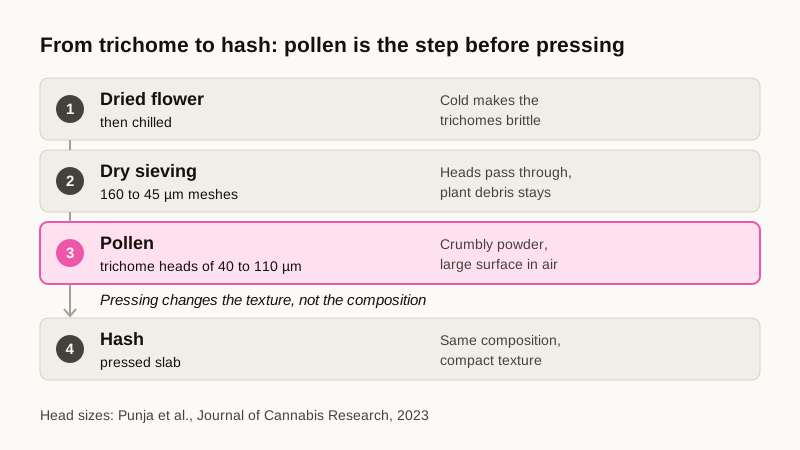
Making it takes three steps. The flower is dried, then chilled: cold makes the trichomes brittle. It is then rubbed gently over a screen, and the trichome heads break off and fall through the mesh. Stacked screens sort the powder by size.
Head size decides which mesh is useful. A Canadian team measured the trichomes of two varieties under a microscope, in a study published in 2023 in the Journal of Cannabis Research. The heads of capitate-stalked trichomes, which carry most of the resin, measure 40 to 110 microns across, with averages of 75 and 90 microns depending on the variety. A 160-micron screen lets most of them through; a 45-micron screen holds back almost all of them.
The harder you rub, the more leaf fragments pass with the resin. A very green pollen therefore holds more plant matter than a blond one. Static sift adds a sorting step using static electricity to remove them. Our guide to hash names, from frozen to 120u places these methods side by side.
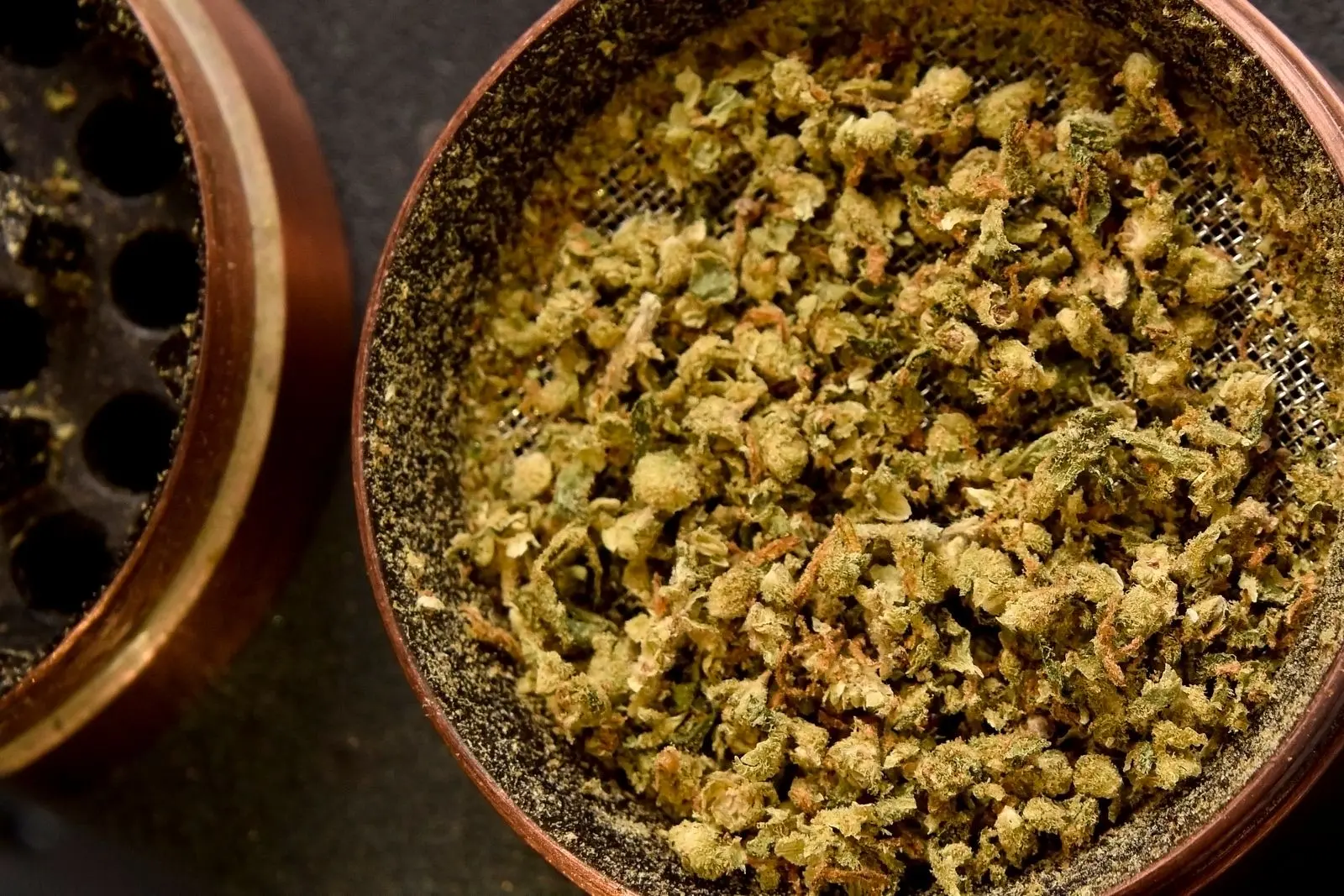
The same principle explains the powder that builds up in the bottom chamber of a three-part grinder: the ground flower rests on a fine screen, and the trichomes that come loose fall through it.
Pollen or hash: same material, different texture
Pollen and hash do not differ in what they contain, but in what has been done to them. Pollen is sold as a powder or barely packed, and it crumbles between the fingers. Hash is the same sift pressed, by hand or with a press, sometimes with heat, into a compact slab. Pressing changes the texture and the surface exposed to air, not the composition.
| Criterion | Pollen (dry sift) | Pressed hash |
|---|---|---|
| Appearance | Powder or crumbly lumps | Compact slab or bar |
| How it is made | Dry sieving | Dry sieving or ice water, then pressing |
| Surface in contact with air | Large | Reduced |
| Composition | That of the trichomes collected | Identical, for the same fraction |
| What sets the content | Mesh, variety, share of debris | The same factors |
Hash can also come from another method, ice water, which has nothing in common with dry sieving. Our guides to homemade CBD hash and to drying hashish and extracts cover these steps.
Content and price: what a lab report says
Because it concentrates the trichomes, a sift holds far more cannabinoids per gram than the flower it came from. The figure cannot be guessed from the colour; it is read on the batch analysis.
In our catalogue, Drysift 90u is a dry sift collected on a 90-micron mesh, then pressed by hand. Its batch PG-26-DBD7 shows 15.11% CBD, 1.04% CBG, 0.28% CBN and 0.16% Δ⁹-THC. Its product name says 20%: the measured value is the one that counts. The price shown on 23 September 2026 is €7.95 per gram at the 2 g tier and €1.90 per gram at the 100 g tier. The other references sit in the resins, hash and pollen category.
Three lines of a lab report are enough to judge a pollen:
- the dominant cannabinoid, as a percentage of mass: CBD, or CBG for some sifts;
- Δ⁹-THC, at 0.30% at most;
- CBN, which forms when THC oxidises: a high value points to an old or poorly stored product.
Our guide to reading a certificate of analysis goes through each line, and the laboratory page describes the measurement methods.
Storing pollen: light first
A pollen probably keeps less well than a whole flower, for a mechanical reason. A 1976 study published in the Journal of Pharmacy and Pharmacology stored flowers, resins and cannabinoid solutions for up to two years. Light, even without direct sunshine, was the main cause of loss. Temperature up to 20 °C had no notable effect. Air oxidation, on the other hand, caused clear losses, which were smaller when the glands stayed intact: the authors compare them to well-filled, well-closed containers.
Pollen is precisely detached glands, sometimes broken, with a large surface exposed to air. Hence four rules:
- an opaque glass jar, or one kept in a closed cupboard;
- a full container, to limit the air above the powder;
- a steady temperature, away from any heat source;
- open it quickly, then close it again.
Under these conditions, the authors judge well-prepared resins and flowers "reasonably stable" for one to two years. Terpenes, being more volatile, go faster: a pollen that barely smells any more has mostly lost its aroma. Our article on best-before dates for hash and flowers gives the labelling rules.
Smoking or vaporising: what heat changes
Pollen is used like other resins: heated, so the cannabinoids turn into vapour. Smoked in a joint, it goes through combustion and its by-products, carbon monoxide and tar, like any burnt plant matter. In France it is also often mixed with tobacco, which adds nicotine. Our article on the differences between tobacco and cannabis compares the two kinds of smoke.
A vaporiser heats without burning, at temperatures set out in our guide to vaporising CBD. None of this changes the main point: CBD is not a medicine, and the only authorised cannabidiol medicine is Epidyolex.
The legal framework in France in 2026
CBD pollen follows the rules for hemp resins. The decree of 30 December 2021 authorises Cannabis sativa L. varieties listed in the official catalogues whose Δ⁹-THC content does not exceed 0.30%, and caps extracts and the products containing them at the same threshold. The Conseil d'État annulled on 29 December 2022 the ban on selling raw flowers and leaves that the same decree contained. Our article on whether CBD hash is legal covers this framework.
Then there is food use. On 20 May 2026, the Ministry of Agriculture recalled that foods containing CBD are not authorised and must be withdrawn from the market, food supplements included. Pollen is therefore sold as a non-food product. Mixed into a dish or drink for sale, it would fall outside this framework.
Frequently asked questions
What exactly is CBD pollen?
It is a dry sift of trichomes, also called kief: the powder of the resin glands of the hemp flower, separated with a screen. It has nothing to do with bee pollen, nor with the real pollen of male plants.
What is the difference between pollen and hash?
Pressing. Pollen is sold as a powder or barely packed; hash is the same sift pressed into a slab. The composition does not change; the texture and the surface exposed to air do.
Is CBD pollen stronger than a flower?
It is more concentrated, because it gathers the trichomes without the rest of the plant. In our catalogue, the Drysift 90u sift shows 15.11% CBD on its batch. Only the batch analysis gives the real content.
Is CBD pollen legal in France?
Yes, if it comes from authorised hemp varieties and contains no more than 0.30% Δ⁹-THC. It is sold as a non-food product: a food containing CBD is not authorised.
How long does CBD pollen keep?
Stored away from light and air, a well-prepared resin stays reasonably stable for one to two years according to the 1976 study. Aromas fade faster than cannabinoids.
Written by the Phytogrammes team
Every article in this journal draws on primary sources (ANSM, EFSA, EUR-Lex, peer-reviewed publications) and on the lab's own practice: batch-by-batch HPLC analyses, measured cannabinoid profiles. Our approach.
Article published on . CBD is not a medicine.