Homemade CBD hash: 2 methods and the THC trap
Hash is made by separating the trichomes, the tiny resin glands that cover the flower, from the rest of the plant. At home, two solvent-free methods exist: dry sifting and ice water washing. The point tutorials leave out: concentrating the resin also concentrates THC, and a compliant flower can give a hash above the French legal limit of 0.30%.
Contents
> Key takeaways > > - Cannabinoids are made and stored in the trichomes, whose heads measure 40 to 110 microns. > - Dry sifting needs cold and patience: the harder you work the flower, the more plant debris ends up in the powder. > - Ice water washing gives cleaner resin, but wet: a failed drying step makes the batch go mouldy. > - The ratio between CBD and THC stays roughly the same: if CBD doubles, THC doubles too. > - Only a laboratory analysis can tell whether the hash stays under 0.30% Δ⁹-THC.
The principle: collecting trichome heads
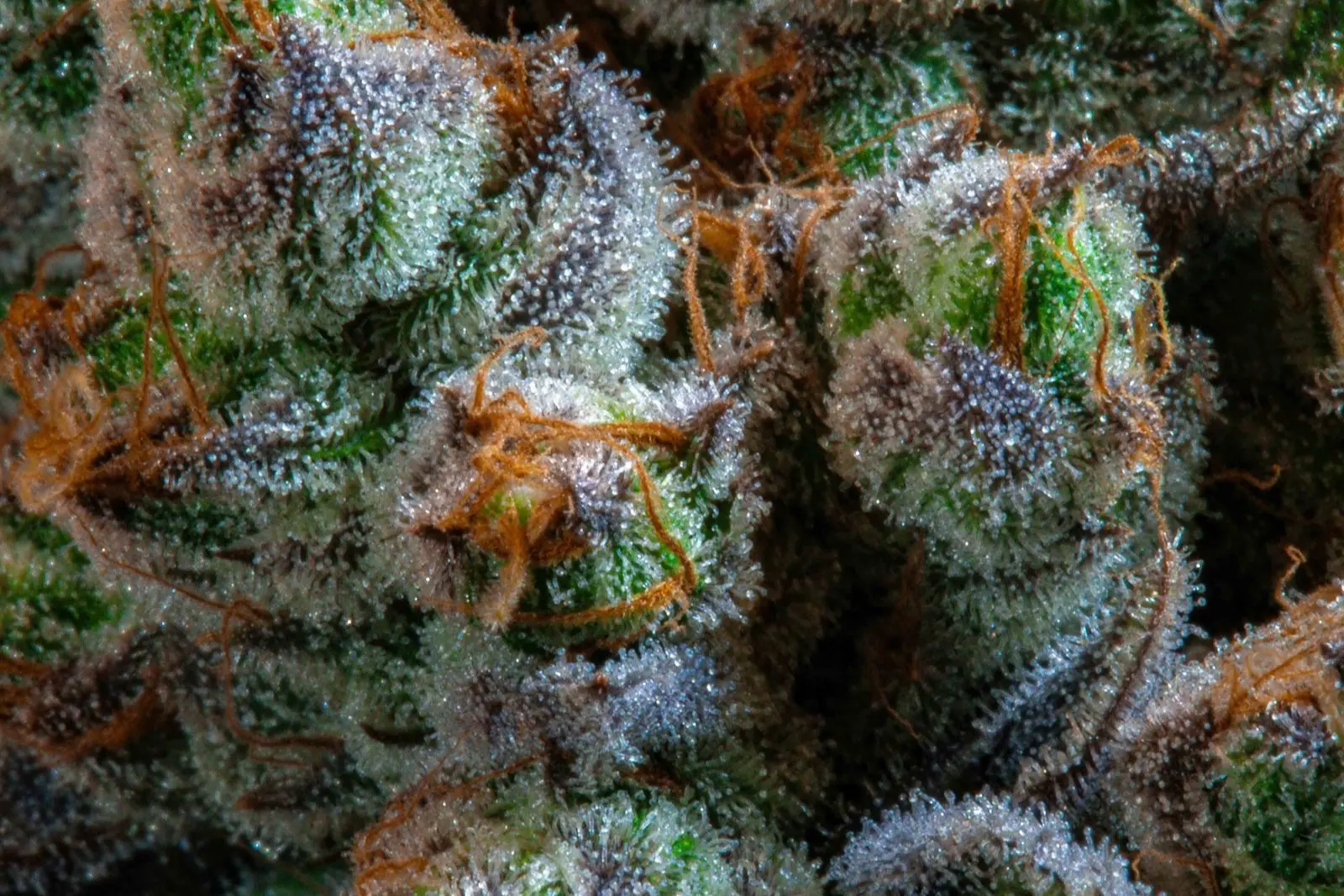
A study published in 2020 in Scientific Reports makes the point: cannabinoids and terpenes are produced and stored in the secretory cells of glandular trichomes, which are especially dense on the top of seedless female flowers. Making hash means detaching these glands and leaving the plant material behind.
Gland size drives the whole process. A Canadian team measured the trichomes of two varieties under the microscope: the heads of capitate-stalked trichomes, the ones that carry most of the resin, are 40 to 110 microns across. The same authors saw a narrowing form at the top of the stalk at maturity, and many heads come off during drying and handling. That is what makes separation possible without any chemical.
Method 1: dry sifting
Dry sift means gently rubbing a dry, cold flower over a fine screen. The trichome heads, smaller than the leaf fragments, pass through the mesh and fall as a powder called kief. By stacking screens of decreasing mesh, you then sort this powder by size. The principle is the same as in the bottom compartment of a four-piece grinder, with more control.
The whole craft is a trade-off. A 2025 study on trichome separation puts it plainly: to get a pure product, you need a cold, dry atmosphere and a short processing time, but the yield is then low. Raising the yield costs purity. The same authors report that a first pass over standard screens gives a powder in which trichomes make up only 40 to 60% of the mass, the rest being plant debris.
In practice, three rules limit that debris: a well-dried flower, a light touch, and short sessions. Static sift adds an electrostatic charge to refine the powder, a technique covered in our feature on static hash.
Method 2: ice water washing
Ice-o-lator, or bubble hash, replaces the dry screen with ice water. The flowers are stirred gently in a bucket of water and ice: the cold makes the heads brittle, and the stirring knocks them off. The mixture then runs through a stack of filter bags, from the widest mesh to the finest. Each bag holds back one fraction, labelled by its mesh: that is where the "90u" or "120u" on labels come from, explained in our guide 90u or 120u.
The resin you get is cleaner than dry sift, because the water carries away some of the light fragments. It comes out soaked, though. Drying is where most batches are lost: leftover moisture encourages mould. Our method for drying hash and extracts gives the conditions.
| Criterion | Dry sifting | Ice water |
|---|---|---|
| Equipment | Fine screens, clean surface | Bucket, ice, stacked filter bags |
| Key condition | Dry, cold flower, short sessions | Very cold water, gentle stirring |
| Purity | Low on the first pass, better after sorting | Generally better |
| Main risk | Plant debris in the powder | Mould if drying is incomplete |
Neither method uses a solvent. Butane or ethanol extractions belong in industry: these solvents are flammable and have no place in a kitchen. Our article on rosin describes another solvent-free route, using heat and pressure.
The trap: THC concentrates along with CBD
CBD and THC are made in the same glands. Separating the trichomes therefore concentrates both in roughly the same proportion. The arithmetic is simple.
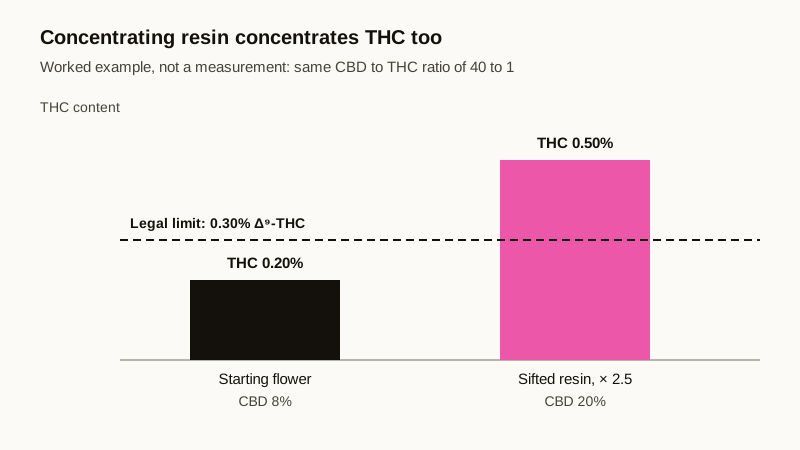
A flower with 8% CBD and 0.20% THC is compliant. If separation multiplies the content by 2.5, the resin reaches 20% CBD and about 0.50% THC. Yet the French order of 30 December 2021 sets the same ceiling of 0.30% Δ⁹-THC for hemp extracts as for the plant. Above it, the product is a narcotic: ANSES and ANSM point out, in their press release of 19 June 2025, that selling, buying and consuming a CBD product with more than 0.3% THC is prohibited.
No home test measures THC to within a few hundredths of a percent. A hash sold in a shop should be traceable to the analysis of its batch, and our guide on how to read a certificate of analysis explains each line. For a resin with a measured content, the CBD resin and hash category is the simplest route.
One more legal limit: the order reserves hemp growing for active farmers, using certified seed, so your starting material has to be a flower you bought, not a plant grown at home. Our article on whether CBD hash is legal covers the three texts that govern resin.
Pressing, drying, storing
Kief is pressed into a block, by hand or with a press, sometimes with gentle heat. Pressing makes the resin more compact and limits its contact with air. Store the result in a closed glass jar, somewhere cool and dark: heat and light break down terpenes and cannabinoids over time.
Frequently asked questions
Does CBD hash get you high?
A hash that stays under 0.30% Δ⁹-THC does not produce the psychoactive effect of cannabis: CBD has none. The risk with homemade hash is precisely crossing that limit without knowing it. Our article does CBD get you high goes into detail.
What yield can you expect from a CBD flower?
It depends on the variety, how rich it is in trichomes and the purity you aim for. No study on CBD flowers gives a reliable figure for home preparation. Keep in mind the trade-off measured in 2025: the more yield you chase, the more debris ends up in the powder.
Can you use a blender to go faster?
No. A blender chops plant material into particles as fine as trichomes, which then pass the screen with them. The powder you get is mostly leaf.
Is it legal to make your own CBD hash?
The legal framework looks at the product: a hemp extract must contain no more than 0.30% Δ⁹-THC. Since concentration can push it over that limit and no home test can measure it, making your own hash exposes you to holding a narcotic without knowing it.
Written by the Phytogrammes team
Every article in this journal draws on primary sources (ANSM, EFSA, EUR-Lex, peer-reviewed publications) and on the lab's own practice: batch-by-batch HPLC analyses, measured cannabinoid profiles. Our approach.
Article published on . CBD is not a medicine.