Indica vs sativa: 89,923 lab tests, no chemical divide
Indica and sativa are old botanical names that described a plant's shape and origin, not its effect. Across 89,923 cannabis samples tested in six US states, products labelled "indica", "sativa" or "hybrid" did not differ in their chemical make-up. For a CBD flower sold in France, the useful guide is the chemotype measured in the lab: the CBD content, the THC content (0.30% at most) and the terpenes.
Contents
> Key takeaways > > - Linnaeus named Cannabis sativa in 1753; Lamarck described Cannabis indica in 1785, based on shape and provenance. > - Trade vocabulary flipped the botany: the "sativa" of seed catalogues matches the subspecies indica. > - Three genetic and chemical studies conclude that the indica or sativa label is a poor predictor of what a plant contains. > - The chemotype, meaning the ratio between THC and CBD, can be measured; CBD hemp belongs to chemotype III. > - To choose, read the batch certificate of analysis rather than the sativa or indica label.
Where the words indica and sativa come from
It starts with a book. For botanists, the publication of Linnaeus's Species Plantarum in 1753 opens modern plant naming, and Cannabis sativa dates from it. Linnaeus's specimen was a European plant grown for fibre, with no intoxicating effect. In 1785 Lamarck described a second species, Cannabis indica, from India: fairly tall plants, loosely branched, with narrow leaflets.
Here is the paradox. Today, sellers call a squat, broad-leaved plant "indica" and a tall, narrow-leaved plant "sativa". Botanist John McPartland, in a 2018 review, sums up the gap in one sentence: trade "Sativa" is really indica, "Indica" is afghanica, and "Ruderalis" is usually sativa. He recognises a single species, Cannabis sativa, split into two subspecies, sativa and indica.
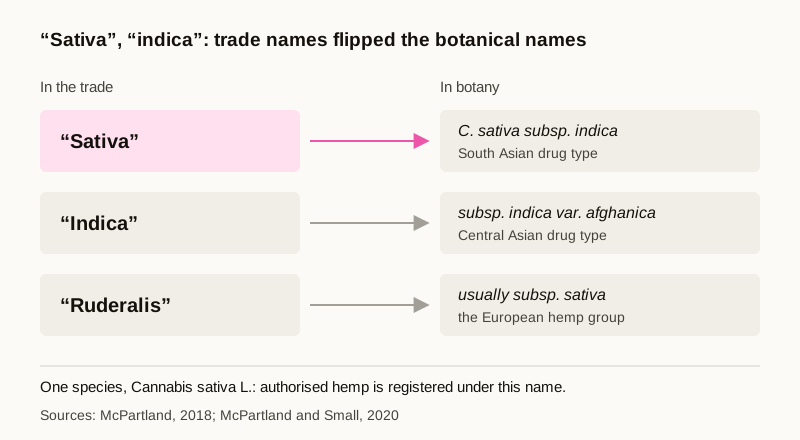
The law, too, names authorised hemp Cannabis sativa L., whatever the variety looks like. The EU common agricultural policy regulation only grants aid for varieties whose THC content does not exceed 0.3% (Article 4). The European Commission counted 116 hemp varieties in the common catalogue in 2024, and France accounts for more than 60% of EU production. Our article on the European variety catalogue explains how to read it.
What genetics and chemistry show
Three studies of cannabis sold in North America have compared the label with the contents. Their results point the same way.
| Study | Samples | What it measured | Result |
|---|---|---|---|
| Sawler et al., 2015 | 81 cannabis, 43 hemp | 14,031 genetic markers | Moderate correlation (r² = 0.36) with reported sativa ancestry |
| Watts et al., 2021 | 137 with complete data | Genome and terpenes | "Sativa" and "indica" samples indistinguishable across the genome |
| Smith et al., 2022 | 89,923 | Terpenes and cannabinoids | No separation of profiles by label |
The study by Sawler and colleagues, published in PLOS ONE in 2015, adds two findings. In 6 comparisons out of 17, samples with the same variety name were genetically closer to samples with a different name. And hemp turned out closer to "indica"-type cannabis than to the "sativa" type.
In 2021, Watts's team, in Nature Plants, analysed more than 100 samples for terpenes, cannabinoids and more than 100,000 genetic markers at once. Samples labelled "sativa" and "indica" were not distinct across the genome. Some terpene synthase genes, on the other hand, were associated with the label.
The largest study is by Smith and colleagues, published in 2022 in PLOS ONE. It covers 89,923 samples tested in six US states. Terpene profiles fall into three families: β-caryophyllene and limonene, myrcene and pinene, terpinolene and myrcene. The indica, sativa and hybrid labels are mixed across all three families, with no clear separation. The authors call marketing that presents indica as sedating and sativa as energising unfounded. Our article on hemp terpenes describes these molecules.
The "energising sativa, relaxing indica" idea: what we know
The idea rests on testimony, not trials. One often-cited source is an online survey published in 2014 of 95 medical cannabis users in the United States. Respondents linked indica with sleep and sedation, sativa with euphoria and energy. The authors acknowledge its limits: participants were not randomly selected, and some questions had very few respondents. A further point is decisive: the labels were not checked in a lab. Nobody knew what the product actually contained, and the expectation created by the label can be enough to steer the answer.
Neurologist Ethan Russo, a cannabinoid specialist, was blunter. In an interview published in 2016, he says you cannot guess a plant's composition from its height, branching or leaves. He recommends dropping both words in favour of cannabinoid and terpene testing. We found no clinical trial that compares, blind, "sativa" and "indica" products of known composition.
For a CBD flower the question matters even less. CBD does not produce the psychoactive effect of THC, and a compliant product contains no more than 0.30% Δ⁹-THC. The article does CBD get you high? covers this point.
The chemotype, a classification you can measure
Researchers classify cannabis by chemotype, meaning its cannabinoid profile. A 2022 review in Plants describes five.
| Chemotype | Dominant cannabinoid | THC/CBD ratio | Plants concerned |
|---|---|---|---|
| I | THC | Above 1 | Drug-type cannabis |
| II | THC and CBD in similar amounts | Close to 1 | Mixed types |
| III | CBD | Below 1 | Industrial hemp and CBD hemp |
| IV | CBG | CBG dominant | CBG hemp |
| V | Almost none | Not applicable | Fibre hemp |
A CBD flower sold in France belongs to chemotype III, or IV for CBG-rich varieties. Two plants with opposite shapes can share the same chemotype, and two plants that look identical can have different ones. That is what a certificate of analysis measures, and what the word sativa or indica does not tell you.
Choosing a CBD flower without trusting the label
An indica or sativa mention on a product page is a statement about genetic origin, sometimes a loose one. Five items on the certificate of analysis tell you more:
The CBD flower pages list each variety's dominant terpene. Our selection criteria are set out in the article on the quality of a smokable CBD.
Frequently asked questions
What is the difference between indica and sativa?
Originally, a difference in shape and provenance: Linnaeus named Cannabis sativa in 1753, Lamarck Cannabis indica in 1785. Today botanists see them as two subspecies of one species, and lab data show the trade label is a poor predictor of composition.
Indica or sativa: which should I choose for a CBD product?
Neither, as a criterion. Choose on the certificate of analysis: CBD content, Δ⁹-THC at 0.30% or below, terpene profile. Those are measurements; indica and sativa are labels.
Does a "sativa" CBD flower contain more CBD?
No. CBD content depends on the variety's chemotype, set by its genetics and growing conditions. A flower called indica can be richer in CBD than one called sativa, and the reverse.
What is a hybrid?
A variety bred by crossing two lines. The word describes a lineage, often as declared by the seller, and tells you no more about composition.
Is CBD hemp a sativa?
Legally, yes: authorised hemp is named Cannabis sativa L., whatever its shape. Genetically, the 2015 study found hemp closer to cannabis sold as "indica".
Written by the Phytogrammes team
Every article in this journal draws on primary sources (ANSM, EFSA, EUR-Lex, peer-reviewed publications) and on the lab's own practice: batch-by-batch HPLC analyses, measured cannabinoid profiles. Our approach.
Article published on . CBD is not a medicine.