Hemp farming in France: 5 facts and figures for 2026
France is the European Union's largest hemp producer: 22,930 hectares in 2025 according to Eurostat, or 61% of the EU's hemp area. Hemp, "chanvre" in French, is a spring crop, sown in April and harvested from mid-August, which usually needs neither irrigation nor pesticide treatment. It mainly supplies paper, insulation and animal bedding; the flower, from which CBD is extracted, is only one outlet among others.
Contents
> Key takeaways > > - 22,930 ha grown in France in 2025, out of 37,830 ha in the EU (Eurostat), by about 1,700 farmers. > - Sown in April, harvested from mid-August to September, then 10 to 20 days of retting in the field. > - Fibre makes up 28% of the harvested plant by weight and half of its value. > - Only active farmers may grow hemp flowers and leaves, from certified seed. > - Hemp and cannabis are one species: the variety and the THC content make the difference.
1. France grows 61% of Europe's hemp
Eurostat series, updated on 10 September 2026, put France far ahead of the other EU countries. Its area grew by more than 3,000 hectares in three years, with a peak in 2024.
| Year | Area in France | Area in the EU-27 | France's share |
|---|---|---|---|
| 2022 | 19,570 ha | 32,260 ha | 61% |
| 2023 | 19,610 ha | 29,030 ha | 68% |
| 2024 | 24,600 ha | 37,600 ha | 65% |
| 2025 | 22,930 ha | 37,830 ha | 61% |
The European Commission credits France with more than 60% of EU production, ahead of Germany (17%) and the Netherlands (5%). The sector sheet from FranceAgriMer, the French public agency for agricultural products, ranks it third in the world behind China and Canada. Areas have grown fivefold since 1990, when 4,000 ha were grown. The trade body InterChanvre counted 1,700 growers in 2023, and FranceAgriMer 7 "chanvrières", the processing plants, all in the northern half of the country. The country-by-country detail is in our article on hemp areas in Europe.
2. A spring crop, without irrigation or treatment
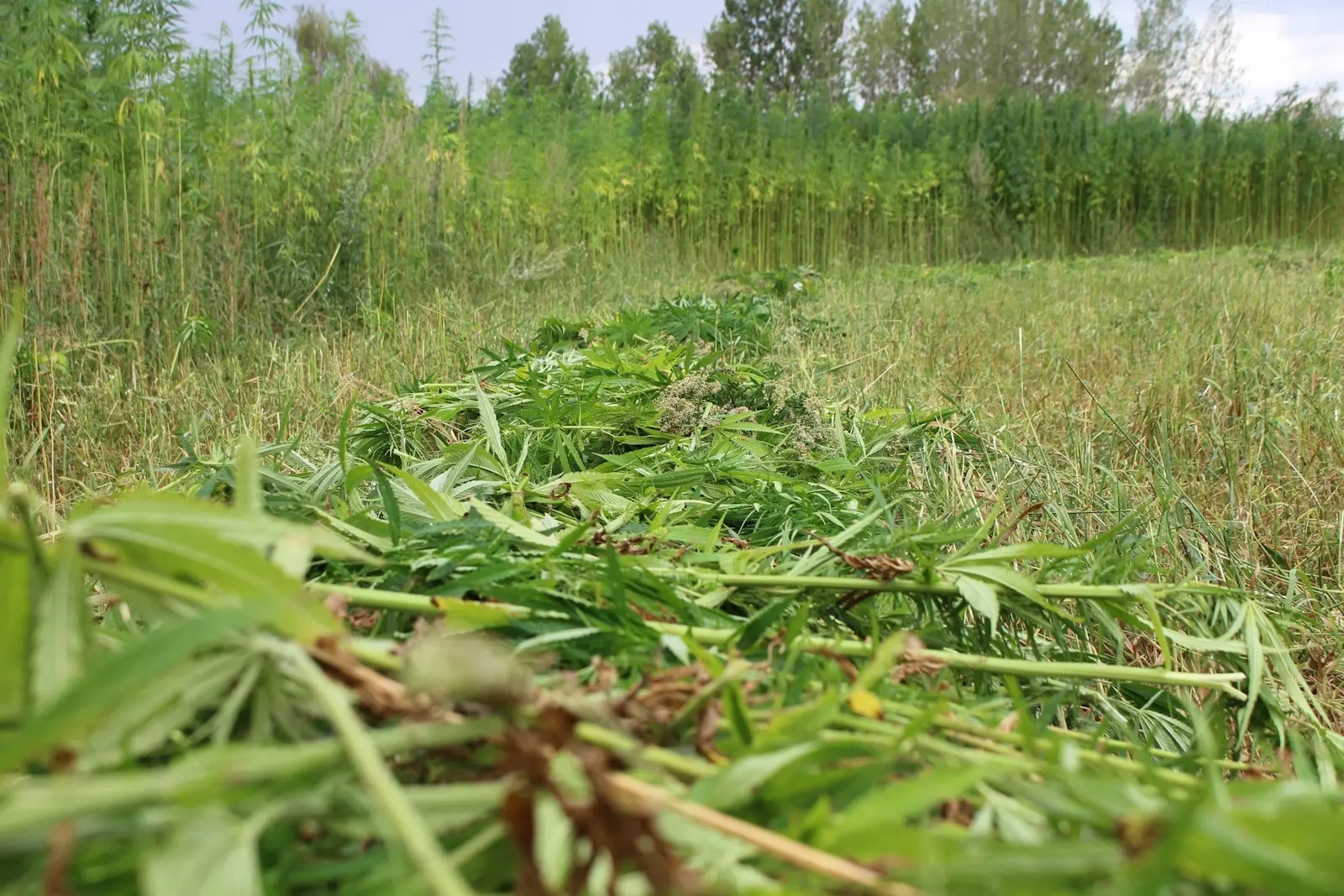
Hemp is sown from April and can grow taller than two metres. FranceAgriMer describes two ways of harvesting it. For straw only, it is cut at the end of flowering, from mid-August. For seed as well, farmers wait until September, when the seed is ripe, and harvest seed and straw. A field yields 6 to 8 tonnes of straw per hectare, about 25% of it fibre, and close to one tonne of seed.
After cutting, the straw stays on the ground for 10 to 20 days. This is retting: water and soil micro-organisms dissolve the binder that holds the fibres to the core of the stem. Scutching, a mechanical step, then separates the fibre from the shiv, the inner woody core crushed into granules.
FranceAgriMer lists the plant's agronomic strengths: no pesticide treatment, good drought resistance that removes the need for irrigation, low needs for nitrogen and phosphorus, and deep roots that structure the soil for the next crop. On climate, the figures come from the sector itself: InterChanvre claims storage of 9 to 15 tonnes of CO₂ per hectare per year, FranceAgriMer uses 15 tonnes per hectare.
Those roots have another consequence. A 2022 review in Plants describes hemp as a good candidate for phytoremediation, the removal of soil pollutants by a plant, because it tolerates accumulating various metals. A plant grown on polluted soil can therefore concentrate them in its tissues. For a CBD product, the origin of the field and heavy-metal testing matter: our article on heavy metals in CBD explains the limits and the measurement method.
3. What the plant becomes: fibre, shiv, seed
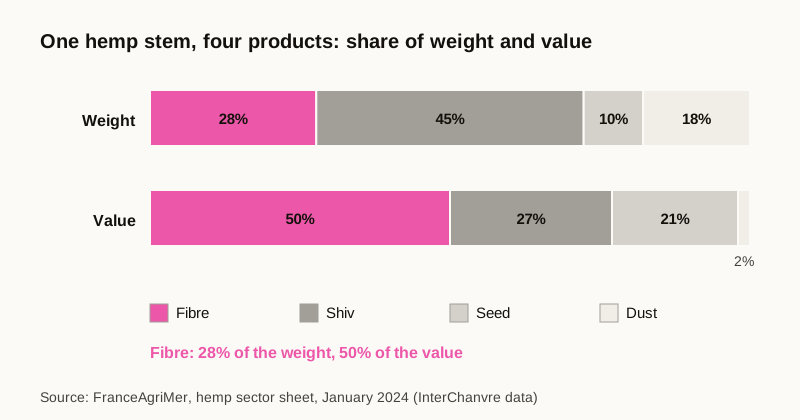
Processing yields four products, which do not weigh the same in the harvest and in turnover. According to InterChanvre data reproduced by FranceAgriMer, shiv makes up 45% of the weight but 27% of the value, and fibre 28% of the weight but 50% of the value.
| Product | Main outlets |
|---|---|
| Fibre | Paper 50%, insulation 29%, plastics 10%, textiles 10% |
| Shiv | Animal bedding 51%, mulch 28%, construction 20% |
| Seed | Animal feed 62%, human food 33% |
| Dust | Energy 80%, compost 20% |
Exports have taken off recently: 415 tonnes in the 2021/2022 season, 21,460 tonnes in 2022/2023, mostly to the European Union. Food-grade seed, pressed into oil, has nothing to do with CBD oil, as our article on hemp seed oil explains. None of the series cited isolates the area devoted to flowers. FranceAgriMer describes flower-top extracts as "a new sector in the making", held back by regulatory questions.
4. Growing it: active farmer, certified seed, 0.30% THC
The Public Health Code bans growing cannabis, "its plant and its resin", in its article R. 5132-86. Hemp can only be grown under the conditions of the order of 30 December 2021. Its article 1 sets the rule:
"Only active farmers within the meaning of the European and national regulations in force may grow hemp flowers and leaves."
Plants must come from certified seed, and selling plants and taking cuttings are both banned. The variety must be listed in the catalogue and contain at most 0.30% delta-9-THC. The EU catalogue listed 116 hemp varieties in 2024, according to the Commission, and FranceAgriMer counts 13 certified in France. Common Agricultural Policy payments require the same conditions: less than 0.3% THC and certified seed. France is one of three countries, with Poland and Romania, that pay coupled support for hemp.
The Conseil d'État annulled on 29 December 2022 the ban on selling flowers to consumers, but left these growing rules in place. A private individual therefore cannot grow hemp, even an authorised variety, as our article on CBD seeds explains. How a variety gets into the catalogue is explained in our article on authorised hemp varieties.
5. Hemp and cannabis: one species, several legal regimes
Botanically, farm hemp and THC-rich cannabis are a single species, Cannabis sativa L. What separates them is the variety, bred to produce little THC, and the measured content. The applicable law changes with the part of the plant and its use.
| Part or product | Regime in France |
|---|---|
| Seeds, seed oil | Authorised food, with no added cannabinoid extract |
| Leaves for infusion | Authorised as food, without enrichment |
| Raw flowers | Sale authorised since December 2022, not as food |
| CBD extracts to swallow | Not authorised as food or supplement |
| CBD cosmetics | Regulation (EC) No 1223/2009 on cosmetics |
| Fibre, shiv | Industrial and farm uses |
The Ministry of Agriculture restated on 20 May 2026 that foods containing CBD are not authorised under the novel food regulation, and that only seeds, their derivatives and leaves for infusion remain allowed as food. Cosmetics fall under Regulation (EC) No 1223/2009. Our overview of CBD regulation in 2026 details this split, and our article on hemp and recreational cannabis the botanical differences. The CBD flowers in the catalogue come from these authorised varieties, and the history of hemp in France traces the path from naval rope-making to today's sector.
Frequently asked questions
How many hectares of hemp are grown in France?
22,930 hectares in 2025 according to Eurostat, after 24,600 hectares in 2024. That is 61% of the hemp area of the European Union, which totalled 37,830 hectares.
Where is hemp grown in France?
Mainly in the northern half of the country, where the 7 chanvrières counted by FranceAgriMer in 2023 are located. These plants turn the straw harvested by growers into fibre, shiv and dust.
Can a private individual grow hemp in France?
No. The order of 30 December 2021 reserves the growing of flowers and leaves for active farmers, from certified seed. Outside this framework, growing counts as producing narcotics.
Is French hemp used to make CBD?
Only in part. The sector is still dominated by fibre, shiv and seed. FranceAgriMer describes flower extracts as a sector still taking shape, and no public statistic isolates the area devoted to them.
What is the yield of a hectare of hemp?
FranceAgriMer gives 6 to 8 tonnes of straw per hectare, about 25% of it fibre, and close to one tonne of seed when harvest waits for the seed to ripen.
Written by the Phytogrammes team
Every article in this journal draws on primary sources (ANSM, EFSA, EUR-Lex, peer-reviewed publications) and on the lab's own practice: batch-by-batch HPLC analyses, measured cannabinoid profiles. Our approach.
Article published on . CBD is not a medicine.