Purple Haze: history of a strain, from Hendrix to CBD flower
Purple Haze is a cannabis strain from the Haze family, most often described as a cross between Purple Thai and Haze. Its name takes up the title of a Jimi Hendrix song released in 1967, but no document links the musician to the plant. In France, a Purple Haze CBD is a hemp flower with at most 0.30% Δ⁹-THC; its colour says nothing about its composition.
- 01The Hendrix song: what do we know for certain?
- 02Where does the Purple Haze strain come from?
- 03Why do some cannabis flowers turn purple?
- 04What aromas and terpenes can you expect from a Purple Haze?
- 05What is the Purple Haze name worth on a CBD flower sold in France?
- 06How do you read the analysis of a Purple Haze CBD?
- 07Frequently asked questions
Track Records released the single "Purple Haze" in the United Kingdom on 17 March 1967, with "51st Anniversary" on the B-side (official Jimi Hendrix website, consulted on 6 October 2026). This guide separates the documented facts from the legend.
Key takeaways
- The song dates from 1967. Hendrix said it came from a dream and a science-fiction novel.
- The lineage most often cited is Purple Thai × Haze; according to another hypothesis, it would be a purple phenotype of the original Haze.
- The purple comes from anthocyanins, which the plant accumulates to a greater or lesser extent depending on its genetics and the temperature.
- To judge a Purple Haze CBD, look at the analysis of its batch: neither the colour nor the name is enough.
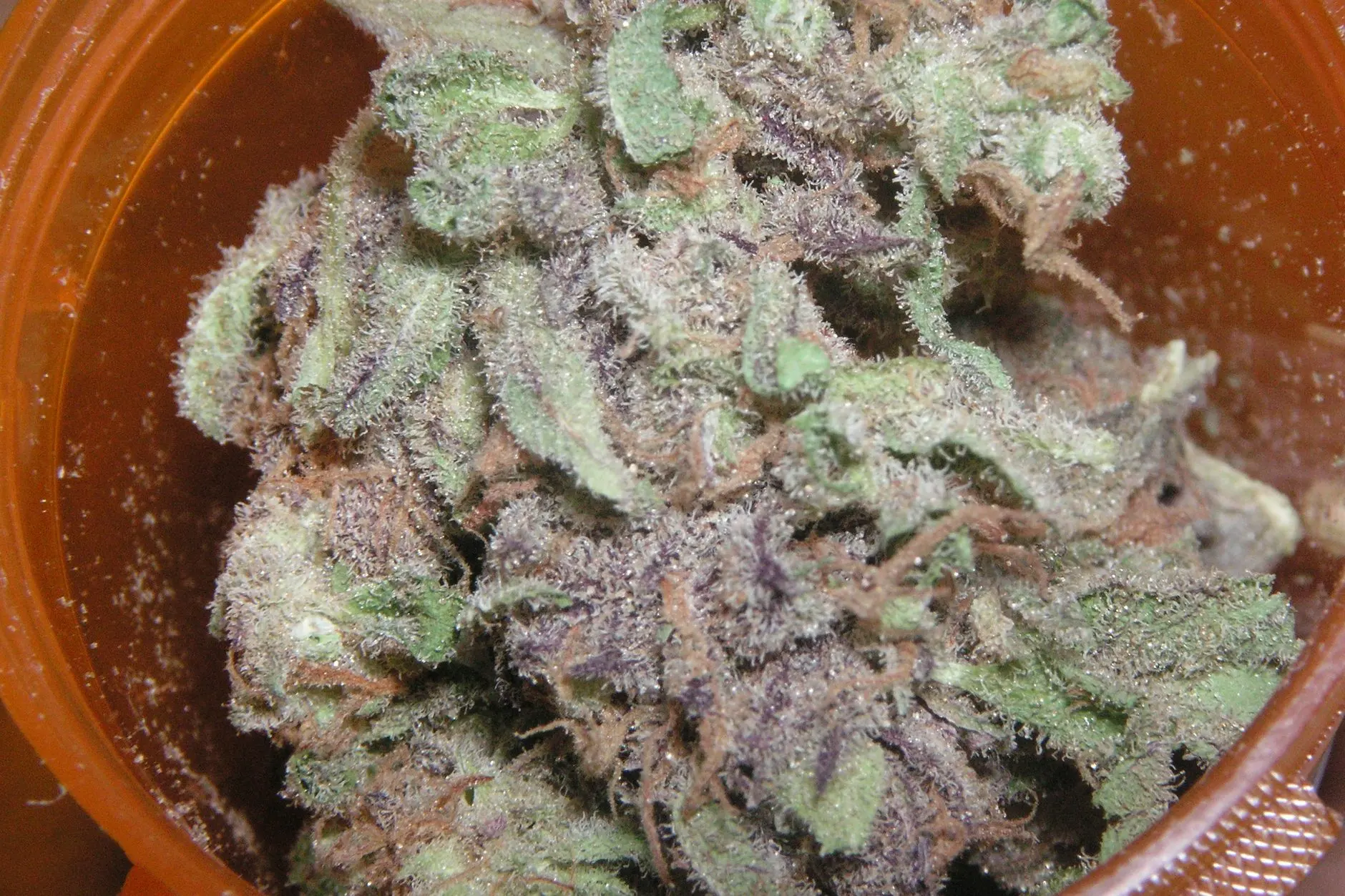
The illustration photo does not show any particular Purple Haze.
The Hendrix song: what do we know for certain?
The artist's official website sets the dates. The basic track was recorded in four hours on 11 January 1967, at the DeLane Lea studios in London, and the single came out in the United Kingdom on 17 March that year.
The lyrics have drawn far more comment. According to NPR, Hendrix said he got the idea in a dream, after reading a science-fiction novel (NPR, 2000). He himself pointed to a line in the second verse, about a girl who had supposedly put a spell on him.
The novel most often cited is Night of Light, by Philip José Farmer, published in 1966: on a distant planet, a purple haze disorients the humans (American Songwriter, 2026). According to the same article, Hendrix saw himself walking under the sea in this dream.
Some listeners heard an allusion to drugs in a few lines. The sources consulted report this reading as the listeners' own, and none ties it to a statement by Hendrix.
| Claim | Status | Source |
|---|---|---|
| Single released in the United Kingdom on 17 March 1967 | Documented | Official website |
| Lyrics born of a dream, after a science-fiction novel | Hendrix's words as reported | NPR, 2000 |
| Inspiring novel: Night of Light (1966) | Common identification | American Songwriter |
| Song about a drug | Listeners' interpretation | American Songwriter |
| Strain's popularity linked to the song | Claim with no source cited | Leafly strain page |
| Strain name borrowed from the song | Chronological inference, undocumented | Leafly, history of Haze |
Where does the Purple Haze strain come from?
None of the sources consulted names the breeder of the original Purple Haze. The Leafly page presents this sativa as a presumed descendant of Purple Thai and Haze (Leafly, consulted on 6 October 2026). It also links its popularity to the 1967 song.
According to another hypothesis, the strain would come directly from Haze. Quoted by Leafly, the cultivation specialist Dan Vinkovetsky describes four original phenotypes at the Haze Brothers, nicknamed Gold, Silver, Blue and Purple (Leafly, 2025). The name would then refer to a purple expression of Haze, with no Purple Thai input.
The dates support a name borrowed from the song. The same article places the Haze Brothers' work on Haze in Santa Cruz, California, in the early 1970s. A Purple Haze from this line would therefore be more recent than the 1967 title, from which it would most likely take its name.
For the full genealogy of the family, from Santa Cruz to the cultivars awarded in Amsterdam, see our overview of Haze strains. The series also devotes an article to two of its descendants, Lemon Haze and Amnesia Haze.
Why do some cannabis flowers turn purple?
The purple comes from anthocyanins, pigments found in many fruits and flowers. In 2021, Italian researchers analysed six cannabis genotypes grown outdoors near Bologna. In the pigmented tissues, vegetative and floral alike, the main anthocyanin was cyanidin-3-rutinoside, or keracyanin (Bassolino et al., 2023).
They describe a synthesis pathway controlled by transcription factors, including those of the MYB family. So it is genetics, first of all, that decides whether a plant can produce these pigments.
Temperature then acts on the quantity accumulated. In a study published in 2025, a CBD-dominant cultivar, chosen for its purple pigmentation, flowered for 30 days under five constant temperatures. Anthocyanins peaked at 8 °C and at 15 °C, and fell at 0.5 °C as at 22 °C (Kim et al., 2025).
The dry weight of the inflorescences and the total CBD content, on the other hand, rose with temperature (from 3.4% to 5.2% for CBD). Since colour and CBD do not follow the same curve, the authors conclude that the regulation pathways are distinct.
Depending on the season or the growing method, two batches of the same genetics can therefore look different. A green Purple Haze is not a counterfeit for all that: its name does not commit it to a colour, which the certificate does not measure anyway. Other lines also take their name from this shade, such as Purple Runtz, whose name derives from Runtz.
What aromas and terpenes can you expect from a Purple Haze?
Leafly describes sweet and earthy flavours, lifted by berries and spices. On the terpene side, the page puts myrcene first, then caryophyllene and limonene. The first is associated with herbaceous notes, the second with pepper and the third with citrus.
These pointers apply to the original Purple Haze, a THC cannabis strain. A hemp flower sold under this name has a profile that depends on selection and cultivation, and that changes again during storage. The real profile of a batch appears on its terpene analysis; our article on hemp terpenes covers this point in detail.
What is the Purple Haze name worth on a CBD flower sold in France?
Under French law, the registered variety is what counts, whatever the trade name. The order of 30 December 2021 restricts the cultivation and commercial use of hemp to varieties in the EU common catalogue or the official French catalogue. Their Δ⁹-THC content must not exceed 0.30% (Légifrance, 2021).
This text also banned the sale of raw flowers, a ban that the Conseil d'État annulled on 29 December 2022 (Conseil d'État, 2022). A Purple Haze CBD is therefore a hemp flower whose name refers to a lineage and a scent. It is compliant or not depending on the variety grown and the content measured on the batch.
The original Purple Haze, a THC cannabis strain, remains banned from sale in France. Taken up on a CBD flower, its name passes on neither its composition nor its status. It announces a scent, which the analysis will confirm or not.
How do you read the analysis of a Purple Haze CBD?
Colour does not appear on a certificate of analysis, because anthocyanins are not among the parameters usually tested on a CBD flower. Read the following lines instead, in this order:
- The batch: the number printed on the bag must appear on the certificate, along with an analysis date.
- Δ⁹-THC: its line must not exceed 0.30%. THCA, the acid form that heat converts into THC, has its own line (THCA explained).
- CBD and CBDA: the content stated on the label must be that of the certificate for the same batch.
- Terpenes: with dominant myrcene, the batch comes close to the profile described for Purple Haze. Another terpene at the top signals a gap, without making the batch non-compliant.
- Undeclared substances: the certificate must make it possible to rule out HHC, classified as a narcotic in France (see the timeline of the HHC classification).
Three addictovigilance centres, with the support of MILDECA, analysed 223 samples of CBD products bought in 2022 and 2023. Of these, 87% were below 0.3% Δ⁹-THC. In 6% of the samples, the study found neocannabinoids missing from the label, such as HHC or Δ8-THC (MILDECA, 2023).
At Phytogrammes, the Purple Haze CBD page gives a reference cannabinoid profile, in which Δ⁹-THC and THCA have separate lines. As of 18 October 2026, no laboratory certificate is published there. For the other flowers, see the CBD Laboratory page.
Worked example You have two flowers in front of you, both sold under the name Purple Haze. One has purple tints, the other is green with orange pistils, and their appearance is not enough to tell them apart. Take the certificate of each batch, compare the CBD and Δ⁹-THC lines, then the dominant terpene.
Frequently asked questions
That is the most common explanation, and the dates make it plausible: the song came out in 1967, while work on Haze began in the early 1970s. No document, however, dates the naming of the strain. Hendrix, for his part, linked his song to a dream and a science-fiction novel.
Its shade comes from anthocyanins, produced in greater or smaller quantities depending on genetics and temperature. A trial published in 2025 recorded a peak of these pigments at 8 °C and at 15 °C, and a drop at 22 °C. A green flower sold under this name can therefore be compliant.
Yes, on two conditions: it must come from a hemp variety listed in the catalogue, and its Δ⁹-THC content must not exceed 0.30%. The ban on selling raw flowers was annulled by the Conseil d'État in 2022. The trade name does not count.
The lineage most often cited is a cross of Purple Thai and Haze, which Leafly puts forward with caution. According to another reading, it would be a purple phenotype of the original Haze, one of the four described by Dan Vinkovetsky. The sources consulted associate no breeder with either version.
For the original strain, Leafly cites myrcene, then caryophyllene and limonene. A CBD flower sold under this name can have another profile, which only the terpene analysis of the batch reveals.
Sources and dates
All linked sources were consulted on 6 October 2026. The dates below refer to publications, events or updates, not the date of consultation.
- Official Jimi Hendrix website, "Purple Haze" entries: recorded on 1967-01-11, single released on 1967-03-17.
- NPR, "The Story Behind Purple Haze", Jesse Wegman: broadcast on 2000-09-18.
- American Songwriter, Clayton Edwards: published on 2026-03-17.
- Leafly, Purple Haze strain page: changing page, update date not recorded.
- Leafly, Ellen Holland, "Beyond Blue Dream: A Haze family genealogy": updated on 2025-08-11.
- Bassolino et al., "When Cannabis sativa L. Turns Purple: Biosynthesis and Accumulation of Anthocyanins", Antioxidants, vol. 12, 2023.
- Kim et al., "Anthocyanin accumulation, inflorescence dry weight and total cannabidiol content have different temperature optima in Cannabis sativa", Journal of Cannabis Research, vol. 7, 2025.
- French order of 30 December 2021 implementing Article R. 5132-86 of the French Public Health Code, Légifrance.
- Conseil d'État, decision no. 444887 of 29 December 2022.
- MILDECA, study on CBD products: published on 2023-11-09.
- Opening photo: Coaster420, public domain, via Wikimedia Commons, format adapted.
Written by the Phytogrammes team
Each journal article draws on cited primary sources: ANSM, EFSA, EUR-Lex and peer-reviewed publications. Product profiles are distinguished from documented laboratory results. Our approach.
Article published on . CBD is not a medicine.