Amnesia Haze CBD: what the name says, what the lot says
Amnesia Haze CBD is a hemp flower sold under the name of a THC cultivar bred in the Netherlands. The name points to an aroma family, the Hazes, and guarantees neither genetics nor potency. For the lot Phytogrammes sells, the reference profile shows 11.7% CBD and 0.2% Δ⁹-THC. No laboratory certificate is published, and only such a document would establish compliance with the 0.30% legal ceiling.
Key takeaways
- "Amnesia Haze" is a trade name, and no official register protects the names of cannabis varieties.
- In a 2019 study of 122 samples from 30 varieties, only four varieties were genetically consistent across their samples.
- Lot PG-26-A32B shows 11.7% CBD and 1.4% CBDA, which comes to about 12.9% CBD once the acid is converted.
- French law checks the registered variety and the Δ⁹-THC level; the name on the bag plays no part.
- A flower sold "for infusion" becomes a food, and such products have been off sale since May 2026.
Where the name Amnesia Haze comes from
Haze is a family of sativa-dominant cultivars descended from Californian hybrids of the 1970s, which Dutch seed companies later stabilised. The plants grow tall and slender and flower for a long time. Amnesia Haze is the best-known member of the line: seed-company listings attribute it to Soma Seeds and give a flowering time of 12 weeks.
Its pedigree is disputed. One account describes a blend of varieties from Afghanistan, Hawaii, Laos and Jamaica, with no named Haze among them. Another presents it as a selection of Super Silver Haze. No published genetic analysis backs either version. Our article on the Haze family of varieties traces the whole line.
The original Amnesia Haze plants are cannabis rich in THC. What France sells under that name is hemp that keeps the name and, at best, some of the aroma profile.
What the name does not guarantee
Between 2019 and 2022, three studies compared trade names with what the plants actually contained. All three dealt with THC-rich cannabis, yet their conclusion holds for any label.
- On genetics, Anna Schwabe and Mitchell McGlaughlin genotyped 122 samples from 30 varieties bought in three US states (Journal of Cannabis Research, 2019). Only four varieties showed the same genetic profile in all their samples, and every other variety had at least one outlier.
- On the sativa and indica labels, a Canadian and Dutch team analysed more than 100 samples across more than 100,000 genetic markers (Nature Plants, 2021). At the genome level, samples labelled sativa could not be told apart from those labelled indica. The label mostly followed a handful of terpenes.
- On chemistry, an analysis of commercial samples from six states found that trade names do not consistently match the measured chemical profiles (PLOS One, 2022).
French law takes no account of trade names in any case. It recognises only the varieties listed in the official catalogue, which have agricultural names such as Futura 75 or Santhica 27. As our article on the European catalogue of hemp varieties explains, "Amnesia Haze" has no regulatory meaning.
The reference profile of the lot on sale
The lot analysis is the only document that describes the flower you actually buy. For lot PG-26-A32B, the Amnesia Haze CBD product page gives the reference profile below; as of 18 October 2026, no laboratory certificate is published there.
| Cannabinoid | Level shown | What it is |
|---|---|---|
| CBD | 11.7% | Cannabidiol, neutral form |
| CBDA | 1.4% | Acid form of CBD, converted by heat |
| CBG | 0.7% | Cannabigerol, precursor of the other cannabinoids |
| CBN | 0.2% | Cannabinol, formed when THC oxidises |
| Δ⁹-THC | 0.2% | The psychoactive molecule, capped at 0.30% |
| THCA | 0.1% | Acid form of THC, not psychoactive as such |
The plant makes its cannabinoids in acid form. Heat strips a carboxyl group from CBDA, which loses about 12% of its mass in the process, so it counts as 0.877 × CBDA. That gives 11.7 + 0.877 × 1.4 ≈ 12.9% CBD available after heating.
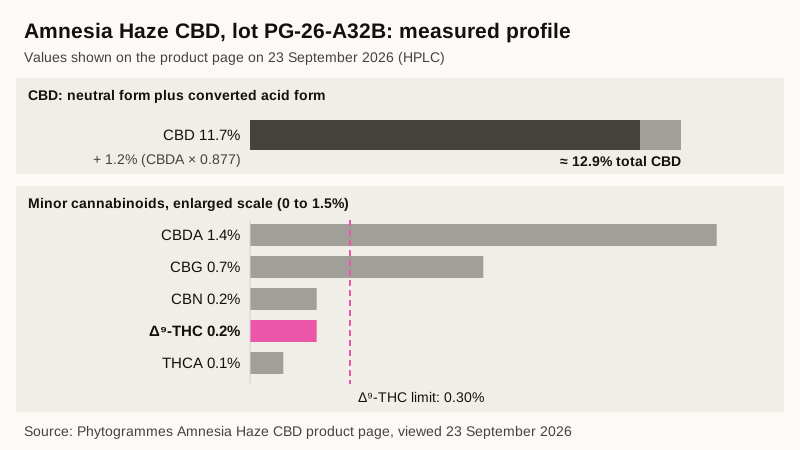
These are the levels shown on 23 September 2026. A new lot will carry different values under the same name. Our guide to reading a certificate of analysis covers each line, and the article on THCA explains the status of THC's acid form.
Aroma: what to expect
A flower's smell comes from its terpenes, volatile compounds made in the same glands as the cannabinoids. More than 200 have been reported in the plant, Ethan Russo notes in his 2011 review in the British Journal of Pharmacology. Together they usually account for less than 1% of the flower.
The product page describes this lot, grown in open fields, as peppery and dry, dominated by α-pinene and β-caryophyllene. Another grower or another harvest may produce a more lemony Amnesia Haze, since the 2021 study found that trade labels differ on precisely a few terpenes. Our article on hemp terpenes describes the main compounds.
The legal framework in France
In law, the name changes nothing. The decree of 30 December 2021 allows only Cannabis sativa L. varieties listed in the common catalogue whose Δ⁹-THC content is not above 0.30%. On 29 December 2022, the Conseil d'État annulled the ban on selling raw flowers and leaves that the same decree contained. Our article on the legal THC level explains the threshold.
Two more limits apply. The ANSM classed HHC and two derivatives as narcotics from 13 June 2023, then H4CBD, THCP and other molecules from 3 June 2024, so a flower containing them is illegal whatever it is called. A flower presented as a food also leaves the hemp framework. On 20 May 2026, the Ministry of Agriculture stated that foods containing CBD must be withdrawn from the market. The exemption covers only seeds and leaves meant for water infusion, and flowering tops are excluded from it.
Price: per gram and per milligram of CBD
The price per gram is only part of the picture, because the three Haze flowers in the catalogue differ in potency. Counted per 100 mg of CBD, they rank differently.
| Flower | Stated CBD | Price at 2 g | 100 mg of CBD at 2 g | Price at 50 g | 100 mg of CBD at 50 g |
|---|---|---|---|---|---|
| Amnesia Haze | 11.7% | €6.45/g | €5.51 | €2.42/g | €2.07 |
| Lemon Haze | 7.7% | €4.95/g | €6.43 | €1.92/g | €2.49 |
| Purple Haze | 11.1% | €4.95/g | €4.46 | €1.92/g | €1.73 |
Amnesia Haze has the highest price per gram, yet it costs less than Lemon Haze per milligram of CBD. These prices were displayed on 23 September 2026, and the quantity you buy weighs more than the variety. The CBD flowers category lists the other products.
Frequently asked questions
The lot on sale shows a reference profile of 0.2% Δ⁹-THC, under a 0.30% ceiling; only a laboratory certificate would establish compliance. CBD does not produce the psychoactive effect of THC. The flower is still a product for adults, and it does contain traces of THC.
No. It takes the name and part of the aroma profile, but it is hemp whose THC stays below 0.30%. The name alone proves no direct genetic link.
Potency depends on the actual genetics, the growing conditions, the harvest date and the drying. Two lots sold under one name can be several points apart, so the lot analysis is what counts.
The flower is sold raw and is not a food. Since May 2026, infusions made from flowering tops containing CBD have been withdrawn from sale in France, as they lack authorisation under the novel food regulation.
Written by the Phytogrammes team
Each journal article draws on cited primary sources: ANSM, EFSA, EUR-Lex and peer-reviewed publications. Product profiles are distinguished from documented laboratory results. Our approach.
Article published on . CBD is not a medicine.