Lemon Haze CBD: a hazy origin, a lemon aroma to check
Lemon Haze is a cannabis variety name with no documented breeder or creation date: at least seven seed companies sell a version, with different parents. Its lemon smell is credited to limonene, a common hemp terpene, but the name does not guarantee that profile. In France, only a hemp flower bearing the name and containing no more than 0.30% Δ⁹-THC is legal; its possible side effects are those of CBD and of combustion.
Contents
> Key takeaways > > - The SeedFinder database lists seven "Lemon Haze" varieties from seven seed companies, with no original breeder identified. > - Super Lemon Haze, a related line, won the High Times Cannabis Cup in Amsterdam in 2008 and 2009. > - Limonene, the terpene in lemon zest, is one of the most common monoterpenes in cannabis. > - In a 2019 study, 26 varieties out of 30 had at least one sample genetically different from the others with the same name. > - At the doses of the medicine Epidyolex, the most frequent side effect of CBD is somnolence (23% of patients).
Where Lemon Haze comes from: what is documented
Almost nothing is on record about its origin. The seed database SeedFinder lists seven varieties sold as "Lemon Haze" by seven different companies. None names an original breeder or a year of creation. The stated parents change from one seller to the next: Lemon Skunk × Silver Haze at one, Lemon Skunk × Amnesia Haze at another.
The "Lemon Skunk × Silver Haze" pedigree, often presented as the only one, is therefore just one version among several. The name describes a style, lemony and from the Haze line, more than a specific plant.
The Haze family itself is better described. A review by Robert Clarke and Mark Merlin, published in 2016 in Critical Reviews in Plant Sciences, traces the first varieties of this type to 1970s hybrids, bred by crossing local varieties from Mexico or Jamaica with later-ripening ones from Colombia, India, Panama or Thailand. "Original Haze" is among those early varieties. Our article on the Haze family traces the line, and the one on Amnesia Haze covers another descendant.
Super Lemon Haze, often confused with Lemon Haze, is better traced. Its breeder, Green House Seeds, describes it as a Lemon Skunk × Super Silver Haze cross selected in the late 2000s. It won the overall ranking of the High Times Cannabis Cup in Amsterdam in 2008 and in 2009, not the sativa category, as is sometimes claimed.
Why it smells of lemon: limonene
The smell comes from terpenes, the aromatic compounds made in the trichomes, the tiny glands that cover the flower. Researcher Ethan Russo, in a 2011 review in the British Journal of Pharmacology, describes d-limonene as common to lemon and other citrus essential oils, and as the second most widely distributed terpenoid in nature. In cannabis, monoterpenes usually dominate: limonene, myrcene, pinene.
So limonene is not specific to Lemon Haze. The analysis of 89,923 US samples, published in 2022, sorts terpene profiles into three families, one of which pairs β-caryophyllene with limonene. Varieties with very different names end up in it. Our article on hemp terpenes describes each molecule.
On the research side, a trial published in 2024 in Drug and Alcohol Dependence tested vaporised limonene in 20 adults, double-blind. In an extra session run with 12 of them, 15 mg of d-limonene combined with 30 mg of THC lowered anxiety and paranoia ratings compared with THC alone. Limonene alone did not differ from placebo. The study was about THC, not CBD, and says nothing about a hemp flower.
The name does not guarantee the profile
Two plants sold under the same name can be genetically different. A study by Schwabe and McGlaughlin, published in 2019 in the Journal of Cannabis Research, analysed 122 samples of 30 varieties bought from 20 dispensaries in three US states. For 26 varieties out of 30, at least one sample differed genetically from the others with the same name. Only 4 were consistent.
For a Lemon Haze CBD flower, the only way to know the real profile is the terpene section of the certificate of analysis, when the lab measured it. If limonene is not at the top, the lemon aroma owes more to the name than to the chemistry of the batch. Our guide to reading a certificate of analysis shows where to find that line, next to the Δ⁹-THC.
Side effects of Lemon Haze CBD
A compliant Lemon Haze CBD does not get you high: it contains no more than 0.30% Δ⁹-THC, and CBD does not produce the psychoactive effect of THC. That does not mean it has no effect on the body. Three sources of risk are documented.
First, CBD itself. The World Health Organization considers it generally well tolerated, with a good safety profile, noting that side effects may come from interactions with other medicines. The most precise frequencies come from Epidyolex, the only authorised CBD-based medicine, prescribed for certain epilepsies. At doses of 10 to 25 mg per kilo per day, its leaflet mainly lists somnolence, decreased appetite and diarrhoea. Liver enzymes rising above three times the normal limit affected 12% of patients, against under 1% on placebo.
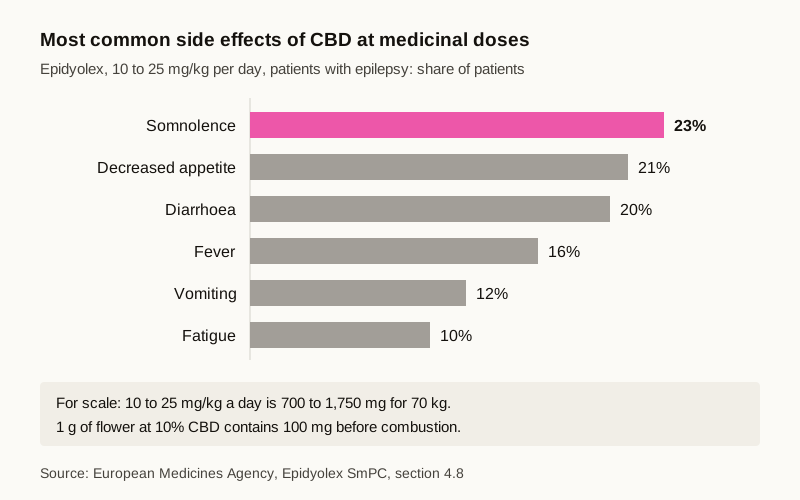
These doses are high: 700 to 1,750 mg a day for a 70 kg adult. One gram of flower at 10% CBD contains 100 mg before combustion, and only part of it is absorbed. Interactions remain the main point to watch: our article on CBD and medicines covers them.
Second, combustion. The US health authorities point out that cannabis smoke contains many of the same toxins, irritants and carcinogens as tobacco smoke. A smoked CBD flower is no exception. Our article on vaporising CBD describes another way to use it.
Third, the real contents. In 2025, the French agencies ANSES and ANSM reported several hundred poisonings linked to products sold as CBD, most often because of synthetic cannabinoids or THC above 0.3%. They advise drivers against these products, as even a small amount of THC can cause drowsiness.
Lemon Haze CBD in France
Selling hemp flowers has been legal since the Conseil d'État annulled their ban on 29 December 2022, provided the variety is authorised and Δ⁹-THC does not exceed 0.30%. The original, THC-rich Lemon Haze remains a narcotic. A Lemon Haze CBD is a hemp flower selected to come close to it in aroma.
The page for our Lemon Haze CBD shows, as of 22 September 2026, prices from €4.95 per gram for 2 g to €1.92 per gram for 50 g. Other varieties are grouped in the CBD flowers category.
Frequently asked questions
What is Lemon Haze?
A cannabis variety name from the Haze family, known for its lemon smell. Several seed companies sell a version, with different parents, most often a Lemon Skunk crossed with a Haze. The CBD version is a hemp flower with no more than 0.30% Δ⁹-THC.
Does Lemon Haze CBD get you high?
No, if it is compliant. CBD does not produce the psychoactive effect of THC, and Δ⁹-THC stays at 0.30% or below. Even at low doses, THC can cause drowsiness, ANSES and ANSM point out.
What are the side effects of Lemon Haze CBD?
Those of CBD, mostly described at high doses: somnolence, decreased appetite, digestive upset, raised liver enzymes, interactions with some medicines. Add the risks specific to smoke. Seek medical advice if you take medication, are pregnant or breastfeeding.
Why does Lemon Haze smell of lemon?
Because of limonene, the terpene in lemon zest, which is common in cannabis. The name does not guarantee it: only the terpene profile on the certificate of analysis tells you what the batch contains.
What is the difference between Lemon Haze and Super Lemon Haze?
Super Lemon Haze is a Green House Seeds variety, a Lemon Skunk × Super Silver Haze cross, awarded in 2008 and 2009. Lemon Haze is a more generic name, used by several seed companies for different crosses.
Written by the Phytogrammes team
Every article in this journal draws on primary sources (ANSM, EFSA, EUR-Lex, peer-reviewed publications) and on the lab's own practice: batch-by-batch HPLC analyses, measured cannabinoid profiles. Our approach.
Article published on . CBD is not a medicine.