Candy Kush CBD: what the name says, what the lab says
Candy Kush is a variety name used by cannabis and CBD hemp growers, often linked to a sweet aroma. It is a trade name: nothing guarantees that a flower sold under it has the same genetics, terpenes or CBD content as another. In France, a Candy Kush flower is legal on the same terms as any CBD flower, with no more than 0.30% Δ⁹-THC, and only the lot's analysis tells you what it contains.
Contents
> Key takeaways > > - A variety name does not guarantee genetics: two "Candy Kush" can be two different plants. > - A 2019 study of 30 varieties bought in three US states found genetic differences within most of them. > - Across six "Kush" flowers in the catalogue, measured CBD ranges from 6.9 to 13.5%. > - French law looks not at the name but at the Δ⁹-THC level, 0.30% at most, and the variety of origin. > - The Phytogrammes catalogue does not offer Candy Kush as of 23 September 2026.
Candy Kush: a trade name, not guaranteed genetics
Nothing stops one grower from calling a plant "Candy Kush" that comes from different crosses than another grower's. Descriptions online give varying parents for the name: we keep none of them, for lack of a verifiable source.
Research has measured this blur. Biologists at the University of Northern Colorado analysed in 2019 30 varieties bought from dispensaries in three US states. Most varieties contained at least one sample genetically distant from the others sold under the same name. The authors conclude that consumers may receive inconsistent products under one name. They also point out that more than 2,000 variety names circulate in the United States, with no registration to verify them.
For a buyer, the upshot is simple: "Candy Kush" describes the grower's intention, not what is in the bag.
What "Kush" suggests, and what it leaves out
In the trade, "Kush" works as a family name for many varieties. The Phytogrammes catalogue alone has six flowers whose name contains it. Our article on OG Kush traces the history of the best-known one.
The word suggests an aroma profile, but measurements call for caution. A study published in 2022 in PLOS ONE analysed the cannabinoids and terpenes of 89,923 samples from six US states. It identifies three main terpene profiles: beta-caryophyllene and limonene, myrcene and pinene, terpinolene and myrcene. Commercial labels do not consistently line up with these profiles, even if some names lean towards one of them.
The "candy" in the name promises a sweet note. Only a terpene analysis of the lot, by gas chromatography, tells you which compounds carry it. Our article on hemp terpenes explains how to read one.
Six "Kush" flowers in the catalogue, measured lot by lot
With no Candy Kush in the catalogue, flowers from the same family show what a shared name hides. The figures below come from the product pages, current lot, read on 23 September 2026.
| Flower | Lot | CBD | CBG | Δ⁹-THC |
|---|---|---|---|---|
| Guava Kush | PG-26-263D | 13.5% | 0.7% | 0.2% |
| Diamond Kush | PG-26-69D2 | 12.7% | 0.3% | 0.3% |
| Strawberry Lemon Kush | PG-26-8C47 | 10.7% | 0.3% | 0.2% |
| Strawberry Kush | PG-26-4457 | 9.3% | 0.6% | 0.2% |
| Kosher Kush | PG-26-A1F2 | 7.4% | 0.6% | 0.2% |
| Lemon Kush | PG-26-C3EE | 6.9% | 0.4% | 0.3% |
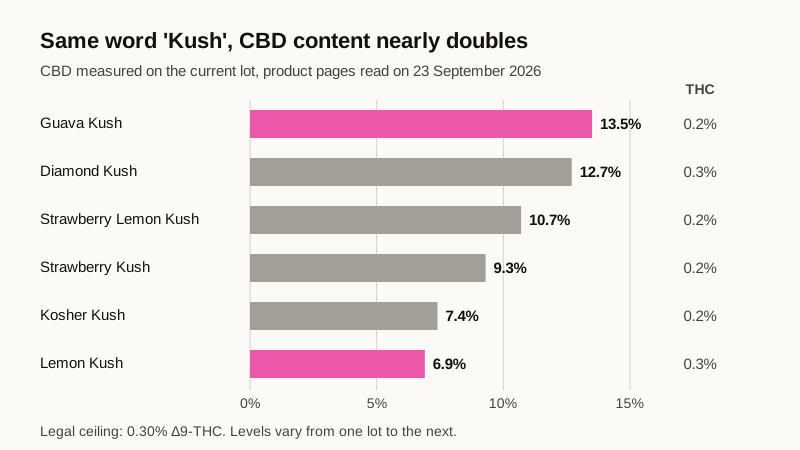
The same word therefore covers CBD levels that nearly double from one flower to another. Two of these flowers show 0.3% Δ⁹-THC, rounded to one decimal: that is the first figure to read on an analysis. Our comparison of Kush CBD lot by lot covers these flowers in detail, and the CBD flowers category lists them all.
What French law says
The variety name does not matter in law. The order of 30 December 2021 authorises the cultivation and sale of Cannabis sativa L. varieties listed in the official catalogues whose Δ⁹-THC content does not exceed 0.30%. On 29 December 2022 the Conseil d'État annulled the ban on selling raw flowers and leaves that this order contained. Our article on the legal THC level explains the threshold.
The trade name printed on a bag is not necessarily the name of the variety listed in the catalogue. The order targets the listed variety and the measured level, not the sales name.
Another point to watch: semi-synthetic cannabinoids sometimes added to flowers. The ANSM classified HHC as a narcotic from 13 June 2023, then H4CBD, THCP and other derivatives from 3 June 2024. A Candy Kush sprayed with one of them would be illegal, whatever its THC level.
Checking a Candy Kush before you buy
Whether it is a flower or a hash sold under the Candy Kush name, the check follows the same order:
- The lot number. The certificate of analysis must carry the same one as the bag.
- Δ⁹-THC. 0.30% at most. Be wary of a missing "total THC" value or an undated certificate.
- Semi-synthetics. If the laboratory looked for them, HHC, H4CBD and THCP must be absent.
- CBD and terpenes. They, not the name, describe the flower.
- The laboratory. Check that its name and accreditation appear on the document.
Our guide to reading a certificate of analysis goes through these lines one by one. For a hash, the variety name tells you the starting plant, not the method: the article is CBD hash legal covers resins.
One last practical point. A compliant flower contains traces of THC, which can be enough to make a saliva drug test positive: our guide to CBD and drug testing explains why.
Frequently asked questions
Does Candy Kush contain THC?
Yes, in trace amounts. A CBD flower sold in France must contain no more than 0.30% Δ⁹-THC. The exact figure is on the lot's certificate of analysis.
Does Candy Kush get you high?
Below 0.30% Δ⁹-THC, it does not produce the effect of a THC-rich variety with a similar name. The risk lies in the actual product: a non-compliant THC level or an added semi-synthetic cannabinoid.
Is Candy Kush the same plant at every seller?
Not necessarily. Nothing guarantees shared genetics under this name, and a 2019 study found genetic differences within most of the 30 varieties tested under a single name.
Where can I find a flower close to Candy Kush?
The Phytogrammes catalogue does not offer one. The six "Kush" flowers measured above range from 6.9 to 13.5% CBD. Choose on the lot's level and terpene profile rather than on the name.
Can I travel with Candy Kush flowers bought in France?
It is risky: the status of CBD flowers varies from country to country. Check the law of your destination before you leave.
Written by the Phytogrammes team
Every article in this journal draws on primary sources (ANSM, EFSA, EUR-Lex, peer-reviewed publications) and on the lab's own practice: batch-by-batch HPLC analyses, measured cannabinoid profiles. Our approach.
Article published on . CBD is not a medicine.