Lebanese hash: the Bekaa, sieving and the red and blond nicknames
Lebanese hash is a cannabis resin obtained by beating and then sieving dried plants, mostly in the Bekaa plain, before pressing it. According to the Lebanese business press, the nicknames "red" and "yellow", or "blond", depend on the harvest period. On a CBD hash sold in France, "Lebanese" designates a style of resin and says nothing about its origin.
- 01Where does Lebanese hash come from?
- 02How is Lebanese hash made?
- 03Red or blond: what do these names mean?
- 04What place does Lebanon hold today?
- 05What does "Lebanese" mean on a CBD hash sold in France?
- 06How do you read the analysis of a "Lebanese" CBD hash?
- 07What are the risks of street Lebanese hash?
- 08Frequently asked questions
Bekaa hashish has been leaving Lebanon since at least the 1920s. According to the UN Bulletin on Narcotics (UNODC, Bulletin on Narcotics, 1965), the 1928 harvest was estimated at 60 tonnes, 90% of which went to Egypt.
This article is documentary. It describes an illicit product to shed light on a vocabulary and is in no way a buying guide.
Key takeaways
- The traditional Lebanese method beats and sieves dried plants to separate the resin, which is then pressed.
- Until the early 1990s, the Bekaa produced "Red Lebanese" in large quantities.
- "Red" and "yellow" designate a harvest period, and no source consulted links these colours to a content.
- Sold in France as "Lebanese", a hash must come from an authorised hemp variety and contain at most 0.30% Δ⁹-THC.
Where does Lebanese hash come from?
The Bekaa, an agricultural plain in the east of the country, concentrates production. UN archives attest to an old trade there: the 1965 Bulletin on Narcotics presents Sinai as a route for Lebanese hashish towards the Nile valley.
From the 1960s, the Lebanese authorities looked for replacement crops. According to the 1967 Bulletin, the Lebanese observer to the Commission on Narcotic Drugs announced a plan in favour of sunflower (UNODC, Bulletin on Narcotics, 1967). The State supplied the seeds and fertiliser and guaranteed a price of about twice the market price.
Exports grew all the same. During the 1960s and 1970s, Morocco and Lebanon became major hashish exporters (Afsahi and Darwich, 2016), to Western and Central Europe, Africa and the Middle East. These authors, who have been researching in the Bekaa since 1995, also note that there is no local market in Lebanon.
Researchers Pierre-Arnaud Chouvy and Kenza Afsahi then identify a turning point (International Journal of Drug Policy, 2014). Until the early 1990s, the Bekaa produced a renowned hash in large quantities, "Red Lebanon". In the 1980s and 1990s, regional wars and drug control in Lebanon weighed on this production, according to them. Morocco is said to have benefited, through a displacement effect.
Botanically, Lebanese cannabis fits poorly into the two usual types. In 2020, a classification noted intermediate forms in many herbarium specimens from the Middle East, Lebanon included (McPartland and Small, PhytoKeys, 2020). For its authors, Central Asian genetics may have arrived there in the 13th century, then in the 17th.
How is Lebanese hash made?
Dry sieving is practised there, which Chouvy and Afsahi describe as the preferred technique in the Bekaa. Drawing on ethnobotanist Robert Clarke, they consider it likely that Morocco borrowed its beating and sieving gestures from Lebanon, by indirect routes.
The Bulletin on Narcotics published a detailed description of these gestures in the Levant in 1950 (UNODC, Bulletin on Narcotics, 1950). Once pulled up, the plants dry on racks before being beaten. The resin falls as dust, which is collected on cloths, then sieved.
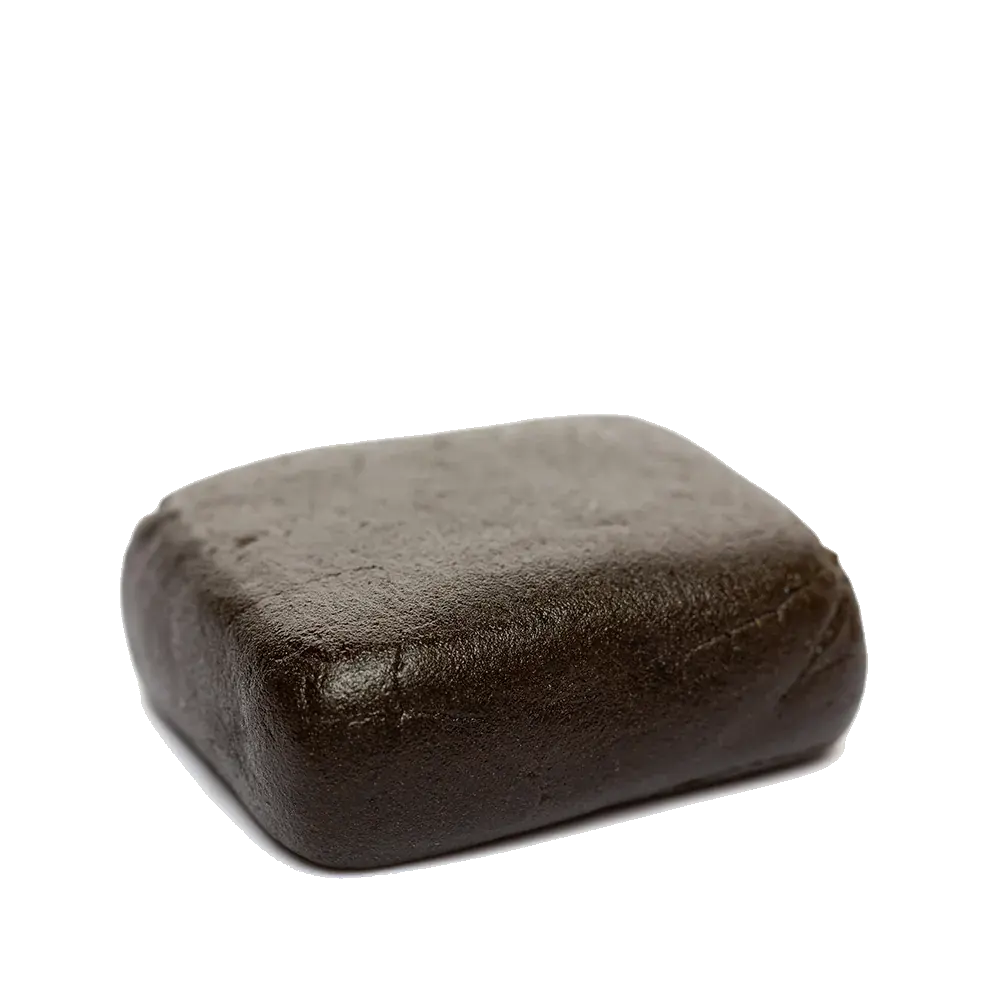
Cloth bags, sometimes skin ones, are then filled with it and exposed for a few moments to the steam of boiling water before being stacked and pressed hard. Out come flattened packets with rounded edges, the "turbahs" of the Levant, about 25 cm by 15 to 16, and 4 to 5 cm thick. They weigh from 500 grams to 2 kilos.
| Step | Levant, 1950 description | Afghanistan, 2009 survey |
|---|---|---|
| Material | Plants pulled up, dried on racks | Plants cut, dried in the field then on the farm |
| Separation | Beating, dust collected on cloths, sieving | Beating on a drum, three sievings on cloth |
| Shaping | Bags steamed, stacked and pressed | Heated kneading, by hand or by machine |
| Format | Flattened packets of 0.5 to 2 kg | Hand-rolled pieces, moulded blocks |
Both traditions separate the resin dry, then shape it differently. Afghan hash is heated and kneaded. Moroccan hash from the Rif shares with Lebanon sieving followed by pressing.
Charas follows another logic: the resin is rubbed by hand from fresh plants, still standing. Chouvy and Afsahi place this process only in the Indian subcontinent; the charas entry in the lexicon describes it.
Red or blond: what do these names mean?
The most direct explanation found in the press comes from the business magazine Le Commerce du Levant, in 2018. According to it, the nickname "Red Lebanese" or "Yellow Lebanese" depends on the point in the season when the harvest takes place (Le Commerce du Levant, 2018).
Its English edition uses "red" and "gold". In everyday French, people also say "blond libanais" (Lebanese blond) for the second category.
The sources consulted say no more: neither which harvest is the earlier one, nor what happens next during drying. The explanations in circulation (early harvest for blond, ripening or ageing for red) come from sellers and forums, and no published study supports them.
The 2014 study presents "Red Lebanon" as the renowned hash of the Bekaa, without giving any measurement that would link its colour to a THC content.
On a CBD hash, colour proves nothing either. Variety, share of plant matter, oxidation or additives can explain it, and the eye cannot decide. The article on the colour of a CBD resin details these four causes.
What place does Lebanon hold today?
For resin, Lebanon still ranks among the major countries of origin (UNODC, World Drug Report 2021, 2021). In seizures from 2015 to 2019, it is among the most cited origins, behind Morocco and Afghanistan, alongside Pakistan.
Six countries in the Near and Middle East, including Jordan and Syria, report that the resin they seize comes mainly from Lebanon. In Cyprus, about 60% of the resin seized in 2019 had this origin.
For cultivated areas, only press estimates are available. The magazine put the crops at between 20,000 and 30,000 hectares (Le Commerce du Levant, English edition, 2019). It reasons in dunams, at ten dunams per hectare. One dunam would give 1,000 to 2,000 kg of raw cannabis, or 4 to 8 kg of resin.
In 2020, the law changed: on 21 April, the Lebanese Parliament legalised the cultivation of cannabis for medical purposes. According to an analysis published in 2022, the text only concerns cannabis with less than 1% THC (El-Khoury et al., 2022). It also sets up a regulatory authority in charge of issuing licences.
Traditional, THC-rich Bekaa hashish therefore remains outside this framework. Nor is the Lebanese threshold the French one, set at 0.30%: a product that complies with Lebanese law is not saleable in France for all that.
What does "Lebanese" mean on a CBD hash sold in France?
Article 1 of the French order of 30 December 2021 requires a variety of Cannabis sativa L. listed in the EU or French catalogue (Légifrance, consulted on 6 October 2026). Its Δ⁹-THC cannot exceed 0.30%, a ceiling that also applies to extracts and to products that contain them.
Traditional Lebanese hashish therefore remains a narcotic, and a "Lebanese" CBD hash cannot be that product. On a label, the word describes a style of resin: dry-sieved, pressed into a slab, sometimes reddish or blond. The variety, the country of cultivation and the content do not appear in it.
The words "red" or "blond" refer to a colour or to a market name. For the dominant cannabinoid and Δ⁹-THC, only the batch analysis counts. The three pitfalls of legal CBD hash complete this framework: added synthetic cannabinoid, driving after use, food use.
How do you read the analysis of a "Lebanese" CBD hash?
Read it line by line, starting from the batch number.
| Line | What it must show | What it does not prove |
|---|---|---|
| Batch number | The same number as on the bag | The quality of another batch |
| Laboratory | Name, ISO 17025 accreditation and its scope | The compliance of a product not analysed |
| Δ⁹-THC | A value of at most 0.30%, with its measurement uncertainty | The absence of a molecule not tested for |
| Dominant cannabinoid | CBD or CBG, as a measured percentage | A link with the colour or the name |
| CBN | A measured value | A precise age of the resin |
| Contaminants | Heavy metals and pesticides, if the report includes them | The absence of contaminants not analysed |
Our guide to reading a certificate of analysis shows where to find each of these lines. The article on Afghan hash, cited above, gives an example with figures, taking a real batch line by line.
At Phytogrammes, the pages in the CBD resins, hash and pollen category give a batch reference and a reference profile for the resins; no laboratory certificate is published there as of 18 October 2026.
Worked example A CBD hash presented as "red Lebanese" shows a CBD content, with no batch number at all. Ask for the certificate of the batch on sale, then check that its number is the one on the bag. Without a match, the figure displayed does not describe your product, whatever its colour.
What are the risks of street Lebanese hash?
Outside the CBD framework, Lebanese hash remains a narcotic, whatever its colour, and nothing indicates its content at purchase. In France, resin contained an average of 29% THC in 2023, against 12.3% in 2011 (OFDT, consulted on 6 October 2026).
The name of a colour tells you nothing about this content, nor about any cutting. The signs supposed to give away cut hashish do not replace a laboratory analysis. If you feel unwell after using it, call 15, the French emergency medical number.
Frequently asked questions
No. Taken from THC-rich cannabis, traditional Lebanese hash is a narcotic. To be sold legally, a resin must come from a catalogued hemp variety and contain at most 0.30% Δ⁹-THC.
According to Le Commerce du Levant, the nickname depends on the point in the season when the harvest takes place. The sources consulted stop there, and none links the colour to a THC or CBD content.
By dry sieving: the dried plants are beaten, then the resin powder is sieved and pressed. A 1950 description mentions cloth bags passed through steam, stacked, then pressed into flattened packets.
On 21 April 2020, Parliament legalised the cultivation of cannabis for medical purposes. An analysis published in 2022 specifies that the text only concerns cannabis with less than 1% THC. Traditional, THC-rich hashish therefore remains outside this framework.
The name does not tell you. In France, the rule concerns the variety, which must appear in the EU or French catalogue. "Lebanese" designates a style of sieved and pressed resin, and it is the traceability of the batch that tells you where it comes from.
Sources and dates
All linked sources were consulted on 6 October 2026. The dates below refer to publications or records.
- UNODC, Bulletin on Narcotics: articles from 1950, 1965 and 1967; harvest estimated for 1928.
- Afsahi and Darwich, International Journal of Drug Policy, vol. 31: published in 2016.
- Chouvy and Afsahi, International Journal of Drug Policy, vol. 25: published in 2014.
- McPartland and Small, PhytoKeys, vol. 144: published in 2020.
- Le Commerce du Levant: French edition of 29 November 2018, English edition of 3 January 2019.
- El-Khoury et al., Cannabis and Cannabinoid Research, vol. 7: published in 2022; law of 21 April 2020.
- UNODC, World Drug Report 2021, booklet 3: mentions from 2015 to 2019.
- French order of 30 December 2021, Article 1: version in force since 29 December 2022.
- OFDT, "Cannabis" summary: average contents for 2011 and 2023.
Written by the Phytogrammes team
Each journal article draws on cited primary sources: ANSM, EFSA, EUR-Lex and peer-reviewed publications. Product profiles are distinguished from documented laboratory results. Our approach.
Article published on . CBD is not a medicine.