Smoking hemp in France: legal, but not risk-free
Smoking a compliant hemp flower is not an offence in France: the law sets a maximum Δ⁹-THC content of 0.30%, not a way of consuming it. Three limits remain. Smoke from any plant contains the same families of toxic compounds as tobacco smoke, a flower at 0.30% holds up to 3 mg of THC per gram, and that THC can be enough to trigger a positive roadside drug test.
Contents
> Key takeaways > > - The provision that banned the "consumption" of hemp flowers was annulled by the Conseil d'État on 29 December 2022. > - The French Public Health Code has a category of "herbal products for smoking", with a mandatory health warning. > - Smoking is still banned in places for collective use, whether or not the cigarette contains tobacco. > - Hemp smoke contains ammonia, hydrogen cyanide and known carcinogens, with or without THC. > - A positive roadside test carries up to 3 years in prison and a €9,000 fine, even after a legal flower.
What the law regulates: the plant, not how you use it
The legal framework for hemp is the decree of 30 December 2021. It authorises varieties of Cannabis sativa L. listed in the official catalogues whose Δ⁹-THC content does not exceed 0.30%. Its original version went further. Its paragraph II banned "the sale to consumers of raw flowers or leaves", and also "their possession by consumers and their consumption".
The Conseil d'État annulled that paragraph on 29 December 2022. The judges found a blanket ban disproportionate, since no public health risk had been established below that THC threshold. Since then, buying, holding and consuming a compliant flower is no longer prohibited. No text says how it should be consumed.
French law even has a category for tobacco-free cigarettes. The Public Health Code devotes a chapter to herbal products for smoking other than tobacco (articles L3514-1 to L3514-6). They are defined as plant products without tobacco "that can be consumed through a combustion process". Their packaging must carry a health warning, and the manufacturer must declare their ingredients before placing them on the market.
Many shops still print "not for smoking" or "aromatic use" on their bags. That wording is the seller's presentation choice, not a legal obligation.
Then there is the place. Article L3512-8 bans "smoking in places for collective use" and on public transport. The text targets the act of smoking, with no exception for a hemp flower.
A flower at 0.30% still contains THC
The legal threshold is not zero. A flower at 0.30% Δ⁹-THC contains up to 3 mg of THC per gram, 1.5 mg in half a gram, 6 mg in two grams. The threshold applies to Δ⁹-THC. THCA, its acidic form, turns into THC when heated and can add to it during combustion.
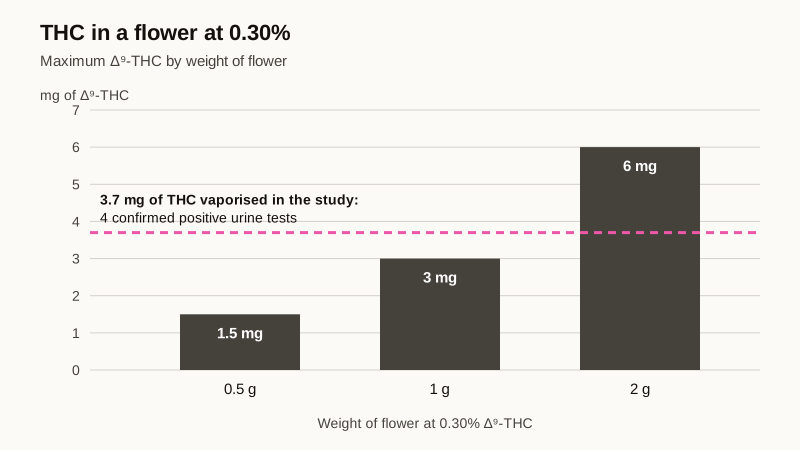
Those milligrams end up in the body. A Johns Hopkins University study had six adults vaporise CBD-rich hemp delivering 100 mg of CBD and 3.7 mg of Δ⁹-THC. Four urine samples exceeded the 15 ng/ml confirmation cutoff for the THC metabolite. With pure CBD, no sample exceeded it.
At the wheel, French law has no threshold. Article L235-1 of the Highway Code punishes driving after drug use shown by a saliva or blood test with three years in prison and a €9,000 fine. The Cour de cassation ruled on 21 June 2023 (no. 22-85.530) that the offence is established "regardless of the dose absorbed", and that the authorisation of CBD makes no difference. Our guide to the saliva test covers detection windows.
What plant smoke contains
Combustion, not THC, drives most of the respiratory risk. In 2008, Health Canada compared the smoke of cannabis and tobacco cigarettes prepared the same way and smoked by machine. Mainstream cannabis smoke contained up to 20 times more ammonia than tobacco smoke. It also contained 3 to 5 times more hydrogen cyanide, nitrogen oxides and some aromatic amines. Polycyclic aromatic hydrocarbons were less concentrated. The authors confirm the presence of known carcinogens in both smokes.
These compounds come from burning plant matter. A low-THC flower does not escape them. Mixing the flower with tobacco adds nicotine and its dependence, a subject covered in our article on the differences between tobacco and cannabis.
A common question: does heat turn CBD into THC? In the lab, yes. Hungarian chemists heated pure CBD between 250 and 500 °C: 25 to 52% was transformed, with Δ⁹-THC as the main product. Under conditions closer to real use, the result differs. A German team machine-smoked, following the ISO 4387 standard, six 1 g joints of CBD-rich hemp: no THC formation could be demonstrated.
Vaporising instead of burning: what changes
A vaporiser heats the flower without setting it alight. Cannabinoids and terpenes turn to vapour while the plant matter does not burn. A University of California, San Francisco trial with 18 volunteers compared a cigarette and a vaporiser using the same cannabis. Blood THC levels were similar, and exhaled carbon monoxide was lower with the vaporiser. The trial measured exposure, not a health benefit.
| Method | Temperature | Combustion | What is inhaled |
|---|---|---|---|
| Joint or pipe | Glowing ember | Yes | Smoke: tar, carbon monoxide, irritants |
| Vaporiser | Set, usually between 160 and 210 °C | No | Vapour of cannabinoids and terpenes |
| Mixed with tobacco | Glowing ember | Yes | Smoke, plus nicotine from the tobacco |
Our guide to vaporisation temperatures gives settings by cannabinoid. To choose a flower, the pages of our CBD flower selection describe the aromatic profile of each variety. The number that matters is the THC content measured on the batch, read on the certificate of analysis.
CBD is not a medicine. Avoid it during pregnancy and breastfeeding, and keep it out of reach of minors.
Frequently asked questions
Is it legal to smoke a CBD flower in France?
Yes, if the flower comes from an authorised variety and contains no more than 0.30% Δ⁹-THC. The ban on consuming flowers, introduced in 2021, was annulled by the Conseil d'État on 29 December 2022. Smoking is still banned in places for collective use.
Why do some bags say "not for smoking"?
It is the seller's choice, not a legal obligation. The Public Health Code in fact provides a category of herbal products for smoking, with a health warning on the packaging.
Can you test positive after smoking a CBD flower?
Yes. A flower at 0.30% contains up to 3 mg of THC per gram, and the law sets no minimum dose for drivers. The Cour de cassation confirmed in 2023 that the authorisation of CBD does not rule out the offence.
Is CBD flower smoke less harmful than tobacco smoke?
It contains the same families of toxic compounds in different proportions. The Health Canada study measured more ammonia and hydrogen cyanide in cannabis smoke, and fewer polycyclic aromatic hydrocarbons. No smoke is risk-free.
Does a vaporiser remove all risk?
No. It avoids combustion and lowers the carbon monoxide inhaled, but the vapour still carries the THC present in the flower. The risk at the wheel is the same.
Written by the Phytogrammes team
Every article in this journal draws on primary sources (ANSM, EFSA, EUR-Lex, peer-reviewed publications) and on the lab's own practice: batch-by-batch HPLC analyses, measured cannabinoid profiles. Our approach.
Article published on . CBD is not a medicine.