Cannabis and CBD worldwide: 4 legal models compared
States handle cannabis through four models: prohibition, still the majority, regulated medical access, tolerance or decriminalisation, and legalisation of adult use, adopted at national level by Uruguay in 2013, then by Canada, Malta and Germany. CBD follows a separate path: hemp defined by a THC threshold, 0.30% in France. A product that is legal abroad is therefore not necessarily legal here.
Contents
- 01The common base: the UN conventions
- 02Model 1: prohibition, still the majority
- 03Model 2: regulated medical access
- 04Model 3: tolerance or decriminalisation
- 05Model 4: legalisation of adult use
- 06CBD: a fifth path, based on a THC threshold
- 07What these frameworks change for a buyer in France
- 08Frequently asked questions
> Key takeaways > > - The UN conventions of 1961 and 1971 remain the common base; cannabis only left Schedule IV, the strictest, in December 2020. > - Uruguay was the first country to legalise production and sale, through a law enacted on 20 December 2013. > - In the European Union, Malta, Luxembourg and Germany now allow some form of adult use, without open commercial sale. > - CBD falls under a different framework: the CJEU ruled in 2020 that it is not a narcotic, and France sets the Δ⁹-THC threshold for hemp at 0.30%.
The common base: the UN conventions
Every national framework positions itself against two treaties: the 1961 Single Convention on Narcotic Drugs and the 1971 Convention on Psychotropic Substances. EU law refers to them to define what a narcotic is, as the Court of Justice recalls in its press release on case C-663/18.
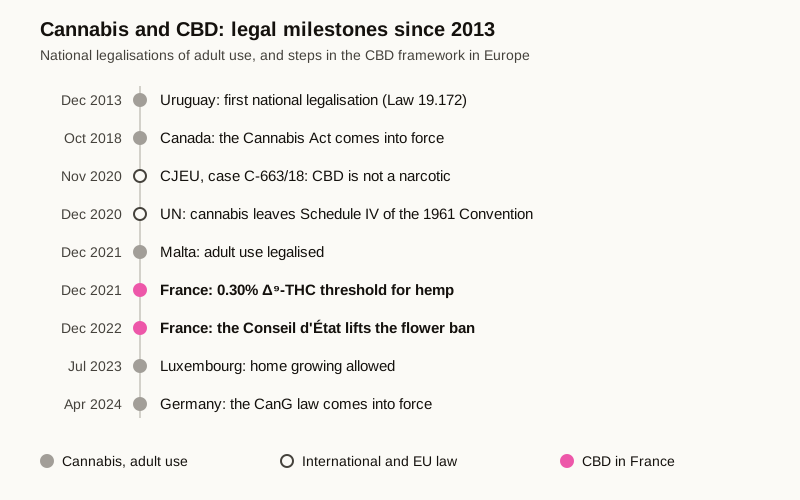
These treaties have moved once, at the margin. On 2 December 2020, the UN Commission on Narcotic Drugs voted, by 27 votes to 25 with one abstention, to remove cannabis and cannabis resin from Schedule IV of the 1961 Convention, the list of substances considered the most dangerous. Cannabis remains in Schedule I: it is still a narcotic under international control.
Model 1: prohibition, still the majority
Most countries ban the production, sale and use of cannabis, applying the conventions directly. The intensity varies widely: some countries in Asia and the Middle East set very heavy penalties for trafficking, others enforce the ban more loosely.
France belongs to this model for cannabis. Possessing and using it remain criminal offences, whatever product was bought abroad. Only hemp below the THC threshold, described further down, escapes this ban.
Model 2: regulated medical access
Many countries, including several EU member states, allow cannabis-based medicines on prescription, for specific indications. This model does not change the status of non-medical use.
France ran a medical cannabis trial from 2021. No new patients have been enrolled since 27 March 2024. According to the ANSM, the French medicines agency, patients already included benefit from a transition phase that will last until three months after the French health authority (HAS) publishes its opinion. None of this concerns the CBD sold in shops, which is not a medicine. The only authorised CBD medicine is Epidyolex, on prescription.
Model 3: tolerance or decriminalisation
Between prohibition and legalisation, some countries choose not to prosecute without authorising anything. The Netherlands is the best-known example. The Dutch government says it plainly: selling small quantities in coffee shops is a criminal offence, but the prosecution service does not pursue it if the shop follows rules, including sales capped at 5 grams per transaction and restricted to people over 18.
Luxembourg took another route on 21 July 2023. An adult may grow up to four plants per household, from seed, for consumption at home. In public, possessing up to 3 grams remains an offence, punished by a fine rather than a prison sentence. There is no legal sale.
Model 4: legalisation of adult use
A few countries have legalised adult use at national level, each with its own limits.
| Country | Law and date | What is allowed |
|---|---|---|
| Uruguay | Law 19.172, enacted on 20 December 2013 | Production and sale under state control, purchases capped at 40 grams per month per user |
| Canada | Cannabis Act, in force on 17 October 2018 | Sale by authorised retailers, possession of 30 grams of dried cannabis in public |
| Malta | Act LXVI of 2021, published on 18 December 2021 | Personal use by adults, non-commercial framework |
| Germany | CanG law, in force on 1 April 2024 | Home growing and non-commercial growing associations |
Uruguay led the way with Law 19.172, which gives the state control over production and distribution. In Canada, Health Canada regulates licensed production, and each province organises retail sale. Malta was the first EU state to legalise personal use, through the Authority on the Responsible Use of Cannabis Act. Germany followed with the CanG law, which allows personal and collective growing without opening commercial sale; our Germany and France comparison details its effects on the CBD market.
In the United States, cannabis remains illegal at federal level, while many states have legalised it for medical use, adult use or both. Elsewhere, recent reforms are often partial: our overview of the Caribbean and our article on Morocco's legal cannabis sector describe two of them.
CBD: a fifth path, based on a THC threshold
CBD fits none of these four models. It relies on hemp, cannabis varieties bred for a very low THC content, grown legally even in countries that prohibit cannabis.
In Europe, the Court of Justice of the EU ruled on 19 November 2020, in case C-663/18, that CBD extracted from the whole plant is not a narcotic within the meaning of the 1961 Convention. A member state therefore cannot ban CBD lawfully produced in another member state, unless it has a proportionate public health justification. In France, the order of 30 December 2021 sets the maximum Δ⁹-THC content of hemp, its extracts and the products that contain them at 0.30%. On 29 December 2022, the Conseil d'État struck down the ban on selling raw flowers and leaves that the order contained. Our article on the 0.3% threshold explains how it is calculated.
Thresholds change from one country to another, and that is the point for a buyer to remember. Switzerland classes cannabis containing 1% THC or more as a narcotic: a flower sold legally in Geneva can therefore exceed the French threshold. In the United States, the 2018 Farm Bill defined hemp as cannabis with no more than 0.3% Δ⁹-THC on a dry weight basis. Our article on Switzerland and France compares the two frameworks.
What these frameworks change for a buyer in France
Nothing, for anything that enters the country. French law applies at the border, whatever the product's status where it was bought. Cannabis bought legally in Montreal or Berlin is still a narcotic in France. A product sold as "CBD" abroad is only accepted if it meets the 0.30% Δ⁹-THC threshold and the other French rules, notably those on products meant to be swallowed, covered in our update on CBD regulation in 2026.
Two situations come up often. For a parcel ordered from outside France, our guide to customs and CBD parcels describes what is checked. For a trip, our article on flying with CBD reviews the rules in France, in Europe and outside the EU.
Frequently asked questions
Which country legalised cannabis first?
Uruguay, with Law 19.172 enacted on 20 December 2013. It was the first country to legalise production, sale and use at national level, under state control. Canada followed on 17 October 2018.
Is the Dutch coffee shop system a legalisation?
No. Selling in coffee shops remains a criminal offence in the Netherlands; the prosecution service chooses not to pursue it if the shop follows strict rules, such as no more than 5 grams per transaction. It is a tolerance policy, not a legalisation.
Is French CBD legal in every country?
No. Each country sets its own THC threshold and its own rules. A product that complies in France may be banned elsewhere, and a product that is legal in Switzerland, where the threshold is 1%, may be banned in France.
Is France considering legalising cannabis?
No legalisation reform is under way to date. Cannabis remains a narcotic in France; only hemp below 0.30% Δ⁹-THC has a commercial framework, and the medical trial is in its transition phase.
Written by the Phytogrammes team
Every article in this journal draws on primary sources (ANSM, EFSA, EUR-Lex, peer-reviewed publications) and on the lab's own practice: batch-by-batch HPLC analyses, measured cannabinoid profiles. Our approach.
Article published on . CBD is not a medicine.