Cannabis in the Caribbean: what 9 islands allow in 2026
No Caribbean island has opened a recreational cannabis market like Canada's. Since Jamaica's 2015 reform, at least eight island states have decriminalised possession of small amounts, from 14 g in Barbados to 2 ounces in Jamaica, and several have created a medical industry and rules for Rastafari religious use. For a French traveller nothing changes: cannabis remains a narcotic in France, and bringing it back counts as importation.
Contents
> Key takeaways > > - Decriminalising possession is not legalising sales: below the threshold there is no prosecution, but no free trade either. > - Thresholds range from 14 g (Barbados) to 2 ounces, about 57 g (Jamaica). > - Jamaica issues visitors a permit to buy for medical use, on a prescription or a simple signed declaration. > - In France, use is still punishable by one year in prison and a 3 750 € fine, with a fixed fine raised to 500 € in August 2026. > - Only hemp whose finished product contains no more than 0.30% Δ⁹-THC is allowed in France.
Decriminalising is not legalising: three regimes to tell apart
Caribbean reforms combine three mechanisms, which have to be separated to understand what is allowed. Decriminalisation removes criminal prosecution for a small amount, replaced at most by a ticket. A medical industry creates licences to grow, process and sell under the supervision of a public authority. Sacramental use allows Rastafari communities, for whom cannabis has religious value, to grow and use it within set rules.
The movement has a regional origin. In 2018 the CARICOM Regional Commission on Marijuana published a report called Waiting to Exhale. It unanimously recommended reclassifying cannabis as a "controlled substance" and replacing criminal penalties with a public health approach, while keeping the ban for minors and in public. Most countries followed part of these recommendations, rarely all of them.
Jamaica: the first reform, in 2015
Jamaica led the way with the Dangerous Drugs (Amendment) Act, in force since 15 April 2015 according to the official government fact sheet. Holding 2 ounces or less, about 57 g, no longer leads to arrest or a criminal record: police can issue a 500 Jamaican dollar ticket, payable within 30 days. Above that, possession is still an offence.
Each household can grow 5 plants, whatever the number of residents. Rastafarians may smoke at their registered places of worship and apply for permission to grow for sacramental use. The law also created the Cannabis Licensing Authority, which issues licences for the medical industry.
The point that matters to travellers is specific. A person who does not live in Jamaica can get a permit to buy and hold up to 2 ounces at a time, for medical use. It requires a prescription or medical recommendation, or a signed voluntary declaration, and the permit is paid for. This is a medical scheme, not open sale.
Trinidad, Antigua, Saint Kitts: home growing within limits
Three countries combined decriminalisation with personal cultivation. In Trinidad and Tobago, Act No. 24 of 2019, assented on 18 December 2019, makes it lawful to hold 30 g of cannabis or 5 g of resin. Above that, fines climb fast: 50 000 Trinidad dollars between 30 and 60 g. Each person can grow 4 plants. A second law, the Cannabis Control Act 2022, provides for licences and sacramental dispensaries, but its entry into force depends on a presidential proclamation.
Antigua and Barbuda set a threshold in March 2018 of 15 g and 4 plants per household, and cleared past convictions for these amounts. The Cannabis Act 2018, assented in January 2019, created a medical cannabis authority and dispensaries reserved for registered religious organisations.
Saint Kitts and Nevis moved in two steps: 15 g in 2019, then 56 g and 5 plants per household with an amendment in June 2023, which refers to a law of the same year recognising Rastafari rights. A medical cannabis authority has existed since the 2020 act.
Barbados, Saint Vincent and others: the medical industry first
Other islands started with the economy. Saint Vincent and the Grenadines passed on 11 December 2018 a law on the medical cannabis industry and an amnesty law that brings traditional growers into the licensed industry. Decriminalisation of 56 g followed, confirmed by the government in March 2021.
Barbados adopted two separate texts on 27 November 2019, one on the medical industry and the other, the Sacramental Cannabis Act, on religious use. It decriminalised 14 g in 2021, the lowest threshold in this overview. Dominica decriminalised 28 g in October 2020 and Saint Lucia 30 g in September 2021. In the Bahamas, a 2024 law created a cannabis authority for medical and sacramental use; the fines planned for small-scale possession were not yet applied in early 2025.
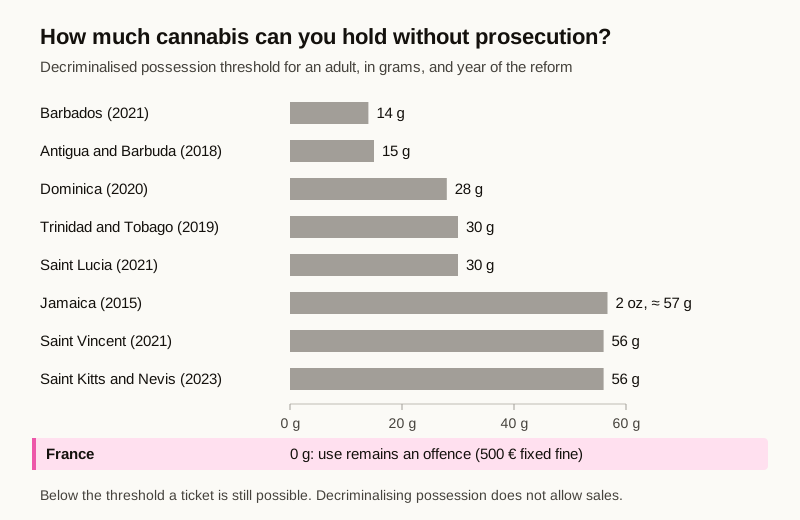
| Country | Decriminalised possession | Home growing | Other regimes |
|---|---|---|---|
| Jamaica (2015) | 2 ounces, about 57 g, ticket | 5 plants per household | Medical, sacramental, visitor permit |
| Trinidad and Tobago (2019) | 30 g, or 5 g of resin | 4 plants per person | 2022 act applies on proclamation |
| Antigua and Barbuda (2018) | 15 g | 4 plants per household | Medical, religious dispensaries |
| Saint Kitts and Nevis (2023) | 56 g | 5 plants per household | Medical, Rastafari |
| Saint Vincent (2018 then 2021) | 56 g | Not specified | Medical, grower amnesty |
| Barbados (2019 then 2021) | 14 g | Not specified | Medical, sacramental |
| Dominica (2020) | 28 g | Not specified | Not specified |
| Saint Lucia (2021) | 30 g | Not specified | Not specified |
What this changes for a French traveller
Legally, nothing. Caribbean law stops at the island's border. In France, drug use remains an offence punishable by one year in prison and a 3 750 € fine. Since 20 August 2026, the fixed fine that can replace prosecution is 500 €, 400 € if paid within 15 days, 1 000 € after 45 days.
Bringing back cannabis bought legally in Jamaica does not change its nature in France: it is importation of narcotics, which article 222-36 of the Penal Code punishes with 10 years in prison and a 7 500 000 € fine. A stopover counts too: you are subject to the law of every country you pass through. Our guide to flying with CBD details the rules at borders.
In France, the only legal offer remains hemp whose finished product contains no more than 0.30% Δ⁹-THC, as our article on the legal THC level explains. Therapeutic cannabis follows a separate medical framework, described in our overview of medical cannabis in France. To place the Caribbean among other models, see our overview of cannabis and CBD around the world and our article on legal cannabis in Morocco.
Frequently asked questions
Can a tourist buy cannabis legally in Jamaica?
Only within the medical scheme. A non-resident can get a paid permit to buy up to 2 ounces at a time, on a prescription, a medical recommendation or a signed voluntary declaration. There is no open recreational sale.
What is the difference between decriminalisation and legalisation?
Decriminalisation removes criminal prosecution for a small amount, replaced at most by a ticket. Legalisation organises production and sale. The Caribbean islands have mostly decriminalised possession and regulated medical and religious use.
Can you bring cannabis bought legally in the Caribbean back to France?
No. In France this is importation of narcotics, punishable by 10 years in prison and a 7 500 000 € fine under article 222-36 of the Penal Code, whatever the country of purchase.
Is cannabis legal in France in 2026?
No. Cannabis remains a narcotic, and its use is punishable by one year in prison and a 3 750 € fine, or a 500 € fixed fine. Only hemp products with no more than 0.30% Δ⁹-THC are allowed.
Why do Rastafarians have separate rules?
For Rastafarians, cannabis has sacramental value. Jamaica, Barbados, Antigua and Barbuda and Saint Kitts and Nevis have recognised this religious use through specific rules, often limited to places of worship or registered organisations.
Written by the Phytogrammes team
Every article in this journal draws on primary sources (ANSM, EFSA, EUR-Lex, peer-reviewed publications) and on the lab's own practice: batch-by-batch HPLC analyses, measured cannabinoid profiles. Our approach.
Article published on . CBD is not a medicine.