Opening a CBD shop in France in 2026: the rules to check
France requires no CBD-specific licence: a shop is set up like any other business, online through the single business formalities portal. What decides whether it is legal is the stock. Every product must contain no more than 0.30% Δ⁹-THC and no semi-synthetic cannabinoids, and belong to a category that is still allowed: since May 2026, CBD foods and supplements are no longer among them.
Contents
> Key takeaways > > - Registration goes through the INPI single portal, mandatory since 1 January 2023; there is no CBD licence. > - In 2022 and 2023, 12.6% of 223 products sold as CBD and tested for MILDECA exceeded 0.3% THC. > - These non-compliant products came from every channel, specialist CBD shops included. > - CBD foods and supplements are not authorised: the French Ministry of Agriculture restated this on 20 May 2026. > - A product presented as treating a disease legally becomes a medicine.
No CBD licence, but rules to know
A CBD shop needs no specific authorisation. Setting one up follows ordinary business law: legal form, registration, declaration of activity. Since 1 January 2023, these steps are done exclusively on the business formalities portal, run by INPI, the French intellectual property office.
The text that governs the products is the order of 30 December 2021. It restricts cultivation and industrial use to hemp varieties listed in the official catalogues, grown from certified seed, and caps Δ⁹-THC at 0.30% in the plant as in finished products. Selling raw flowers has been possible since the Conseil d'État, France's highest administrative court, annulled their ban on 29 December 2022. Our article on the order banning CBD flowers goes over that decision.
What you can sell in 2026, format by format
The applicable rule depends on the product category, not the molecule. The table sums up the situation on 23 September 2026.
| Format | Status in 2026 | Watch point |
|---|---|---|
| Flowers and resins | Allowed below 0.30% Δ⁹-THC | Do not present them as food or as a tea to drink |
| Oils and capsules to swallow | Not authorised as food | Withdrawn from the market, food supplements included |
| CBD cosmetics | Allowed | Cosmetics regulation, own label and notification rules |
| E-liquids and vapes | Allowed, except disposable vapes | Sale to minors banned |
| HHC, H4CBD, THCP and derivatives | Banned | Narcotics, even when sold "next to" CBD |
For foods, the Ministry of Agriculture published a clarification on 20 May 2026: foods containing CBD are not authorised under the EU novel food regulation and must be withdrawn from the market, supplements included. Only hemp seeds, their derivatives such as seed oil, and leaves intended for infusion remain saleable, with no cannabinoid-enriched extract.
For semi-synthetic cannabinoids, the ANSM, France's medicines agency, classified HHC as a narcotic from 13 June 2023, then H4CBD, THCP and other derivatives from 3 June 2024. A seller holding them is exposed to prosecution under drug law. For vapes, our article on the disposable vape ban explains which formats remain on sale.
The first risk: what your stock really contains
A retailer's main danger is not paperwork. It is selling an illegal product without knowing it. A study funded by MILDECA, the French government's drug policy body, and carried out by addiction-monitoring centres bought and tested CBD products in 2022 and 2023. Its December 2023 report gives figures any professional buyer should know.
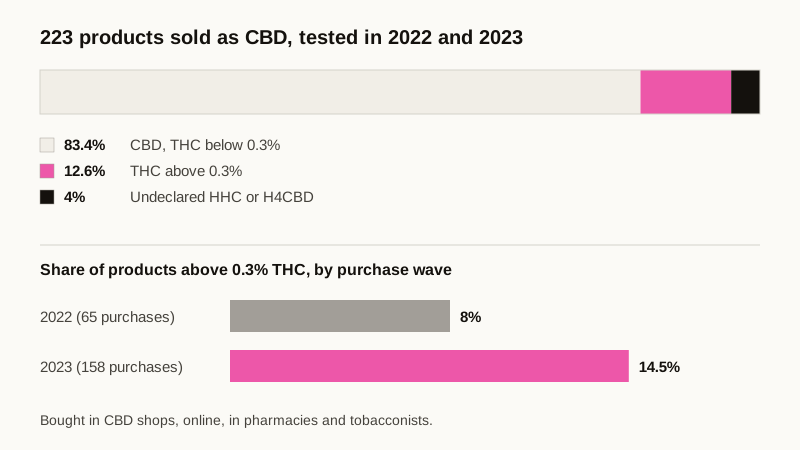
Of 223 products sold as CBD, 12.6% exceeded 0.3% THC and 4% contained HHC or H4CBD missing from the label. The share of products above the limit rose from 8% of the 65 purchases in 2022 to 14.5% of the 158 purchases in 2023. The authors stress that these illegal products came from every channel: CBD shops, websites, pharmacies, tobacconists.
Another useful finding: of six products bought again from the same website a few months apart, five had a CBD content that differed by more than 20%. A certificate of analysis therefore applies to a batch, not to a brand. Ask for it with every order, check that the batch number matches the delivery, that the laboratory is accredited for the test and that semi-synthetic cannabinoids were screened for. Our guide to reading a certificate of analysis covers each line, and our article on choosing a wholesaler lists the documents to request.
Labels, window, website: what you may write
No health promise is allowed. The French public health code defines a medicine as any substance presented as having curative or preventive properties with regard to diseases. A poster promising better sleep or less pain therefore turns the product, legally, into a medicine sold without authorisation.
The same care applies to recreational cannabis vocabulary, which can be read as incitement to drug use. Our article on CBD advertising covers the four applicable texts and their penalties. For packaging, CBD product labelling depends on the format: a cosmetic does not carry the same statements as a flower. An online shop adds the distance-selling statements described in our list of what a CBD website must display.
Getting ready for inspections
Inspections cover two things: what is sold and what is said. The 20 May 2026 clarification states that checks are being stepped up in 2026 through the departmental anti-fraud committees. Hemp professionals have been informed since 2023, with each control plan.
Three habits limit the risk. File the certificate for every batch received, together with the invoice that ties it to the product. Keep a register of batches sold, so you can withdraw a product if a supplier reports a problem. And train staff on the permitted wording, because a sentence said at the counter commits the shop as much as a label does. Our article on CBD product recalls shows how a batch number is traced.
Frequently asked questions
Do you need a licence to open a CBD shop in France?
No. There is no CBD-specific authorisation. The shop is set up like any other business, on the single business formalities portal, and its products must comply with the order of 30 December 2021.
Can a shop sell CBD oil in 2026?
Not as a food or a food supplement: on 20 May 2026 the Ministry of Agriculture restated that such foods must be withdrawn from the market. An oil sold as a cosmetic falls under a different regime, with its own labelling rules.
What documents should you ask a supplier for?
The certificate of analysis for the delivered batch, from an accredited laboratory, with the measured Δ⁹-THC and screening for HHC, H4CBD and THCP. Add the origin of the variety, which must be listed in an official catalogue.
Can CBD be sold to a minor?
No French text sets an age limit for CBD in general. E-liquids and vapes, however, cannot be sold to under-18s. Many shops choose to restrict all their products to adults.
Can the legal framework still change?
Yes. An EU classification of CBD as toxic for reproduction is under review, and it would ban CBD cosmetics if adopted. Keeping track of new texts is part of the job.
Written by the Phytogrammes team
Every article in this journal draws on primary sources (ANSM, EFSA, EUR-Lex, peer-reviewed publications) and on the lab's own practice: batch-by-batch HPLC analyses, measured cannabinoid profiles. Our approach.
Article published on . CBD is not a medicine.