CBD wholesaler in France: 5 checks before you order
A reseller who buys CBD wholesale is answerable for what they sell. Five points can be checked on documents before ordering: a variety listed in an official catalogue, certified seeds, a Δ⁹-THC content of no more than 0.30% including in extracts and finished products, non-food use, and an analysis from a laboratory accredited for that measurement. None of these points depends on the supplier's word.
Contents
> Key takeaways > > - The order of 30 December 2021 requires a variety listed in the EU or French catalogue and certified seeds. > - The 0.30% Δ⁹-THC cap also applies to extracts and to any product that contains them. > - In 2022 the Conseil d'État only annulled the ban on selling raw flowers and leaves; the rest of the order still applies. > - Since the Ministry of Agriculture's reminder of 20 May 2026, no CBD food is authorised, supplements included. > - A laboratory accreditation covers a specific scope: the number alone is not enough.
The applicable text and what it covers
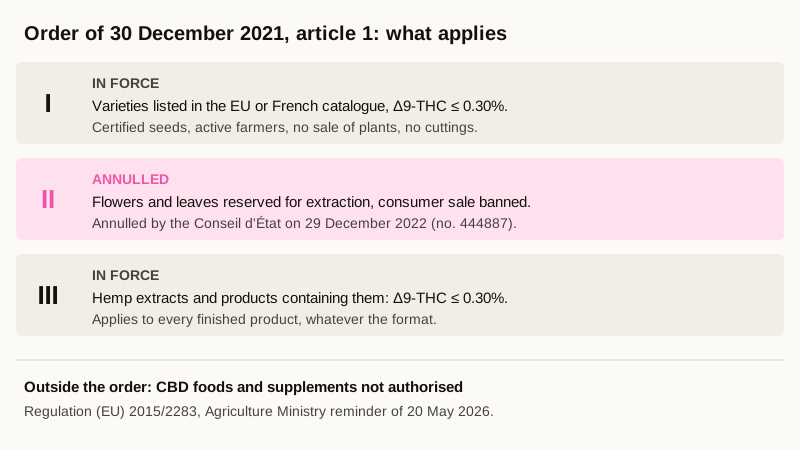
The framework rests on the order of 30 December 2021, issued to apply article R. 5132-86 of the Public Health Code. Its article 1, paragraph I, only authorises varieties of Cannabis sativa L. whose Δ⁹-THC content does not exceed 0.30% and which are listed in the EU common catalogue of varieties of agricultural plant species or in the official French catalogue.
Three conditions come with this authorisation, and buyers often forget them. Flowers and leaves must come from certified seeds. Growing them is reserved for active farmers. Selling plants and taking cuttings remain banned.
Paragraph III carries most of the commercial risk: "The delta-9-tetrahydrocannabinol content of hemp extracts, and of the products that incorporate them, shall not exceed 0.30%." The cap therefore does not only target raw flowers. It applies to the extract and to every finished product that contains it.
France holds a special place in this sector. According to the European Commission's hemp page, it accounts for more than 60% of EU hemp production, and 116 varieties were listed in the common catalogue in 2024. A supplier should be able to name theirs.
What the Conseil d'État annulled, and what it left standing
Trade literature often gets this wrong. In its decision no. 444887 of 29 December 2022, the Conseil d'État, France's highest administrative court, did not annul the order. Its ruling annuls paragraph II of article 1, the one that reserved flowers and leaves for industrial extraction and banned their sale to consumers.
The variety rule, the certified-seed requirement and the 0.30% cap on extracts therefore survived the litigation. A supplier who presents the decision as general liberalisation is misdescribing the law.
The Conseil d'État's press release sets out the reasoning: CBD "has no psychotropic effect and does not cause dependence". The decision also notes that the THC content of flowers can be checked "by means of quick and inexpensive tests". The court itself based its ruling on analytical proof.
Food status, the dividing line for stock
Food status is now the biggest risk. In a notice of 20 May 2026, the Ministry of Agriculture reminds businesses that foods containing CBD among their ingredients are not authorised under Regulation (EU) 2015/2283 on novel foods, as their safety has not been demonstrated.
Only two categories remain lawful as food: hemp seeds and their derivatives, including seed oil, and leaves intended solely for aqueous infusion. Neither may be enriched with cannabinoid extracts. The ministry is extending checks to all foods that highlight CBD, supplements and online sales included, through the departmental anti-fraud operational committees.
These checks enforce a rule that already existed. A stock of gummies or supplements bought before 2026 was therefore never lawful as food. On 9 February 2026, the EFSA published a provisional safe level of 0.0275 mg per kilo of body weight per day, about 2 mg for a 70 kg adult: an assessment benchmark, not an authorisation. Our guide to CBD regulation in 2026 covers this shift in detail.
What remains open to wholesale trade: flowers, resins, non-food extracts, vaping products and cosmetics, each under its own rules.
The certificate of analysis: proof, if you check it
A certificate without an identifiable laboratory proves nothing. Decree no. 2008-1401 of 19 December 2008 designates the French accreditation committee (COFRAC) as the national accreditation body. Testing laboratories are accredited against the NF EN ISO/IEC 17025 standard, which covers technical competence and impartiality.
Two checks are rarely made. First, note the accreditation number. Then, check that the scope covers the quantification of cannabinoids in the matrix concerned: flower, resin or oil. An accreditation is valid for a defined scope, not in general. Our article on a laboratory's accreditation scope shows where to find it.
The order does not in itself require an accredited laboratory. Accredited analysis is the way to prove compliance with the 0.30% cap, not a standalone obligation. Our guide to reading a certificate of analysis details the lines to check, and the laboratory page describes the measurement methods.
The checklist, document by document
| Point to check | Document to request | What it must show | Text |
|---|---|---|---|
| Authorised variety | Variety name, seed invoice | Listing in the EU or French catalogue | Order of 30 Dec. 2021, art. 1, I |
| Certified seeds | Seed labels or certificates | Official certification of the seed lot | Order of 30 Dec. 2021, art. 1, I |
| Δ⁹-THC ≤ 0.30% | Certificate of analysis for the delivered batch | Same batch number, result in %, method | Order of 30 Dec. 2021, art. 1, III |
| Non-food use | Product sheet, label | No mention of ingestion or supplements | Regulation (EU) 2015/2283 |
| Competent laboratory | COFRAC accreditation number | Scope covering cannabinoids in that matrix | Decree no. 2008-1401 |
The same batch must link these documents. A certificate for another batch, or another product, proves nothing about the goods delivered. For resins, our article on solvents in hash shows what a certificate can reveal. The CBD flowers and resins in the catalogue illustrate the formats concerned.
What the law does not say
In the official sources consulted, we found no authorisation scheme specific to the CBD trade. This is the finding of documentary research, not a legal guarantee. Our article on opening a shop brings together the other factors, and the one on the notices a CBD website must display covers online shops.
Neither French nor EU law provides a legal grading of flower quality. Commercial labels for size or range carry no regulatory consequence. For goods coming from another country, our article on customs and CBD parcels describes the checks that apply.
Frequently asked questions
Do you need a licence to sell CBD wholesale in France?
No official source consulted establishes an authorisation scheme specific to CBD. The obligations concern the product: a catalogue-listed variety, certified seeds, a Δ⁹-THC content of no more than 0.30%, and compliance with food status.
Can a wholesaler still offer CBD products to swallow?
No. On 20 May 2026 the Ministry of Agriculture reminded businesses that foods containing CBD are not authorised under Regulation (EU) 2015/2283. Only hemp seeds, their derivatives and leaves for aqueous infusion remain lawful, without added cannabinoids.
Does the 0.30% threshold apply to extracts and finished products?
Yes. Paragraph III of article 1 of the order of 30 December 2021 expressly covers hemp extracts and the products that incorporate them. The Conseil d'État did not annul it in 2022.
Is a certificate of analysis enough to prove compliance?
Only if it carries the number of the delivered batch and comes from a laboratory whose accreditation covers cannabinoids in that matrix. A generic certificate, or one for another batch, proves nothing about the goods received.
Written by the Phytogrammes team
Every article in this journal draws on primary sources (ANSM, EFSA, EUR-Lex, peer-reviewed publications) and on the lab's own practice: batch-by-batch HPLC analyses, measured cannabinoid profiles. Our approach.
Article published on . CBD is not a medicine.