French CBD: no official label, five proofs to ask for
No official label certifies French CBD as of September 2026. The French Senate asked for one in 2022, the project announced with AFNOR has published nothing, and 80 to 85% of the CBD consumed in France is imported, according to the Confédération paysanne. The word "French" is optional on a label: what you can check is where the hemp was grown, where it was processed, and the lot analysis.
Contents
> Key takeaways > > - "French" may refer to growing, processing or only packaging: ask which one. > - An origin claim is optional; when it appears, it follows customs rules of origin. > - The French Senate proposed a quality label for French CBD on 17 November 2022, by 179 votes to 7. It still does not exist. > - The legal framework is the same for French and imported products: no more than 0.30% Δ⁹-THC. > - An analysis of the lot by an ISO/IEC 17025 accredited laboratory remains the strongest proof.
"French CBD": three steps, three possible origins
A CBD product goes through three steps: growing the hemp, processing it (drying, sieving or extraction) and packaging. Each can take place in a different country. A flower grown in Italy and bagged in Lyon, or a US extract diluted in France, can both carry a French flag on the pack.
Origin marking is not compulsory, except for some foods. When a seller uses it, it follows the non-preferential rules of origin of the Union Customs Code. France's Directorate-General for Enterprise sums them up: the product must be wholly obtained in France, or have undergone its last substantial processing there. It adds that a flag or national symbol can be misleading if the product was not made in France.
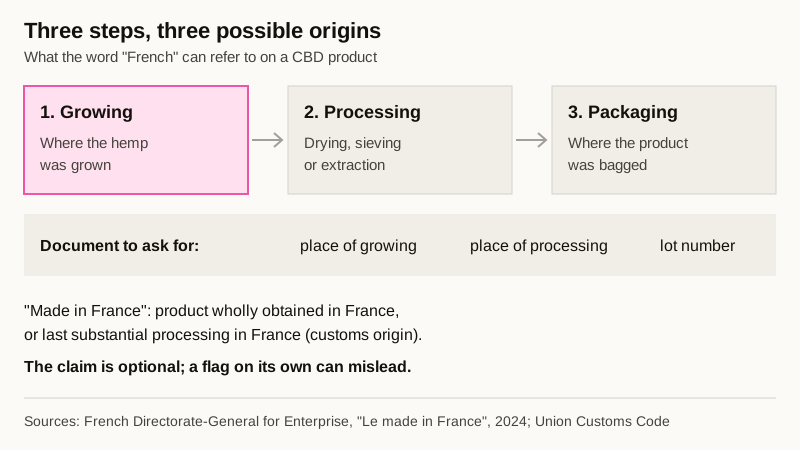
For a flower that is grown, then simply dried and bagged, the useful question is therefore where it was grown. For an oil, you also need to know where it was extracted.
How big the French hemp sector is
France grows a lot of hemp, but mostly for fibre and seed. According to the European Commission, it accounts for more than 60% of EU hemp production, ahead of Germany (17%) and the Netherlands (5%). The trade body InterChanvre counted 23,600 hectares and 1,550 growers in 2024, according to La France Agricole.
CBD hemp is a smaller segment. More than 1,200 farms grow it, for a turnover of nearly 900 million euros, according to the trade organisations quoted by La France Agricole in June 2026. These are industry figures, not official statistics. The Confédération paysanne, a farmers' union, estimated in October 2025 that 80 to 85% of the CBD consumed in France is imported. Our article on hemp in Europe compares areas country by country.
The official French CBD label does not exist
On 17 November 2022, the French Senate adopted a resolution on the hemp sector that "proposes that the Government create a quality label for French CBD products". The vote was 179 for and 7 against. A resolution is not binding: it invites the Government to act without forcing it to.
A week later, the Union of Industrialists for the Valorisation of Hemp Extracts (UIVEC) announced a label "under construction" with AFNOR, the French standards body. As of September 2026, we found no published specification, no list of labelled products and no official logo.
What is moving at AFNOR is measurement methods. The draft standard NF V38-002 describes, in three parts, how to measure hemp cannabinoids: liquid chromatography with ultraviolet detection, liquid chromatography coupled with mass spectrometry, and gas chromatography. It will harmonise laboratory work without creating a consumer logo.
The organic label does exist, but it covers the growing method, not origin or THC content. A flower grown hydroponically cannot be organic, as our article on what the organic label guarantees for flowers explains.
French or imported: the same legal framework
Origin changes nothing in the substantive rules. The decree of 30 December 2021 only allows varieties of Cannabis sativa L. listed in the common catalogue whose Δ⁹-THC content is not above 0.30%. On 29 December 2022, the Conseil d'État annulled the ban on selling raw flowers and leaves that the decree contained. Our article on the legal THC level explains this threshold.
Some molecules are banned wherever they come from. The ANSM listed HHC and two derivatives as narcotics on 13 June 2023, then H4CBD, THCP and other cannabinoids on 3 June 2024.
Products meant to be swallowed follow a separate line. On 20 May 2026, the Ministry of Agriculture stated that foods containing CBD must be withdrawn from the market: none has been authorised under the EU novel food regulation. In its answer of 1 September 2026 to a written question in the National Assembly, it specified that this applies to every CBD food sold in France, whether the CBD comes from plants or is synthetic. Only seeds, their derivatives and leaves meant for water infusion are exempt. A CBD food grown in France is therefore no more legal than an imported one. Our overview of CBD regulation in 2026 covers this withdrawal.
The proof you can check: the lot analysis
Without a label, one document really tells you about the product: the certificate of analysis for the lot, issued by a third-party laboratory. Its value depends on the laboratory's accreditation to ISO/IEC 17025, which confirms its competence for a given test. In France, this accreditation is granted by Cofrac.
A useful certificate is read in four points. The lot number matches the one on the bag. Cannabinoids are quantified, usually by liquid chromatography (HPLC). Δ⁹-THC stays below 0.30%. Contaminants are tested, starting with pesticides and heavy metals. Our guide explains how to read a certificate of analysis line by line, and the laboratory page describes the measurement methods.
The buying checklist in five checks
| Question | What answers it | What does not |
|---|---|---|
| Where was the hemp grown? | A written place of growing, region or country | A flag, "French CBD" with no detail |
| Where was it processed? | The place of drying or extraction | "Packed in France" |
| Is the product compliant? | Δ⁹-THC measured at no more than 0.30% on the lot | A percentage in the product name |
| Is the analysis reliable? | A laboratory accredited to ISO/IEC 17025 for that test | "Lab tested" with no name |
| Is the pitch honest? | Checkable facts: levels, lot, origin | A promise of cure |
The last point is not a formality. A product presented as having curative or preventive properties is a medicine under article L5111-1 of the French Public Health Code, and cannot be sold without authorisation. The only authorised CBD medicine is Epidyolex. In our shop, the CBD flowers show the number and measured level of the lot on sale.
Frequently asked questions
Is CBD sold as French necessarily grown in France?
No. The claim may cover only the processing, or even just the packaging. Ask for the place of growing and the place of processing, in writing.
Is there an official label for French CBD?
Not as of September 2026. The Senate proposed one in 2022 and UIVEC announced a project with AFNOR the same year, but no specification has been published. Only standards for analytical methods are in preparation.
Is French CBD safer than imported CBD?
Origin guarantees nothing by itself. A French product can exceed 0.30% THC, and an imported product can be compliant. Safety is read on the lot analysis, whatever the source.
Does a French flag on the pack prove the origin?
No. According to France's Directorate-General for Enterprise, a flag or national symbol can mislead if the product was not made in France. Only a precise document on growing and processing settles the question.
Written by the Phytogrammes team
Every article in this journal draws on primary sources (ANSM, EFSA, EUR-Lex, peer-reviewed publications) and on the lab's own practice: batch-by-batch HPLC analyses, measured cannabinoid profiles. Our approach.
Article published on . CBD is not a medicine.