CBD flowers in France: why the 2021 ban was struck down
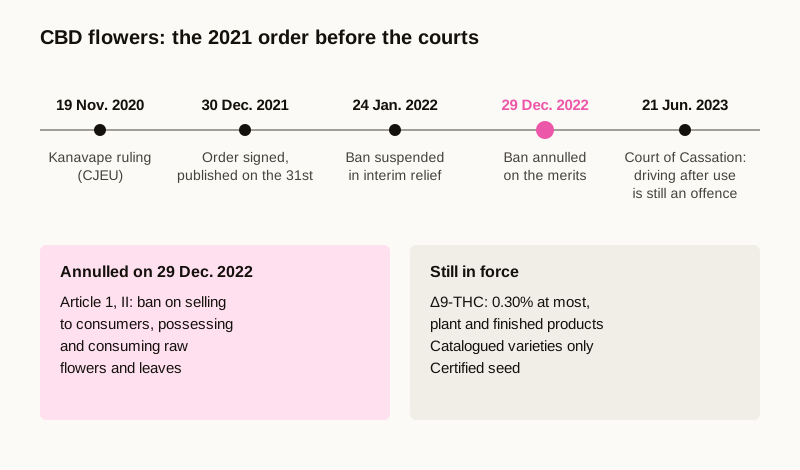
The French order of 30 December 2021 banned the sale of raw hemp flowers and leaves to consumers, as well as their possession and consumption. The Conseil d'État, France's highest administrative court, suspended the ban on 24 January 2022 and annulled it on 29 December 2022, finding it disproportionate for varieties with no more than 0.30% THC. The rest of the order still applies, including that 0.30% limit.
Contents
> Key takeaways > > - Only paragraph II of article 1 was annulled: reserving flowers for extracts and banning their raw sale, possession and consumption. > - The court gave three reasons: CBD has no psychotropic effect and causes no dependence, no risk was shown below 0.30% THC, and rapid tests allow checks. > - The 0.30% Δ⁹-THC limit, catalogued varieties and certified seed remain mandatory. > - Driving after using a CBD flower is still an offence if a test detects THC, whatever the dose.
What the order of 30 December 2021 banned
The order of 30 December 2021, published in the Journal officiel on 31 December, replaced the 1990 order that limited hemp to its fibre and seeds. It opened cultivation and industrial use to Cannabis sativa L. varieties listed in the official catalogues whose Δ⁹-THC content does not exceed 0.30%.
Flowers and leaves were treated separately. They could only be harvested, imported or used to produce extracts. Paragraph II of article 1 added a ban, quoted here as the Conseil d'État reproduced it:
"the sale to consumers of raw flowers or leaves in any form, alone or mixed with other ingredients, their possession by consumers and their consumption"
The ban therefore targeted raw plant matter, whatever the stated use: flower for smoking, herbal tea, blend. An extract made from the same flowers remained legal if it met the 0.30% limit. It was this difference in treatment between the plant and its extract that shops and growers challenged.
24 January 2022: suspension in interim relief
Hearing an urgent application, the Conseil d'État's interim relief judge suspended the ban on 24 January 2022, just over three weeks after publication. Interim relief is a fast procedure: the judge does not decide the case, but freezes a text when there is urgency and serious doubt about its legality.
The doubt was about public health, not EU law. Nothing in the file showed that flowers with no more than 0.30% THC posed a risk justifying "a general and absolute ban". The same order used that very limit to define authorised varieties. The judge also noted that checks make it possible to tell compliant products apart.
The suspension covered the first paragraph of section II, the one that reserved flowers for extracts and banned their sale, possession and consumption. The other contested provisions were not suspended.
29 December 2022: annulment on the merits
Almost a year later, the Conseil d'État ruled on the merits, joining fifteen applications. In decision No 444887, it annulled the whole of paragraph II of article 1. Its press release sums up three reasons.
| Argument examined | What the Conseil d'État held |
|---|---|
| CBD is a narcotic | No: it has no psychotropic effect and causes no dependence, unlike THC. |
| Flowers pose a health risk | The risk depends on the amount of THC taken in. Below 0.30%, no risk justifies a general and absolute ban. |
| Hemp flowers hamper drug enforcement | THC content can be checked with fast, cheap tests; the argument does not justify the ban. |
The reasoning matches that of the EU Court of Justice in the Kanavape ruling of 2020: a sales ban must rest on an established risk, not a hypothetical one. The Conseil d'État did, however, reject other challenges: the 0.30% limit and the certified-seed requirement, also contested, were upheld.
What the annulment does not change
The annulment removed a ban, not the conditions. A CBD flower sold in France must still come from a variety listed in the EU or French catalogue, grown from certified seed. Its Δ⁹-THC content must not exceed 0.30%, the limit explained in our article on the legal THC level.
How the product is sold matters too. A flower presented as a food or a supplement falls outside the order and under the EU novel food regulation. On 20 May 2026, the French Ministry of Agriculture reminded operators that such CBD foods are not authorised. Our overview of CBD regulation in 2026 explains that distinction.
To check a flower before buying, the document that matters is the batch certificate of analysis: it shows the measured Δ⁹-THC, not just the CBD content. Our laboratory page explains how these measurements are made. The products on sale are grouped in the CBD flowers category.
The limit that remains: driving
A flower that is legal to buy is not neutral behind the wheel. On 21 June 2023, the Court of Cassation held that the offence of driving after drug use is made out as soon as a test shows a controlled substance, "regardless of the dose absorbed". The fact that the product was sold legally below 0.30% THC makes no difference.
Since the law of 9 July 2025, the offence carries up to 3 years in prison and a €9,000 fine. Our article on CBD and driving covers the tests and penalties.
Frequently asked questions
Are CBD flowers legal in France in 2026?
Yes, if they come from an authorised variety and contain no more than 0.30% Δ⁹-THC. The 2021 ban was annulled by the Conseil d'État on 29 December 2022, and no text has reinstated it since.
Why did the order target flowers and not extracts?
The government wanted to reserve flowers and leaves for extract production. It argued that a legal flower looks like a cannabis flower and hampers checks. The Conseil d'État found this argument insufficient, since rapid tests measure THC.
What is the difference between suspension and annulment?
The suspension of 24 January 2022 was temporary: the interim relief judge froze the ban pending the full judgment. The annulment of 29 December 2022 is final: the ban is deemed never to have existed.
Did the THC limit change after the annulment?
No. The 0.30% Δ⁹-THC limit set by the order of 30 December 2021 was upheld by the Conseil d'État. It applies to the plant and to finished products alike.
Can you drive after smoking a CBD flower?
It is risky. A flower at 0.30% THC can be enough to trigger a positive test, and the Court of Cassation holds that the offence is made out whatever the dose consumed.
Written by the Phytogrammes team
Every article in this journal draws on primary sources (ANSM, EFSA, EUR-Lex, peer-reviewed publications) and on the lab's own practice: batch-by-batch HPLC analyses, measured cannabinoid profiles. Our approach.
Article published on . CBD is not a medicine.