CBD coffee shop vs Amsterdam: 0.3% against 15.6% THC
A French "CBD coffee shop" shares only its name with a Dutch coffee shop. In France it is a shop selling hemp flowers, resins and cosmetics that contain no more than 0.30% Δ⁹-THC, with no right to smoke on the premises. In the Netherlands, coffee shops sell cannabis under a toleration policy: the best-selling weed there averaged 15.6% THC in the latest official survey.
Contents
> Key takeaways > > - In France, CBD flowers may be sold since the Conseil d'État ruling of 29 December 2022, with no more than 0.30% Δ⁹-THC. > - Smoking is banned in any enclosed, covered place open to the public: a CBD shop cannot act as a smoking room. > - In the Netherlands, coffee shop sales remain illegal but tolerated, up to 5 g per transaction. > - Bringing Dutch cannabis into France is importing narcotics, punishable by 10 years in prison.
What a "CBD coffee shop" is in France
The phrase comes from marketing, not from law. A CBD shop is a retailer selling products from authorised hemp varieties. The order of 30 December 2021 caps their content at 0.30% Δ⁹-THC in the finished product. It also banned the sale of raw flowers, but the Conseil d'État struck down that ban on 29 December 2022.
The shelves of a CBD shop in 2026 therefore hold a few families: CBD flowers, resins and hash, cosmetics, e-liquids. Some shops had added a counter serving CBD drinks and pastries, hence the word "coffee". That model no longer holds: on 20 May 2026 the Ministry of Agriculture recalled that foods containing CBD are illegal and must be withdrawn, for lack of authorisation under the EU novel food regulation.
A flower at 0.30% THC does not produce the effect of a cannabis flower. Our article does CBD get you high explains why, and the one on hemp and recreational cannabis sets out what separates the two plants.
The Dutch coffee shop: toleration, not legalisation
In the Netherlands too, selling cannabis is an offence. The Dutch government says so plainly: the Public Prosecution Service does not prosecute coffee shops that meet the toleration criteria. No more than 5 g of cannabis per transaction, no hard drugs, no sales to minors, no advertising, no nuisance.
Since 1 January 2013, a national rule in principle restricts access to residents of the Netherlands. How it is applied depends on each municipality: Maastricht, Breda and Heerlen apply it, Amsterdam does not. Each municipality also decides whether to allow coffee shops at all.
The system is changing. Since 7 April 2025, ten municipalities have taken part in a controlled supply chain experiment: their coffee shops may only sell cannabis grown by licensed producers. The experiment is due to last four years in principle.
| CBD shop in France | Coffee shop in the Netherlands | |
|---|---|---|
| Status of sales | Legal, ordinary retail | Illegal but tolerated |
| THC in the product | 0.30% at most | No cap; 15.6% on average for the best-selling weed |
| Quantity per purchase | No legal limit | 5 g per transaction |
| Minors | No general rule, sale of vaping products banned | Sales banned |
THC measured in coffee shops
Every year the Trimbos Institute measures, for the Dutch Ministry of Health, the strength of products sold in coffee shops. For the THC monitor 2024-2025, its researchers anonymously bought 195 samples in 49 coffee shops between December 2024 and January 2025. The best-selling Dutch weed contained 15.6% THC on average, the one sold as the strongest 17.4%. Imported hash reached 23.0%, and hash made from Dutch weed 23.7%.
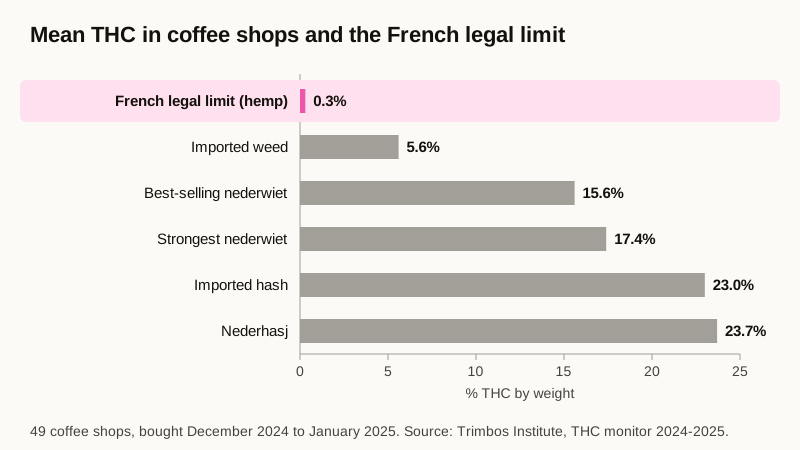
The same report notes that these products contain almost no CBD. The median CBD content of the best-selling Dutch weed was 0.0%. A coffee shop product is thus the reverse of a CBD flower: a lot of THC, very little cannabidiol. The factor of 52 between 15.6% and 0.30% gives the order of magnitude of the gap.
Smoking on the premises: what French law says
The answer is no, and it does not depend on the product. Article L3512-8 of the French Public Health Code bans smoking in places for collective use. Article R3512-2 sets its scope: all enclosed, covered places that receive the public or are workplaces. A CBD shop is both. Smoking a hemp flower there, even a compliant one, falls under the same ban as a cigarette.
Nor can a shop serve flower infusions or CBD drinks, since these are unauthorised foods. The only intended use is buying, then consuming elsewhere, following the rules of each place.
Travel: what you risk by bringing cannabis home
Buying in an Amsterdam coffee shop does not change the product's status in France. Above 0.30% Δ⁹-THC, cannabis falls outside the exemption granted to hemp and remains a narcotic. Taking it across the border is importation, which article 222-36 of the French Penal Code punishes with 10 years in prison and a €7,500,000 fine. A small quantity creates no exception.
On French soil, use is punishable by one year in prison and a €3,750 fine. Since 20 August 2026, the fixed fine that can replace prosecution is €500. Our article on the words beuh, weed and CBD places them against the law, and the guide to travelling with CBD covers the reverse journey.
Spotting a serious CBD shop
The shop's name tells you nothing. Four points can be checked before buying:
Our guide to reading a certificate of analysis shows where to find these lines, and the checklist for choosing a CBD product covers the other criteria.
Frequently asked questions
Is a CBD coffee shop the same as a Dutch coffee shop?
No. The first legally sells hemp products with no more than 0.30% THC, with no consumption on site. The second sells cannabis under a toleration regime specific to the Netherlands: the best-selling weed there contained 15.6% THC on average.
Can you smoke CBD inside a shop in France?
No. The smoking ban applies to all enclosed, covered places open to the public, whatever is being smoked.
Can a tourist buy in an Amsterdam coffee shop?
Yes, Amsterdam does not apply the residents-only rule. Other municipalities, such as Maastricht, do. Cannabis bought there must stay in the Netherlands.
Can you bring Dutch cannabis back to France?
No. It is importing narcotics, punishable by 10 years in prison and a €7,500,000 fine under article 222-36 of the Penal Code.
Can a CBD coffee shop serve CBD drinks?
Not any more. The Ministry of Agriculture treats CBD foods and drinks as illegal and has required their withdrawal since May 2026.
Written by the Phytogrammes team
Every article in this journal draws on primary sources (ANSM, EFSA, EUR-Lex, peer-reviewed publications) and on the lab's own practice: batch-by-batch HPLC analyses, measured cannabinoid profiles. Our approach.
Article published on . CBD is not a medicine.