40% CBD oil: 16 to 20 mg per drop, the maths
A 40% CBD oil usually contains 4,000 mg of cannabidiol in a 10 ml bottle, or 400 mg per millilitre. With a dropper that delivers 20 to 25 drops per millilitre, each drop carries 16 to 20 mg of CBD: eight to ten times EFSA's provisional reference for a whole day. In France, an oil like this can no longer be sold to be swallowed since May 2026.
Contents
> Key takeaways > > - 40% usually means 400 mg of CBD per ml, so 4,000 mg in 10 ml. > - One drop holds 16 to 20 mg, against 2 to 2.5 mg for a 5% oil. > - EFSA sets 2 mg a day for a 70 kg adult; the UK Food Standards Agency sets 10 mg. > - Of 29 oils bought in the UK, only 5 contained the stated amount within 10%. > - France's agriculture ministry restated on 20 May 2026 that CBD foods are not authorised.
What "40%" on a bottle means
The percentage expresses the share of CBD in the oil. In common seller usage, 40% means 400 mg per millilitre: 4,000 mg in 10 ml, 12,000 mg in 30 ml. The rest is the carrier oil, often medium-chain triglycerides (MCT), olive oil or hemp seed oil.
The figure is still easy to misread. A percentage can be calculated by weight or by volume, and labels rarely say which. The reliable number is the total in mg divided by the volume: 4,000 mg in 10 ml makes 400 mg/ml, however the percentage is written. If the label gives no total in mg, "40%" does not allow any precise calculation.
The word "spectrum" matters too. A full-spectrum oil keeps the other hemp compounds, including a little THC under the 0.30% limit; an isolate-based oil contains only CBD. Our definition of full spectrum and our comparison of full spectrum and isolate explain the difference.
Table: mg of CBD per drop by strength
The calculation rests on the size of a drop. The Food Standards Agency (FSA), the UK food regulator, states that 10 mg of CBD is about 4 to 5 drops of 5% oil. A 5% oil holds 50 mg/ml, so one drop is 2 to 2.5 mg, which implies 20 to 25 drops per millilitre. The table applies the same dropper to the other strengths.
| Strength | CBD per ml | CBD per drop | CBD in 10 ml |
|---|---|---|---|
| 5% | 50 mg | 2 to 2.5 mg | 500 mg |
| 10% | 100 mg | 4 to 5 mg | 1,000 mg |
| 20% | 200 mg | 8 to 10 mg | 2,000 mg |
| 30% | 300 mg | 12 to 15 mg | 3,000 mg |
| 40% | 400 mg | 16 to 20 mg | 4,000 mg |
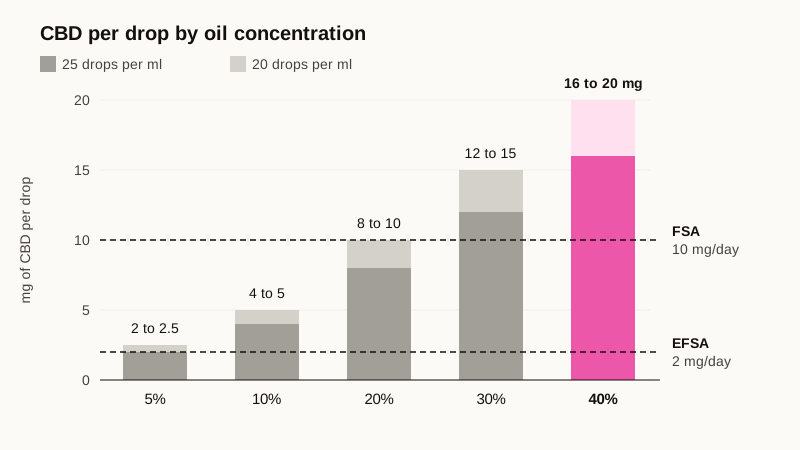
This table is an estimate. Drop size depends on the dropper tip, the oil's viscosity, its temperature and how the bottle is tilted. At 40%, that uncertainty weighs heavily: a slightly larger drop adds several milligrams. A graduated syringe is more precise: 0.1 ml of a 40% oil contains 40 mg of CBD, and 0.05 ml contains 20.
Why a single drop already exceeds official references
Two authorities publish a figure for CBD in food. On 9 February 2026, EFSA set a provisional safe level of 0.0275 mg per kilo of body weight per day, about 2 mg for a 70 kg adult. That level applies only to CBD at least 98% pure, and the agency could not establish safety for people under 25, pregnant or breastfeeding women, or people on medication. The UK FSA has advised since October 2023 not to exceed 10 mg a day.
One drop of 40% oil is 8 to 10 times EFSA's daily reference and 1.6 to 2 times the FSA's. Reaching 2 mg would take a tenth of a drop, which no dropper can deliver. That is the practical limit of this format: it packs so much CBD into so little liquid that a small amount cannot be measured by the drop. Our article on how much CBD per day explains where these references come from.
These figures are not recommended doses. The only authorised CBD medicine, Epidyolex, is a 100 mg/ml solution prescribed for rare forms of epilepsy, under medical supervision. A 40% oil is four times more concentrated, with none of those controls. CBD interacts with some medicines: if you take any treatment, ask a doctor or a pharmacist.
What the bottle really contains
A high strength on the label does not guarantee the contents. In 2023, a UK team tested 29 CBD oils bought in the UK: only 5 contained the stated amount within 10%, 23 contained less, and one contained 50% more. In France, the addiction monitoring study run with Lille University Hospital found, among ten products bought in pharmacies, mostly oils, a CBD level matching the label in only one case out of two.
On a certificate of analysis, three lines matter for an oil. The CBD concentration in mg/ml, to compare with the stated total. The Δ⁹-THC, which must not exceed 0.30% of the product: at 0.2%, one gram of oil contains 2 mg of THC. And the batch number, which must match your bottle. Our guide to reading a certificate of analysis covers each line, and the laboratory page describes the measurement methods.
Trace THC in a full-spectrum oil can also matter behind the wheel. Our guide to saliva drug tests explains what the tests detect.
The legal framework in 2026: no more oil to swallow
A CBD oil meant to be swallowed is a food, whether it comes in a bottle or a capsule. It falls under Regulation (EU) 2015/2283 on novel foods, which only allows authorised foods onto the market. No CBD-based ingredient has been authorised.
On 20 May 2026, France's agriculture ministry published its position: foods containing CBD are not authorised, food supplements included, and checks now cover every sales channel. Only hemp seeds and their derivatives, such as hemp seed oil, remain allowed, provided they are not enriched with cannabinoids. Strength makes no difference: a 5% oil for swallowing is targeted just like a 40% oil.
An oil sold for the skin falls under a different text, the EU cosmetics regulation, and cannot be presented as something to swallow. Our overview of CBD regulation in 2026 sets out the timeline. The oils in our catalogue, with stated strengths from 5.1 to 19.6%, are grouped in the CBD oils category; none reaches 40%.
Frequently asked questions
How many mg of CBD are in one drop of 40% oil?
From 16 to 20 mg, for a dropper that delivers 20 to 25 drops per millilitre. A 40% oil contains 400 mg per ml. The real size of a drop varies with the dropper tip and the oil's viscosity.
Is a 40% oil more effective than a 10% oil?
Not in itself. The percentage tells you how much CBD fits in a given volume, not an effect. One drop of 40% oil contains as much CBD as four drops of 10% oil, and is far harder to measure precisely.
How much CBD is in a 10 ml bottle of 40% oil?
About 4,000 mg, if the maker means 400 mg per ml. Check the total in mg on the label and on the batch certificate of analysis: that is the figure that lets you work out the real concentration.
Can you buy a 40% CBD oil in France in 2026?
Not to swallow. France's agriculture ministry restated on 20 May 2026 that CBD foods and supplements are not authorised under the novel food regulation. A cosmetic oil cannot be presented as something to ingest.
Can you dilute a 40% oil to measure it more easily?
Mixing two oils yourself gives a concentration that nothing verifies, and the resulting bottle no longer has a lab report. A lower strength, chosen at purchase, is easier to measure.
Written by the Phytogrammes team
Every article in this journal draws on primary sources (ANSM, EFSA, EUR-Lex, peer-reviewed publications) and on the lab's own practice: batch-by-batch HPLC analyses, measured cannabinoid profiles. Our approach.
Article published on . CBD is not a medicine.