Mango Kush CBD: where does the mango scent come from?
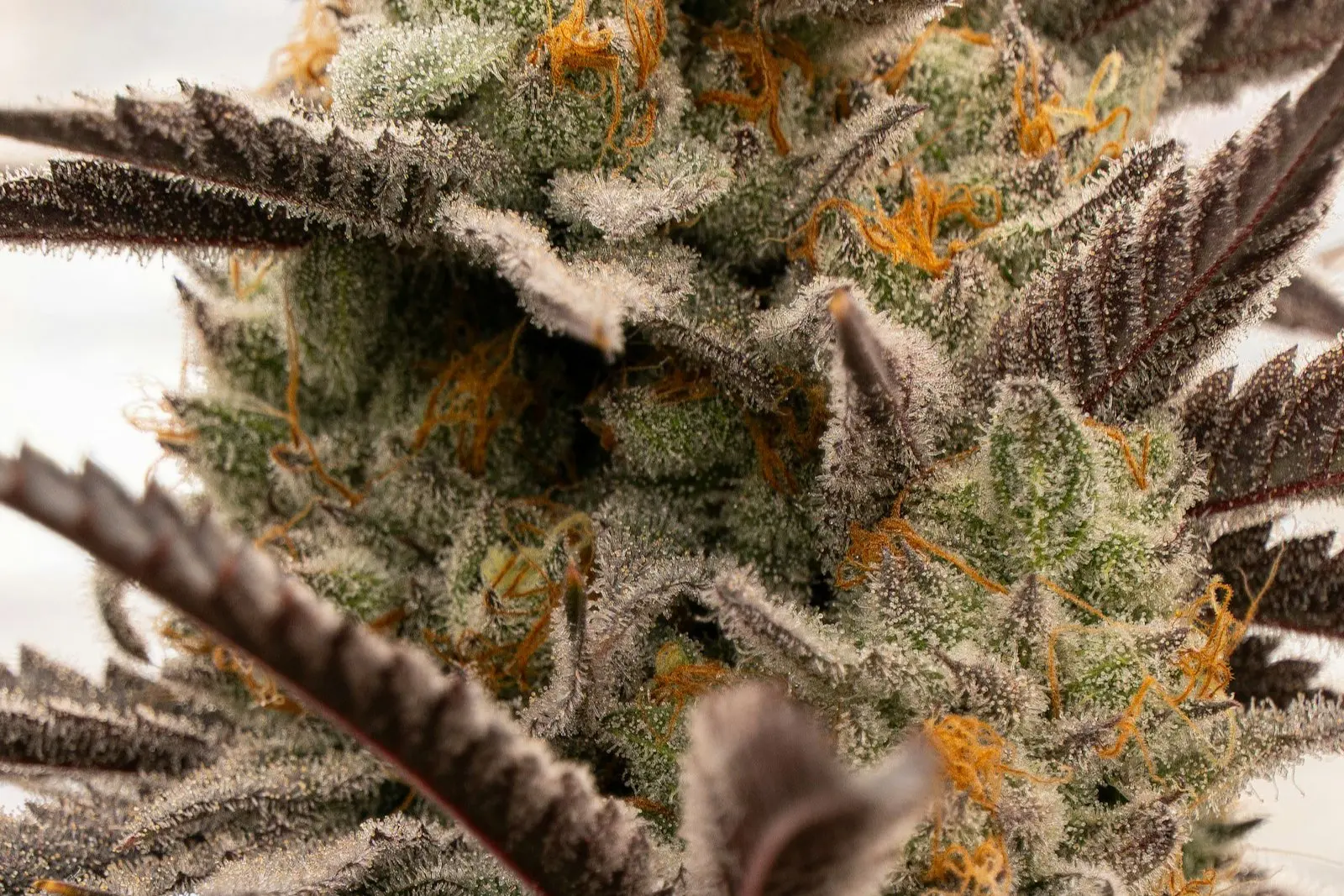
Mango Kush is a cannabis strain sold for its ripe-mango scent, also available as a CBD hemp flower under 0.3% Δ⁹-THC. Myrcene, often credited with that scent, explains only part of it: a 2023 study traces the tropical notes of cannabis to trace amounts of sulfur compounds. When you buy, rely on the batch's certificate of analysis, because the name guarantees neither the genetics nor the content.
Key takeaways
- "Mango Kush" is a trade name, and its stated lineage, which varies between catalogues, could only be confirmed by a genetic test.
- Terpenes account for about 1 to 4% of a flower's mass, yet they explain fruity aromas poorly.
- In more than 100 samples, the indica and sativa labels corresponded to no overall genetic difference.
- A CBD flower sold in France must come from a hemp variety listed in the catalogue and contain at most 0.3% Δ⁹-THC.
- On 23 September 2026, the Phytogrammes catalogue had no Mango Kush; the nearest profile is Mango Zkittlez.
What the name Mango Kush means
The name claims a lineage: "Mango" for the fruit and "Kush" for lines from the Hindu Kush range, between Afghanistan and Pakistan. Seed banks describe it as an indica-dominant cross, but the parents they name vary from one source to the next. Without a genetic test, nobody can say what a bag sold under this name contains.
The CBD version adds a further question. The French order of 30 December 2021 allows only hemp varieties listed in the EU common catalogue or the official catalogue, with at most 0.30% Δ⁹-THC. A legal flower sold as "Mango Kush CBD" is therefore a hemp flower selected for a similar aroma profile, and a different plant from the THC-rich cannabis strain of that name. Our article on varieties in the EU catalogue explains how listing works.
Where the mango scent comes from
Myrcene, a terpene present in most cannabis strains, often gets the credit for the mango smell. The chemistry is more complicated. A 2023 study in ACS Omega compared strains with very different aromas and found their terpene profiles very similar. Myrcene was barely linked to the "exotic" notes a panel perceived, with a correlation of 0.12.
The authors traced the explanation to compounds present in trace amounts. A family of sulfur compounds bearing a 3-mercaptohexyl group produces the citrus and tropical fruit notes. The same molecules occur in passion fruit, grapefruit, some grapes and hops. They weigh less than a thousandth of the flower's mass, against 1 to 4% for terpenes, yet their smell is far stronger.
A terpene list on a product page thus describes the flower's dominant chemistry, which may differ from what your nose picks up. Our article on the role of terpenes explains what these molecules do and what they do not.
Indica, sativa, Kush: what the labels are worth
Almost every Mango Kush product page says "Indica-dominant". A study published in 2021 in Nature Plants tested these labels. The researchers analysed more than 100 cannabis samples, measured their terpenes and cannabinoids and read more than 100,000 genetic markers. Across the genome, samples labelled indica could not be told apart from those labelled sativa. The label followed only a few terpenes, governed by a small group of genes.
The word "indica" therefore describes an aroma profile more than a lineage. Our article indica or sativa traces where these terms come from, and our comparison of Kush CBD strains shows what the family covers in practice.
Choosing a flower with a Mango Kush profile
A strain name guarantees nothing, and two batches sold under one label can differ in CBD as much as in aroma. You can check four points on the product page or the certificate of analysis:
- The batch number, which has to match the product sold.
- The measured Δ⁹-THC, at 0.3% at most. The sale of flowers within this framework became legal with the Conseil d'État decision of 29 December 2022.
- The measured CBD of the batch, which is the figure that counts, whatever the trade name suggests.
- The absence of semi-synthetic cannabinoids such as HHC, which are controlled drugs. Be wary of a CBD flower that promises a strong effect.
On 23 September 2026, the Phytogrammes catalogue had no Mango Kush. In the CBD flowers category, the closest flower by name and profile is Mango Zkittlez. Its reference profile for batch PG-26-1D35 shows 7.7% CBD and 0.2% Δ⁹-THC, with no certificate published, and a sweet tropical aroma carried by limonene and myrcene, at €7.95 per gram at the 2 g tier. A fruit name tells you little about aroma: Guava Kush, named after guava, has a lemony profile dominated by limonene, with 13.5% CBD on batch PG-26-263D.
These contents and prices appeared on the product pages on 23 September 2026, and a new batch may show a different profile. Our guide explains how to read a certificate of analysis line by line.
Keeping the scent to the last bud
The molecules behind the smell are volatile, and heat, light and air drive them off or break them down. An airtight, opaque jar stored cool and away from sunlight slows the loss. Excess humidity, however, favours mould, and a mouldy flower should never be consumed. Our guide on storing CBD flowers gives the humidity and temperature settings.
The way you consume the flower also changes what you perceive. A vaporiser heats the flower without burning it, whereas combustion destroys part of the aroma and produces tar. Our article on vaporisation temperatures shows the heat at which each family of compounds is released.
Frequently asked questions
Yes, provided the flower comes from a hemp variety listed in the catalogue and contains no more than 0.3% Δ⁹-THC. The name "Mango Kush" says nothing about compliance, which only the batch's certificate of analysis can show.
A compliant flower does not. CBD has no psychoactive effect, and THC is capped at 0.3%. Our article does CBD get you high explains why a high should be a warning sign.
The name is a trade name and comes with no controlled genetics. The grower, the growing method, the drying and the age of the batch all change the terpenes and the trace sulfur compounds that make up the scent.
Both are trade names that claim tropical fruit notes, and neither lineage can be verified. Compare the analyses: the catalogue's Mango Zkittlez shows 7.7% CBD on batch PG-26-1D35, with a profile of limonene and myrcene.
Written by the Phytogrammes team
Each journal article draws on cited primary sources: ANSM, EFSA, EUR-Lex and peer-reviewed publications. Product profiles are distinguished from documented laboratory results. Our approach.
Article published on . CBD is not a medicine.