How to store CBD flower: 55-65% humidity, out of the light
To store CBD flower, keep the buds whole, in a closed jar, away from light and somewhere cool, at an equilibrium humidity of 55 to 65%. That range comes from the ASTM D8197 standard, the only published reference on the subject. Storage studies show that aroma goes first: more than half of the terpenoids disappear within four months, against roughly a quarter of the cannabinoids in a year.
Contents
- 01The four rules and the evidence behind them
- 02Humidity: what ASTM D8197 actually sets
- 03Light, the main cause of loss
- 04Heat: 4 °C versus 25 °C
- 05Terpenes go before cannabinoids
- 06Keep the flower whole until the last moment
- 07CBD does not turn into THC as it ages
- 08Fridge, freezer, expiry date: practical cases
- 09Frequently asked questions
> Key takeaways > > - ASTM D8197 sets a water activity of 0.55 to 0.65 for dried flower: above it, mould becomes a risk; below it, the flower crumbles. > - The reference study from 1976 names light as the main cause of cannabinoid loss. > - In an extract, THCA lost 85% in a year at 25 °C, against 22% at 4 °C. > - Ground flower degrades faster than whole flower. > - Stored CBD does not turn into THC: the 2021 study found CBN, never THC.
The four rules and the evidence behind them
Four factors degrade dried flower: badly set humidity, light, heat and air. Each has been measured by at least one published source.
| Factor | Practical rule | What was measured | Source |
|---|---|---|---|
| Humidity | Equilibrium at 55-65% inside the jar | Water activity of 0.55 to 0.65 | ASTM D8197 |
| Light | Opaque container, or a closed cupboard | Main cause of cannabinoid loss | Fairbairn et al., 1976 |
| Heat | Cool, 4 °C in the study | 25 °C, the worst condition | Milay et al., 2020 |
| Air | Whole buds, tightly closed jar | Ground flower degrades more | Milay et al., 2020 |
Humidity: what ASTM D8197 actually sets
The ASTM D8197 standard has a plain title: maintaining a water activity between 0.55 and 0.65 for dried cannabis flower. It explains both limits. Below 0.65, you guard against the growth of micro-organisms such as mould. Above 0.55, the flower does not break when handled.
Water activity, written aw, is not the same as water content. It measures the available water, the part that can move into the air or feed a mould. In a closed jar, the air eventually balances with the flower: its relative humidity, as a percentage, then equals the water activity multiplied by 100. An aw of 0.55 to 0.65 therefore means 55 to 65% relative humidity in the jar.
The 58 or 62% printed on humidity packs are manufacturers' specifications. Both sit inside the standard's range, but neither is a reference in itself. To check, a small hygrometer placed in the closed jar and read after a few hours is enough. If it shows more than 65%, the flower is too moist: our article on mould on CBD flower lists the signs to watch for. Humidity is set first during drying, covered in our guide to drying and curing.
Light, the main cause of loss
The reference work dates from 1976. Fairbairn and colleagues followed pure cannabinoids and cannabis samples for two years in the Journal of Pharmacy and Pharmacology. Their conclusion: light is the greatest single factor in cannabinoid loss, especially in solution. Air oxidation also caused clear losses, which were smaller when the plant's glands stayed intact. Up to 20 °C, temperature mattered little under their conditions.
The authors judged the samples reasonably stable for one to two years when kept in the dark at room temperature. In practice, opacity matters more than the container's material. A clear glass jar is fine if it lives in a closed cupboard. Sitting on a lit shelf, it is the worst place possible, even in a cool room.
Heat: 4 °C versus 25 °C
A study published in 2020 in Frontiers in Plant Science stored flowers and extracts in the dark for a year at four temperatures: -80, -30, 4 and 25 °C. According to Milay and colleagues, whole flowers kept at 4 °C gave the best conditions, while 25 °C produced the largest changes in cannabinoids. Deeper cold did no better than 4 °C.
The gap was widest in extracts. Dissolved in ethanol or DMSO, a laboratory solvent, THCA lost about 22% in a year at 4 °C, against 85% at 25 °C. In olive oil, the gap was far smaller: 18% against 24%. The two studies do not contradict each other: in 1976, heat had little effect up to 20 °C; in 2020, a year at 25 °C became the deciding factor.
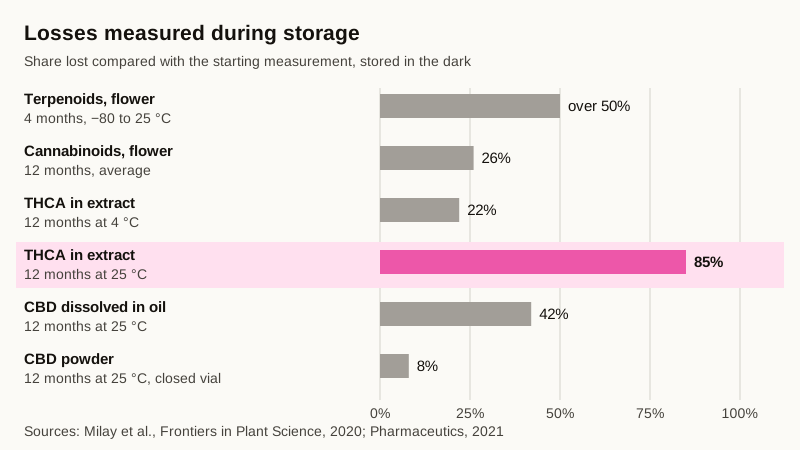
The format matters as much as the temperature. A study published in 2021 in Pharmaceutics exposed CBD to 25 °C and 60% humidity. CBD powder stayed stable for 270 days and had lost only about 8% after a year in a closed vial. Dissolved in sunflower oil, the same CBD had lost 42% in a year. Our article on storing CBD oil draws the consequences for bottles.
Terpenes go before cannabinoids
In the 2020 study, flower terpenoids had lost more than 50% within four months, whatever the temperature. Cannabinoids lost 26% on average over twelve months. Terpenes, which give the flower its smell, are more volatile: they evaporate at room temperature.
The practical consequence: a flower can keep most of its cannabinoids and still have lost half its scent. A faded smell does not mean an empty product, only that the most fragile fraction has gone. Conversely, a figure on a certificate of analysis holds for the date of the test, not for a flower stored badly for a year. Our article on hemp terpenes explains the chemistry, and the one on trichomes shows where the plant stores these molecules.
Keep the flower whole until the last moment
In the 2020 study, ground samples held more degradation products than whole flowers, especially at 25 °C. Fairbairn had already explained why in 1976: the plant's glands, the trichomes, protect their contents like tiny containers. Grinding opens them and multiplies the surface exposed to air.
So grind at the time of use, not a week ahead. A jar sized to the amount stored, rather than a large half-empty one, also limits the air in contact with the buds. That last point is a deduction from the role of oxidation, not a published measurement.
CBD does not turn into THC as it ages
The 2021 study looked for CBD's breakdown products over a year. It found CBN in many partly degraded samples, and no Δ⁹-THC. The idea that CBD flower "gains" THC over time comes from a confusion with reactions triggered in the laboratory, in acidic conditions.
CBN, on the other hand, is the classic sign of ageing. Fairbairn had already seen THC oxidise into CBN in air, in the dark. A high CBN figure on the analysis of an older batch is therefore nothing unusual. Our comparison of CBD and CBN sets out the difference between the two molecules.
Fridge, freezer, expiry date: practical cases
The fridge. This is the condition the 2020 study found best for whole flowers. The catch is condensation: a cold jar opened in a warm room fogs up with moisture. Let it return to room temperature, closed, before opening it.
The freezer. At -30 and -80 °C, the study got no better result than at 4 °C for whole flowers. Nothing justifies freezing flower you plan to use in the coming months.
The expiry date. No primary source sets a precise shelf life for flower. Think in terms of conditions rather than dates, and read our guide to the best-before date of flower, hash or oil. Resins and concentrates follow other rules, described in our article on storing rosin and crumble. To choose a flower, the CBD flower page gives the variety and measured level of each product.
Frequently asked questions
What humidity should CBD flower be stored at?
ASTM D8197 sets a water activity of 0.55 to 0.65, which is 55 to 65% relative humidity in a closed jar at equilibrium. Above that, the risk of mould rises; below it, the flower crumbles. The 58 or 62% figures are settings of commercial humidity packs, within that range.
How long does CBD flower keep?
No precise shelf life has been established. Published measurements give rates instead: over 50% of terpenoids lost in four months, about 26% of cannabinoids in a year. In 1976, samples kept in the dark at room temperature stayed reasonably stable for one to two years.
Should CBD flower go in the fridge?
It is the best condition measured for whole flowers: 4 °C, in the dark. Always let the jar return to room temperature before opening it, or condensation will moisten the flower.
Does CBD turn into THC over time?
No. The stability study published in 2021 in Pharmaceutics followed CBD for a year and found no THC among its breakdown products. It found CBN.
Is a clear glass jar suitable?
Yes, as long as it is kept in a closed cupboard or drawer. Light was the main cause of loss identified in 1976; exposure matters more than the container's material.
Written by the Phytogrammes team
Every article in this journal draws on primary sources (ANSM, EFSA, EUR-Lex, peer-reviewed publications) and on the lab's own practice: batch-by-batch HPLC analyses, measured cannabinoid profiles. Our approach.
Article published on . CBD is not a medicine.