Storing CBD oil: heat, air and light, by the numbers
Keep a CBD oil tightly closed, cool and in the dark, and use it up within months of opening. In a 2021 study carried out away from light, CBD dissolved in sunflower oil stayed stable for six months at 25 °C, then had lost 42% after one year. At 40 °C, the loss reached 76%. Heat is the best-documented factor.
Contents
> Key takeaways > > - At 25 °C in the dark, CBD in oil stayed stable for at least 180 days, then lost 42% in one year. > - At 40 °C, the loss reached 16.5% in six months and 76% in one year, in a closed vial. > - In solution, CBD stayed stable for at least 12 months at 5 °C in a 2020 study. > - Exposed to daylight for 30 days, CBD e-liquids lost 13%, against 4% in the dark. > - As it ages, CBD turns into CBN and oxidation products, not THC.
What stability studies measure
Few studies have followed a CBD oil over time. The most complete was published in 2021 in Pharmaceutics by a team in Prague. It stored CBD powder and CBD dissolved in sunflower oil in the dark for one year, at 25 °C with 60% humidity and at 40 °C with 75%. The conditions follow the international guidelines for drug stability testing.
CBD in oil proved much less stable than the powder. At 25 °C, it lost nothing measurable for at least 180 days, then only 58% of the original CBD remained after one year. At 40 °C, in a closed vial, the loss was 16.5% after six months and 76% after one year. In an open vial, only 1% remained. The powder, by contrast, had lost only about 8% in one year at 25 °C in a closed vial.
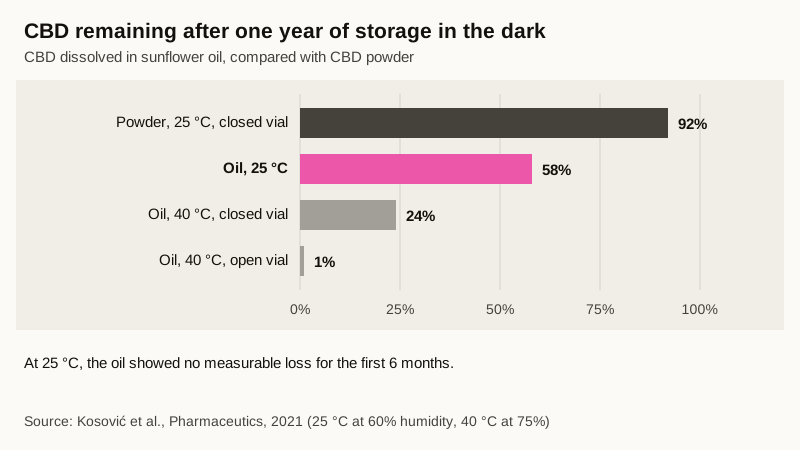
These figures apply to sunflower oil samples each containing 5 mg of CBD. Another carrier oil or another concentration may age differently, but the direction of the effect is clear.
Heat, the clearest factor
The studies cited here all point the same way: the warmer it is, the faster CBD disappears. A 2020 study from Milan on 13 CBD e-liquids measured an average loss of up to 20% in 30 days at 37 °C, against less than 5% at 4 °C. A team in Madrid studied CBD in solution: it proved unstable at room temperature but stable for at least 12 months at 5 °C.
In practice, the places to avoid are the ones that heat up: a sunny windowsill, the top of a radiator, a car in summer, an overheated bathroom. A closed cupboard away from heat sources is fine. The fridge slows degradation further.
| Place | Verdict | Why |
|---|---|---|
| Closed cupboard, temperate room | Fine | Dark, stable temperature |
| Fridge | Fine, even slower | CBD in solution stable for 12 months at 5 °C |
| Windowsill | Avoid | Light and heat combined |
| Car, next to a radiator | Avoid | 37 to 40 °C clearly speed up the loss |
Light and air, two factors to qualify
Light matters over time. In the Milan study, e-liquids left in daylight for 30 days lost 13% of their CBD on average, against 4% for samples wrapped in aluminium foil. On the other hand, the Czech photostability test, five days under intense light, found no significant loss in the oil at 25 °C. Brief exposure is not a disaster; weeks on a shelf in daylight are. Amber glass filters part of the light, but it does not replace storage in the dark.
Air matters mostly when it is hot. At 25 °C, the Czech researchers found no significant difference after one year between open and closed vials. At 40 °C, the gap was huge: 24% of CBD left in a closed vial, 1% in an open one. Closing the bottle after each use costs nothing and limits this risk.
The carrier oil ages too
CBD is not alone in the bottle. The oil that dilutes it oxidises as well. In the 2021 study, the sunflower oil turned from orange to brown and thickened markedly at 40 °C, a sign that its unsaturated fatty acids were oxidising and polymerising. Hemp seed oil is rich in polyunsaturated fatty acids, which oxidise in contact with air even at room temperature, according to a 2024 study by the US Department of Agriculture. Medium-chain triglycerides (MCT), made of saturated fatty acids, lack these double bonds: by their structure, they are much less prone to oxidation.
The signs of an oil that has aged badly are concrete: a darker colour, a thicker texture, a rancid smell. A 2018 analysis of 14 CBD oils sold in Europe looked for these lipid oxidation products; it also found 9 oils out of 14 whose content differed markedly from the label. Our article on the definition and formats of CBD oil describes the usual carrier oils.
CBD does not turn into THC in a cupboard
The idea comes up often: as it ages, a CBD oil would "produce" THC. The 2021 study looked for degradation products over one year. It found CBN and oxidation products, and no Δ⁹-THC.
THC appears under far harsher conditions. A 2022 study heated pure CBD to 220 °C: it had lost more than 80% after 60 minutes, and Δ⁹-THC, Δ⁸-THC and CBN were among the products formed. That is cooking chemistry, unrelated to storage. Our comparison CBD or CBN explains the molecule that actually forms.
How long to keep an opened bottle
Since May 2026, a CBD oil can no longer be sold in France as a food: the Ministry of Agriculture stated that foods containing CBD must be withdrawn from the market. Those still on sale are sold, among other things, as cosmetics, and their label follows article 19 of Regulation (EC) No 1223/2009.
The regulation sets two cases. If the product keeps for 30 months or less, the label carries a date of minimum durability, preceded by an hourglass or the words "best used before the end of". Beyond 30 months, it shows the period after opening: an open jar followed by a number of months, for example "12 M". Write the opening date on the bottle so you know where you stand. Our article on the best-before date of a flower, hash or oil details these mentions, and the CBD oils category lists the products in the catalogue.
Frequently asked questions
Where should I store CBD oil?
In a closed cupboard, away from light, from windows, radiators or any appliance that gives off heat. Close the bottle tightly after each use.
Should CBD oil go in the fridge?
It is not essential, but cold slows degradation. In a 2020 study, CBD in solution stayed stable for at least 12 months at 5 °C.
How long does an opened CBD oil keep?
Follow the period after opening shown on the label. As a benchmark, the oil tested in 2021 had lost nothing measurable in six months at 25 °C, but 42% after one year.
Is an oil that has changed colour still good?
An oil that darkens, thickens or smells rancid has oxidised. Its CBD content has probably dropped, and the carrier oil itself has degraded: better not to use it any more.
Does CBD turn into THC over time?
No. The 2021 stability study found CBN among the degradation products, never Δ⁹-THC. THC has been observed when pure CBD was heated strongly, to 220 °C, not in ordinary storage.
Written by the Phytogrammes team
Every article in this journal draws on primary sources (ANSM, EFSA, EUR-Lex, peer-reviewed publications) and on the lab's own practice: batch-by-batch HPLC analyses, measured cannabinoid profiles. Our approach.
Article published on . CBD is not a medicine.