Cannabis in East Africa: export yes, recreational use no
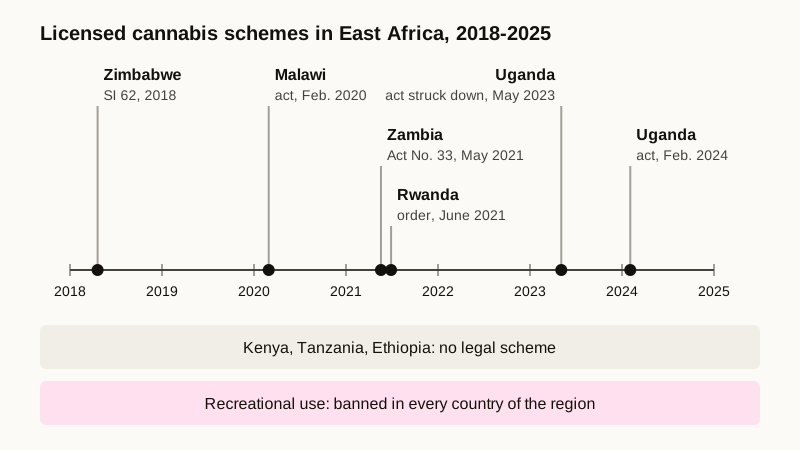
In East Africa, five countries opened a legal cannabis sector between 2018 and 2024: Zimbabwe, Malawi, Rwanda, Zambia and Uganda. All of them control it through licences, for medical, scientific or industrial use, often geared to export. None allows recreational use, and Kenya, Tanzania and Ethiopia keep a complete ban.
Contents
- 01Which countries count as East Africa?
- 02Zimbabwe, Malawi, Zambia: the first to open up
- 03Rwanda and Uganda: a medical sector under state control
- 04Kenya, Tanzania, Ethiopia: the ban stands
- 05The international framework: what the 2020 vote changed
- 06What it means for a consumer in France
- 07Frequently asked questions
> Key takeaways > > - Zimbabwe led the way in 2018; in 2025 its medical production was still reserved for export. > - Rwanda regulates cultivation and export through a ministerial order published on 28 June 2021, for medical and research use. > - In Uganda, a law struck down in May 2023 did not legalise cannabis; the replacement law dates from February 2024. > - In Tanzania, growing a prohibited plant carries at least 30 years in prison. > - None of these laws changes the French framework: no more than 0.30% Δ⁹-THC in products sold in France.
Which countries count as East Africa?
The boundaries depend on who draws them. In the United Nations geographic classification, the "Eastern Africa" region covers about twenty countries and territories: those of the East African Community, the Horn of Africa, but also Malawi, Zambia, Zimbabwe, Mozambique, Madagascar and the Indian Ocean islands. Réunion and Mayotte are included too, and French law applies there in full.
This overview follows that broad definition. It covers the countries that changed their law and the three large countries that did not.
| Country | Reference text | What is allowed | Recreational use |
|---|---|---|---|
| Zimbabwe | Regulation SI 62 of 2018 | Licensed medical cultivation, for export | Banned |
| Malawi | Cannabis Regulation Act, 2020 | Medical cannabis and industrial hemp | Banned |
| Rwanda | Ministerial Order No. 3 of 2021 | Medical and research cultivation, export | Banned |
| Zambia | Act No. 33 of 2021 | Medical, scientific and research use | Banned |
| Uganda | Narcotics act of 2023, signed in 2024 | Cultivation under a health minister's licence | Banned |
| Kenya | Narcotics act of 1994 | Nothing | Banned |
| Tanzania | Drug control act of 2015 | Nothing | Banned |
| Ethiopia | Criminal Code of 2004 | Nothing | Banned |
Zimbabwe, Malawi, Zambia: the first to open up
Zimbabwe legalised the production of cannabis for medical and scientific use in 2018, through regulation SI 62 of 2018. The country's medicines agency, MCAZ, spells it out in its February 2025 FAQ: medical production is, for now, for export only. The same document separates industrial hemp, defined in Zimbabwe as containing less than 1% THC, from medical cannabis, above that level.
Malawi followed in 2020. Parliament passed a law on 28 February 2020 covering the cultivation, processing, import, export and use of medical cannabis and industrial hemp. An article in the Malawi Medical Journal notes that the text separates marijuana, which remains illegal, from industrial hemp and medical cannabis, and that it sets up a regulator in charge of licences.
In May 2021, Zambia passed two twin laws: the Cannabis Act, No. 33 of 2021, signed on 19 May 2021, and an Industrial Hemp Act, No. 34 of 2021. The first restricts the cultivation, manufacture, import and export of cannabis to medical, scientific or research purposes, under licence from the Zambian medicines regulator.
Rwanda and Uganda: a medical sector under state control
In Rwanda, the Cabinet approved on 12 October 2020 guidelines on "high value therapeutic crops", the phrase used for medical cannabis. The legal framework is Ministerial Order No. 3 of 2021, published in the Official Gazette on 28 June 2021. It covers the cultivation, processing, distribution and use of cannabis for medical and research purposes, with renewable five-year licences and export permits. Medical use requires a prescription from a specialist doctor. In March 2024, the New Times reported that a first company, KKOG, had obtained an export licence. We found no public record of a first export.
Uganda went through an often misunderstood episode. On 5 May 2023, the Constitutional Court struck down the 2015 narcotics act because Parliament lacked a quorum when it was passed. Several media outlets concluded that cannabis had been legalised. The Ugandan judiciary denied it in a press release of 9 May 2023: the restrictions of the older drugs law still applied.
Parliament then passed a new narcotics act, known as the 2023 Act, signed into law in February 2024. Growing a prohibited plant now requires a licence from the health minister; without one, the penalty is up to 5 years in prison, and up to life for a repeat offence. The national drug authority issues export licences. According to the Daily Monitor newspaper, a first cultivation and export licence was granted in July 2025 to a private farm.
Kenya, Tanzania, Ethiopia: the ban stands
Kenya applies the Narcotic Drugs and Psychotropic Substances (Control) Act of 1994, which replaced a 1933 law. A bill tabled in 2018 to regulate cannabis never came to a vote. The Institute for Security Studies (ISS) traces this Kenyan debate on decriminalisation, which led to no change in the law.
Tanzania is the strictest country in the region. Its 2015 drug control and enforcement act lists cannabis among prohibited plants: growing them carries at least 30 years in prison. In April 2024, the minister in charge told Parliament that the question should not be rushed.
Ethiopia punishes personal use of narcotics, cannabis included, under article 525 of its Criminal Code. The Ministry of Justice states a penalty of up to 7 years in prison and a 50,000 birr fine.
The international framework: what the 2020 vote changed
All these laws sit within the 1961 Single Convention on Narcotic Drugs, which lists cannabis and cannabis resin in Schedule I. On 2 December 2020, the UN Commission on Narcotic Drugs removed cannabis from Schedule IV, the list of substances with particularly dangerous properties, by 27 votes to 25 with one abstention. Cannabis stays in Schedule I: its non-medical use remains prohibited under the conventions. The vote eased the way for medical schemes, without opening any recreational market.
What it means for a consumer in France
Nothing, directly. In France, the framework remains the order of 30 December 2021: only hemp varieties listed in the official catalogues, with no more than 0.30% Δ⁹-THC, are authorised, and the same limit applies to products that contain them. The Rwandan, Ugandan and Zimbabwean schemes produce THC-rich medical cannabis for regulated markets; a private individual cannot import it.
Receiving a parcel from these countries brings French customs rules into play, described in our article on CBD and customs. For comparison with other regions, see our overview of Central Africa, the case of Morocco and its legal sector, and our summary of the three legal models worldwide.
Frequently asked questions
Which East African country has legalised cannabis?
None has legalised recreational use. Five countries allow licensed cultivation: Zimbabwe since 2018, Malawi since 2020, Rwanda and Zambia since 2021, and Uganda with its law signed in 2024. These schemes serve medicine, research, industrial hemp and export.
Is cannabis legal in Rwanda?
Not for private individuals. The ministerial order published on 28 June 2021 allows the cultivation, processing and export of cannabis for medical and research purposes, under licence. Medical use requires a prescription from a specialist doctor.
Did Uganda legalise cannabis in 2023?
No. On 5 May 2023 the Constitutional Court struck down a 2015 law on procedural grounds, and four days later the judiciary made clear that cannabis remained banned. A new law, signed in February 2024, makes any cultivation subject to a licence from the health minister.
Is cannabis legal in Kenya?
No. The 1994 narcotics act still applies, and the bill tabled in 2018 to regulate cannabis never came to a vote.
Written by the Phytogrammes team
Every article in this journal draws on primary sources (ANSM, EFSA, EUR-Lex, peer-reviewed publications) and on the lab's own practice: batch-by-batch HPLC analyses, measured cannabinoid profiles. Our approach.
Article published on . CBD is not a medicine.