Is delta-8 THC legal in France? No, it is a narcotic
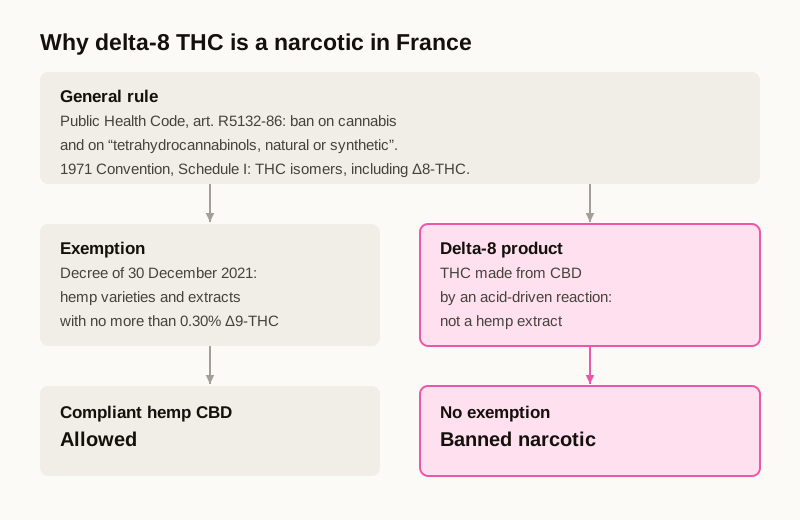
No, delta-8 THC is not legal in France. Article R5132-86 of the Public Health Code bans “tetrahydrocannabinols, natural or synthetic”, and delta-8 is one of them. The exemption that CBD relies on only covers hemp whose Δ⁹-THC stays under 0.30%: it does not cover THC made from CBD.
Contents
> Key takeaways > > - Delta-8 THC is an isomer of ordinary THC. It is psychoactive, occurs only in traces in the plant, and in practice is made from CBD. > - In France it falls under the general ban on tetrahydrocannabinols. No specific decision was needed. > - Use is punishable by one year in prison and €3,750, or a fixed fine of €500 since 20 August 2026. > - A study of 27 delta-8 products found none correctly labelled, and Δ⁹-THC in all of them.
What is delta-8 THC?
Delta-8-tetrahydrocannabinol (Δ⁸-THC) has the same formula as Δ⁹-THC, the psychoactive molecule in cannabis. Only the position of one double bond in one of the molecule's rings changes. The two are isomers: same atoms, different arrangement.
The plant makes very little of it. The WHO critical review of THC isomers reports Δ⁹/Δ⁸ ratios ranging from 99.9/0.1 to 98.6/1.2. It adds that the Δ⁸ found in cannabis may simply be a breakdown product of Δ⁹. The delta-8 sold online is therefore manufactured: the same document describes the most common synthesis, cyclising CBD in strong acid.
Its effects are the same in kind as those of THC. According to the WHO, the few human trials described an intoxication “similar in quality” but weaker than that of Δ⁹-THC. A delta-8 product is a psychoactive product, which sets it firmly apart from CBD.
Why it is banned in France
This point is often misunderstood, including by some sellers. French law does not list THCs one by one: article R5132-86 of the Public Health Code bans the production, sale, possession and use of cannabis and of “tetrahydrocannabinols, natural or synthetic”, along with their esters, ethers and salts. Delta-8 falls into that category without any new text being needed. Internationally, it also sits in Schedule I of the 1971 Convention on Psychotropic Substances, with other THC isomers, according to the same WHO document.
CBD escapes this ban through an exemption. The decree of 30 December 2021 allows Cannabis sativa L. varieties whose delta-9-THC content does not exceed 0.30%, and caps extracts and the products containing them at the same level. The exemption concerns hemp and its extracts, not THC made by synthesis. The fact that the threshold only names Δ⁹ opens no door for Δ⁸: it remains a banned tetrahydrocannabinol.
ANSM classifications have since added other molecules that were not THCs in the strict sense. HHC, HHCO and HHCP have been narcotics since 13 June 2023. H4CBD, H2CBD, HHCPO and THCP followed on 3 June 2024. Our HHC timeline and our page on THCP trace these decisions.
What users and sellers risk
As a narcotic, delta-8 falls under the general penalties. The amounts below are those of the texts in force on 23 September 2026:
| Situation | Text | Maximum penalty |
|---|---|---|
| Use | Art. L3421-1, Public Health Code | 1 year and €3,750, or a fixed fine of €500 (€400 reduced, €1,000 increased) |
| Supplying a consumer | Art. 222-39, Criminal Code | 5 years and €75,000 |
| Transport, possession, offer, sale | Art. 222-37, Criminal Code | 10 years and €7,500,000 |
| Driving after use | Art. L235-1, Highway Code | 3 years and €9,000 |
The fixed fine rose from €200 to €500 under law No. 2026-798, in force since 20 August 2026. A shop selling delta-8 gummies or cartridges faces the penalties of article 222-37, whatever the word “hemp” on the packaging.
What delta-8 products actually contain
Because it is made by a chemical reaction, a delta-8 product also contains whatever that reaction leaves behind. A study published in 2022 in Chemical Research in Toxicology analysed 27 delta-8 vape cartridges from 10 brands. None showed an accurate Δ⁸-THC content. Eleven contained undeclared cutting agents. All contained synthesis by-products, including Δ⁹-THC, metals and a previously undescribed cannabinoid.
The United States, where delta-8 was sold freely, has the most complete figures. The FDA recorded 104 adverse event reports between December 2020 and February 2022. From January 2021 to February 2022, US poison centres logged 2,362 delta-8 exposure cases, 41% of them involving under-18s. Among unintentional exposures, 82% affected children. Two thirds of the reports to the FDA followed eating a food product, such as a gummy or a brownie.
In France, ANSES reported in June 2025 several hundred poisonings since early 2024 linked to products sold as CBD but containing other substances: HHC, H4CBD, synthetic cannabinoids, or THC above the legal threshold. Our article on synthetic cannabinoids in CBD covers these cases.
Behind the wheel: what the test looks for
The decree of 13 December 2016 sets the thresholds for roadside testing. All of them target 9-tetrahydrocannabinol: 15 ng/ml of saliva for the roadside test, 1 ng/ml for the confirmatory saliva analysis, 0.5 ng/ml in blood. The text does not mention delta-8.
That does not protect a driver at all. The 2022 analyses found Δ⁹-THC in every delta-8 product tested. And article L235-1 of the Highway Code punishes driving after using any substance “classified as a narcotic”. On 21 June 2023 (No. 22-85.530), the Court of Cassation ruled that the offence is made out as soon as use of a narcotic is established, even when the product consumed was sold legally. Our guide to drug testing covers detection windows.
United States: the loophole behind delta-8 is closing
Delta-8 spread in the United States because the federal definition of hemp only capped Δ⁹-THC. A federal law passed in November 2025 switches to “total THC” and excludes from hemp any finished product with more than 0.4 mg of total THC per container. It is due to apply from late 2026. France never had this loophole: its ban has covered every tetrahydrocannabinol from the start.
Spotting a product to avoid
On a label or product page, these signs are enough to rule a product out:
A compliant CBD product promises no psychoactive effect. The certificate of analysis for a batch should show Δ⁹-THC at 0.30% or less: our guide to the certificate of analysis and our laboratory page explain how to read it. To report a suspicious product in France, the DGCCRF's SignalConso platform is open to everyone. If you feel unwell after use, call 15 or a poison centre, and keep the packaging.
For help with drug use, Drogues Info Service answers on 0 800 23 13 13, 7 days a week.
Frequently asked questions
Is delta-8 THC legal in France?
No. Article R5132-86 of the Public Health Code bans natural or synthetic tetrahydrocannabinols. Delta-8 is one of them, and the exemption granted to hemp does not cover THC produced by synthesis.
Is delta-8 the same as CBD?
No. It is usually made from CBD, but the reaction turns it into psychoactive THC. CBD does not intoxicate; delta-8 does.
Why was delta-8 sold legally in the United States?
The federal definition of hemp only capped Δ⁹-THC. A law passed in November 2025 replaces that criterion with total THC, due to apply from late 2026.
Does delta-8 show up in roadside tests?
The official thresholds target Δ⁹-THC, but every delta-8 product analysed contained some. And the law punishes driving after using any narcotic, which includes delta-8 itself.
Is HHC legal in 2026?
No. HHC, HHCO and HHCP have been narcotics since 13 June 2023. H4CBD, H2CBD, HHCPO and THCP followed on 3 June 2024.
Written by the Phytogrammes team
Every article in this journal draws on primary sources (ANSM, EFSA, EUR-Lex, peer-reviewed publications) and on the lab's own practice: batch-by-batch HPLC analyses, measured cannabinoid profiles. Our approach.
Article published on . CBD is not a medicine.