Are THC edibles legal in France? Gummies, drinks, oils
No, THC gummies, drinks and oils are not legal in France. Any product designed to deliver an active dose of THC falls under narcotics law: making, selling, holding or importing it is an offence, even if it was bought legally in the United States. Since 15 May 2026, CBD gummies and drinks have been withdrawn from sale too, for a different reason: none has been authorised as a novel food.
Contents
> Key takeaways > > - In the United States, a 4 g gummy containing 10 mg of THC stays under the 0.3% by weight limit that has defined hemp since 2018. > - In France, THC is a narcotic; the 0.30% limit tolerates a trace in hemp, not a dose. > - Importing narcotics is punishable by 10 years in prison and a €7,500,000 fine. > - Swallowed, THC takes 30 to 90 minutes to act and its effects last 4 to 12 hours, against 2 to 3 hours when smoked. > - The only hemp foods still allowed are seeds, seed oil and leaves for infusion, with no added extract.
What you can legally swallow in France in 2026
The table sums up the situation in September 2026, format by format.
| Product | Status in France | Legal basis |
|---|---|---|
| THC gummy, drink, oil or chocolate | Narcotic: prohibited | Order of 22 February 1990; article R5132-86 of the Public Health Code |
| Product containing HHC, H4CBD or THCP | Narcotic: prohibited | ANSM decisions of 2023 and 2024 |
| CBD gummy, drink, capsule or food oil | Withdrawn from sale since 15 May 2026 | Regulation (EU) 2015/2283, known as Novel Food |
| Hemp seeds, seed oil, leaves for infusion | Allowed, with no added cannabinoid extract | Foods consumed before 1997 |
THC is on the narcotics list, and article R5132-86 of the Public Health Code prohibits the production, sale and use of tetrahydrocannabinols, "natural or synthetic". The only exemption is for hemp: the order of 30 December 2021 tolerates no more than 0.30% Δ⁹-THC in the plant and its products. That tolerance covers a residual trace. It does not cover a product formulated for its psychoactive effect, whatever its percentage. The details are in our article on delta-9 THC in France.
For CBD, the obstacle is food law. On 20 May 2026, the French Ministry of Agriculture restated that foods containing CBD are not authorised, because CBD has not been shown to be safe. Hemp seeds, their oil and leaves for water-based infusion remain allowed, provided they respect THC limits and are not enriched with any extract. Our article on CBD gummies covers the withdrawal, and the one on 2026 regulation covers every format.
Why these products are legal in the United States
The 2018 Farm Bill defines hemp as Cannabis sativa L. with no more than 0.3% delta-9 THC on a dry weight basis. The limit is a percentage of weight, not a dose. A 4-gram gummy containing 10 mg of THC therefore comes in at 0.25%: it is still "hemp" under federal law while delivering an active dose. The US market for "hemp-derived THC" grew on that arithmetic.
Congress set out to close the gap. The agriculture appropriations act of 12 November 2025 (P.L. 119-37) changes the definition: it counts total THC, excludes finished products with more than 0.4 mg of total THC per container and rules out cannabinoids synthesised outside the plant. According to the Congressional Research Service, the new definition was due to take effect on 12 November 2026. A 10 mg gummy is twenty-five times over that cap.
France never had that gap. Its law does not reason in percentage of a product's weight, but on the molecule and on what the product is meant for.
Why swallowed THC works differently
The format changes nothing about legal status, but it changes the effect a lot. Smoked or vaped, THC passes from the lungs into the blood within minutes. Swallowed, it first goes through the gut and then the liver, which breaks down a large share and turns another part into 11-OH-THC, a metabolite that is also psychoactive.
A clinical pharmacology review published in 2003 gives the average timings. Inhaled, THC acts within seconds to a few minutes, peaks at 15 to 30 minutes and fades within 2 to 3 hours. Swallowed, it acts after 30 to 90 minutes, peaks at 2 to 3 hours and its effects last 4 to 12 hours. A 2018 review puts a figure on the share that reaches the blood: 10 to 35% by inhalation, sometimes only 6% by mouth.
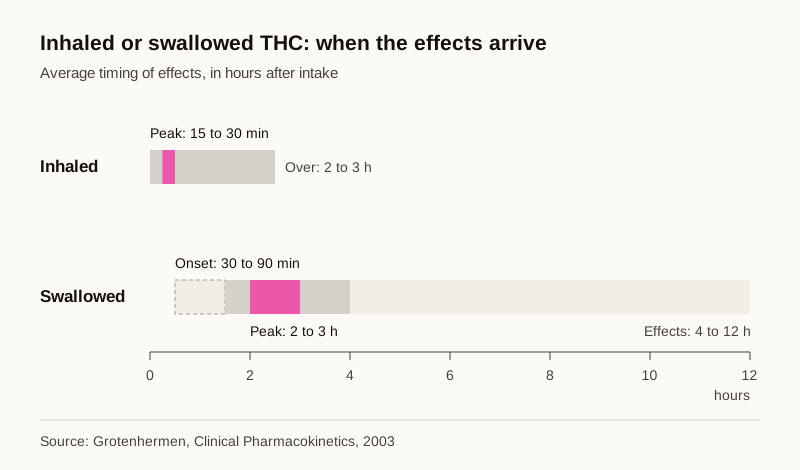
This delay has a practical consequence: feeling nothing after half an hour pushes people to take another gummy, and the two doses end up acting together. Children are exposed in another way: a gummy looks like a sweet. In the United States, poison centres recorded 207 child exposures to cannabis edibles in 2017, and 3,054 in 2021, a rise of 1,375%; 22.7% of the children involved were admitted to hospital.
Bringing THC gummies back from abroad
Buying legally in California or Canada changes nothing on arrival. Crossing the border with a THC product means importing a narcotic. Article 222-36 of the French Criminal Code punishes unlawful import of narcotics with ten years in prison and a €7,500,000 fine. Use, for its part, is punishable by one year in prison and a €3,750 fine.
The same reasoning applies to an online order delivered in France, and to "sleep" gummies that combine CBN and THC. Our article on CBN and THC gummies covers that case, and the one on fast-acting THC gummies covers the US formulations.
Behind the wheel, the long duration of a swallowed product weighs even more. Article L235-1 of the French Highway Code punishes driving after drug use with 3 years in prison and a €9,000 fine, with no THC threshold at all. Our guide to drug testing gives the tests' detection thresholds.
What about CBD you swallow?
CBD is not a narcotic, but a CBD food is still an unauthorised novel food. In February 2026, the European Food Safety Authority (EFSA) published a provisional safe level of about 2 mg of CBD a day for a 70 kg adult, limited to supplements made from pure CBD. That figure authorises no product; our article on EFSA's reference dose explains it.
A CBD oil sold as a cosmetic stays on sale, as long as it claims no food use. Do not confuse it with hemp seed oil, an ordinary food with no added CBD: our article on the different hemp oils makes the distinction.
Frequently asked questions
Are THC gummies legal in France?
No. A gummy designed to deliver a dose of THC is a narcotic, whatever its percentage. Making, selling, holding or importing it is an offence.
Are CBD gummies legal in France?
Not since 15 May 2026. They have been withdrawn from sale because no CBD food has been authorised under the Novel Food regulation. CBD itself is not banned: flowers, resins and cosmetics remain on sale.
Can I bring back THC gummies bought in the United States?
No. Buying them legally abroad changes nothing: bringing them into France is importing narcotics, punishable by ten years in prison and a €7,500,000 fine.
Why does a THC gummy take so long to work?
Because swallowed THC goes through the gut and then the liver before reaching the blood. Effects appear after 30 to 90 minutes and can last up to 12 hours, hence the risk of taking another dose too early.
Which hemp foods can you still buy?
Hemp seeds, seed oil and leaves for water-based infusion, with no added cannabinoid extract. These foods were consumed before 1997, so they fall outside the novel food rules.
Written by the Phytogrammes team
Every article in this journal draws on primary sources (ANSM, EFSA, EUR-Lex, peer-reviewed publications) and on the lab's own practice: batch-by-batch HPLC analyses, measured cannabinoid profiles. Our approach.
Article published on . CBD is not a medicine.