How to use a CBD flower: 5 ways and what French law allows
A CBD flower is smoked, in a joint without tobacco or in a pipe, or vaporised: that is the use it is sold for in France, with no more than 0.30% Δ⁹-THC. Tea and cooking fall under a different body of law, food law, and no shop may sell you a flower "for brewing" or "for cooking". Only hemp leaves intended for tea escape this rule.
Contents
- 01The 5 ways at a glance
- 02Joint, pipe or vaporiser: same route, different heat
- 03Smoke or vapour: what the measurements show
- 04Flower tea: why a shop cannot sell it
- 05Cooking: a long delay and an unknown dose
- 06The September 2026 EFSA opinion: what it changes
- 07Where to smoke, and when to drive
- 08Frequently asked questions
> Key takeaways > > - Smoked, CBD peaks in the blood after about 3 minutes; swallowed, the peak usually comes between 1 and 4 hours. > - According to the French Ministry of Agriculture, on 20 May 2026, every food containing CBD must be withdrawn from sale; seeds and leaves for tea remain allowed. > - The positive EFSA opinion of 18 September 2026 covers a pure synthetic CBD in a food supplement: it authorises nothing yet and does not concern flowers. > - A compliant flower contains traces of THC: driving after using it exposes you to 3 years in prison and a 9,000 € fine.
The 5 ways at a glance
There are two families. A joint, a pipe and a vaporiser send CBD through the lungs; tea and cooking send it through the stomach and the liver.
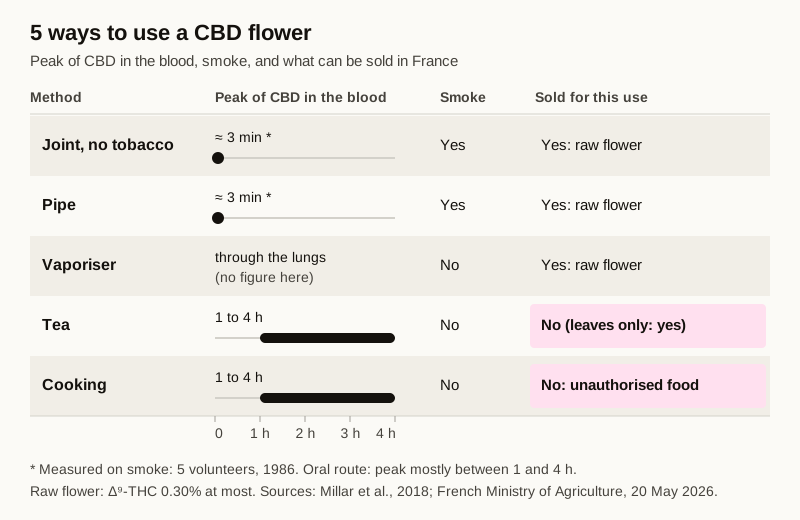
| Way | Peak of CBD in the blood | Smoke | Sale for this use |
|---|---|---|---|
| Joint without tobacco | About 3 minutes | Yes | Raw flower on sale |
| Pipe | About 3 minutes | Yes | Raw flower on sale |
| Vaporiser | Through the lungs, fast | No | Raw flower on sale |
| Tea | 1 to 4 hours | No | Banned, except leaves |
| Cooking | 1 to 4 hours | No | Banned |
The flowers in our catalogue are in the CBD flowers category, sold raw, with no food claim.
Joint, pipe or vaporiser: same route, different heat
A joint and a pipe both burn the flower. The difference is practical: a joint needs paper and enough material to keep burning, while a pipe takes a small pinch. To roll without tobacco, our guide to smoking without tobacco covers grinding and the filter tip.
A vaporiser heats the ground flower, with no flame, until the cannabinoids and terpenes, the plant's aromatic compounds, turn into vapour. Our article on vaporisation temperatures gives the measured settings.
The inhaled routes are fast. A review published in 2018 in Frontiers in Pharmacology gathered the studies on what happens to CBD in the human body. In the smoked-CBD study the review cites, five volunteers inhaled about 19 mg of CBD: the blood peak came after 3 minutes, and about 31% of the CBD reached the circulation. Five people is a small group, so treat this as an order of magnitude. The review has no equivalent measurement for a flower vaporiser.
To choose the flower itself, see our 6 checks before you buy.
Smoke or vapour: what the measurements show
Any plant material that burns produces irritating compounds. In 2008, Health Canada researchers used a smoking machine to analyse the smoke of cannabis and tobacco cigarettes prepared the same way. The cannabis smoke contained up to 20 times more ammonia than tobacco smoke, and 3 to 5 times more hydrogen cyanide, nitrogen oxides and some aromatic amines. Removing tobacco removes nicotine, not these compounds.
A vaporiser avoids combustion. An online survey published in 2007 questioned 6,883 cannabis users, 152 of whom mainly used a vaporiser. Those users reported fewer respiratory symptoms, such as coughing, even after accounting for age, tobacco and amount used. The authors list the limits themselves: self-reported symptoms, a sample that was not random, and no lung-function test.
The rule is simple: if you want to avoid smoke, only the vaporiser does that. It reduces an exposure; it does not make inhaling risk-free.
Flower tea: why a shop cannot sell it
On 20 May 2026, the French Ministry of Agriculture published a clear notice: foods containing CBD are not authorised and must be withdrawn from the market. The reason is the EU Novel Food regulation: a food not widely eaten in Europe before 1997 needs an authorisation before it can be sold, and CBD has never received one. The ministry also targets online sales and reports several hundred poisonings linked to CBD foods since 2024.
There is one exception: hemp seeds, seed oil and leaves "intended exclusively for making an aqueous infusion" remain allowed, with no added cannabinoid extract. That draws the line:
- Hemp leaves sold for tea: allowed.
- Flowering tops, meaning the flower, sold "for brewing": banned.
- Raw flower sold with no food claim: on sale, under hemp rules.
The same flower, labelled "herbal tea", becomes an unauthorised food. These rules govern sales, not your kitchen, but their reason applies at home too: for the authorities, the safety of swallowed CBD has not been shown. Our overview of legal CBD in 2026 sets out the texts.
Cooking: a long delay and an unknown dose
Swallowed, CBD usually peaks between 1 and 4 hours, according to the 2018 review, and the liver breaks down a large share before it reaches the circulation. CBD is highly fat-soluble: it dissolves in fats and very poorly in water. In studies cited by the review, exposure to CBD was up to 5 times higher in people who had eaten than in people who had fasted. A homemade recipe therefore tells you nothing about how much will be absorbed.
A quick calculation shows the scale. In February 2026, EFSA set a provisional safe level of 2 mg of CBD per day for a 70 kg adult, for CBD at 98% purity in a food supplement. A flower with 10% CBD contains 100 mg per gram, which is 50 times that benchmark, and nobody knows how much ends up in a dish. The benchmark does not apply as such to a flower: it measures the distance.
The September 2026 EFSA opinion: what it changes
On 18 September 2026, the European Food Safety Authority (EFSA) published in the EFSA Journal a favourable opinion on a synthetic CBD as a novel food. On 21 September, the trade journal FoodNavigator described it as EFSA's first positive opinion on CBD in food. The scope is narrow:
- CBD made by chemical synthesis, at least 98% pure, dissolved in an MCT-type oil;
- in a food supplement, at 2 mg per day at most;
- for adults over 25, excluding pregnant or breastfeeding women; safety is not established for people taking medication.
On 21 September, two more opinions followed, on a CBD isolated from hemp and on a hemp extract. For both files, EFSA concluded that safety cannot be established, as the applicants did not answer its requests for data.
For a flower, nothing changes. An opinion is not an authorisation: the European Commission and the Member States still have to decide, and the product assessed is a pure molecule dosed at 2 mg, not a plant.
Where to smoke, and when to drive
France's Public Health Code bans "smoking" in places of collective use and on public transport, under its article L3512-8. The text says smoking, without distinguishing what burns. Since 1 July 2025, the list has grown to include parks and gardens, beaches, bus shelters and the surroundings of schools, under decree no. 2025-582 of 27 June 2025.
Behind the wheel, the risk is real. A compliant flower contains up to 0.30% Δ⁹-THC, and a roadside saliva test looks for THC, not CBD. If it is positive, the offence of driving after drug use is established whatever the dose, punishable by 3 years in prison and a 9,000 € fine since July 2025. Our article on CBD and driving gives measured detection times and the case law.
Frequently asked questions
Can you smoke a CBD flower without tobacco?
Yes. The flower is rolled on its own, finely ground, with a card filter tip. Without tobacco there is no nicotine, but combustion still produces irritating smoke.
Can you make tea with a CBD flower?
No shop may sell you a flower for that use: a flower presented as a tea is an unauthorised food. Only hemp leaves sold for tea are allowed.
How long after a CBD flower can you drive?
No waiting time guarantees a negative test, because a compliant flower contains traces of THC, and the offence is established whatever the dose. The safest choice is not to drive after using it.
Written by the Phytogrammes team
Every article in this journal draws on primary sources (ANSM, EFSA, EUR-Lex, peer-reviewed publications) and on the lab's own practice: batch-by-batch HPLC analyses, measured cannabinoid profiles. Our approach.
Article published on . CBD is not a medicine.