CBD and appetite: trials point to a decrease
CBD does not make you hungry the way THC does. In clinical trials where it was given at high doses, the opposite comes up most often: decreased appetite, reported by 9 to 29% of patients at 20 mg per kilo per day. At the amounts found in an over-the-counter product, no effect on hunger has been measured, and no appetite claim is permitted in France.
Contents
> Key takeaways > > - THC activates the CB1 receptor, which explains the "munchies". CBD, by contrast, tends to dampen that receptor in cell models. > - A 2022 review of 11 controlled trials concludes that CBD tends to have an "anorexigenic" effect, mostly at high doses. > - The Epidyolex leaflet lists decreased appetite among its most common side effects (21%). > - These doses bear no relation to those of a wellness product: EFSA puts the provisional safe level at about 2 mg a day.
THC and CBD: opposite actions on the same receptor
Appetite depends partly on the endocannabinoid system, a network of receptors and messengers found in the brain and the gut. Its main receptor in the brain is called CB1. Our article on the endocannabinoid system explains how it works.
THC activates CB1 directly. That explains the hunger associated with cannabis, and it is a recognised medical use elsewhere: in the United States, dronabinol, a synthetic THC, has been approved since 1985 and is indicated for anorexia with weight loss in patients with AIDS.
CBD works differently. In 2015, a team at Dalhousie University showed in cells that CBD behaves as a negative allosteric modulator of the CB1 receptor: it does not activate it, it reduces the effect of the molecules that do, THC included. In animals, a 2012 study in rats observed that CBD reduced the amount of food eaten, while CBN increased it. These are laboratory data, which do not translate directly to humans. For CBN, see our dedicated page.
What human trials show
The most complete synthesis is a systematic review published in 2022 in Clinical Drug Investigation by Joaquim Pinto and Fátima Martel. It included 11 placebo-controlled trials: six in children with severe epilepsies, one in autism, one in type 2 diabetes, one in Covid-19 and two in healthy volunteers. Most report decreased appetite or weight, a few report no change, and only one reports an increase.
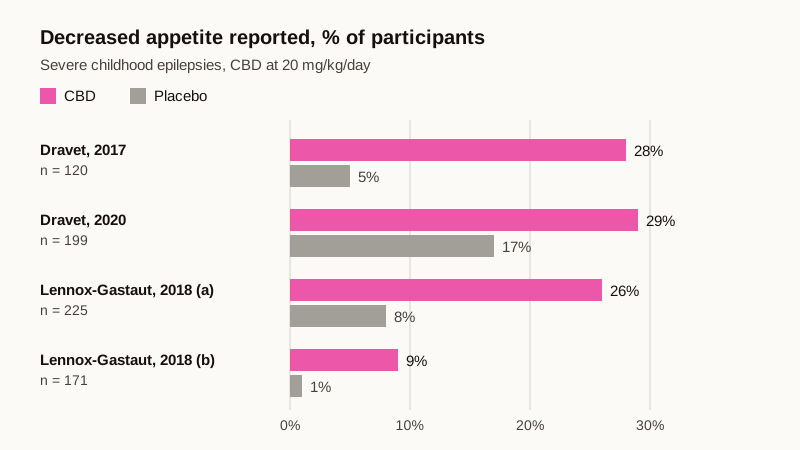
In the four large trials in Dravet and Lennox-Gastaut syndromes, at 20 mg of CBD per kilo per day, decreased appetite affected 9 to 29% of patients on CBD, against 1 to 17% on placebo. The European product information for Epidyolex, the only authorised CBD-based medicine, lists decreased appetite among the most common side effects (21%) between 10 and 25 mg/kg/day. It adds that 21% of patients at 20 or 25 mg/kg/day lost at least 5% of their body weight, against 7% at 10 mg/kg/day. Our article on Epidyolex and epilepsy covers these trials in detail.
The review's authors list the limitations themselves. In five epilepsy trials, some children were also taking topiramate, an antiepileptic known to reduce appetite. The Epidyolex leaflet notes that combining CBD with valproate increases the frequency of decreased appetite. For most trials, the authors rate the risk of bias as a concern, and it is not always clear whether appetite was reported by the patient or by the parents.
What about the doses in a wellness product?
The difference in scale is considerable. For a 70 kg adult, 20 mg/kg/day means 1,400 mg of CBD a day. In February 2026, EFSA set a provisional safe level of 0.0275 mg/kg/day, about 2 mg a day for a 70 kg adult, for supplements of CBD at least 98% pure. That level does not apply to people under 25, pregnant or breastfeeding women, or people on medication. Our article on EFSA's reference dose explains the calculation.
| Context | Daily dose | Reported effect on appetite |
|---|---|---|
| Epilepsy trials | 20 mg/kg, i.e. 1,400 mg for 70 kg | Decrease in 9 to 29% of patients |
| Type 2 diabetes trial | 100 mg twice a day | No effect on appetite or weight |
| Healthy volunteers | 600 mg | Increase in 2 of 16 participants |
| EFSA provisional safe level | about 2 mg | Not studied |
At the usual amounts in a CBD oil or flower, no trial has shown an effect on hunger, in either direction. The changes some consumers describe remain individual impressions, with no control group: a change in schedule, sleep or habits can be enough to explain them. The side effects observed, dose by dose, are listed in our article on CBD side effects.
What the law allows sellers to say
Presenting a product as acting on appetite, to increase hunger or curb it, is a health claim. Regulation (EC) No 1924/2006 only allows claims that are authorised and entered in the EU register, and none concerns CBD. A product presented as having curative or preventive properties also becomes a medicinal product by presentation, under Article L5111-1 of the French Public Health Code.
Then there is the question of ingestion. On 20 May 2026, the French Ministry of Agriculture restated that foods containing CBD are not authorised and must be withdrawn from the market, food supplements included. The full picture is in our article on CBD regulation in 2026.
Frequently asked questions
Does CBD make you hungry like THC?
No. THC activates the CB1 receptor, which stimulates appetite. CBD does not activate it and tends instead to dampen its activation in cell models. In high-dose clinical trials, the effect most often reported is decreased appetite.
Is CBD an appetite suppressant?
No, and nothing allows it to be presented as one. The decreased appetite was observed in patients on very high doses, often alongside other medicines that encourage it. The Epidyolex leaflet lists it as a side effect to monitor, not as a benefit.
Can a CBD oil change my appetite?
No trial has shown this at the doses of a wellness product, which remain far lower than in clinical studies. If you notice a lasting change in your appetite or weight, talk to a doctor and mention the products you take.
Why is CBN sometimes linked to appetite?
Because a 2012 study in rats observed that CBN increased food intake, the opposite of CBD. No human data confirm this effect, and no claim is authorised for CBN either.
Written by the Phytogrammes team
Every article in this journal draws on primary sources (ANSM, EFSA, EUR-Lex, peer-reviewed publications) and on the lab's own practice: batch-by-batch HPLC analyses, measured cannabinoid profiles. Our approach.
Article published on . CBD is not a medicine.