Strong CBD flower: 72 levels compared, price doesn't follow
A "strong" CBD flower is one rich in cannabidiol, not one with a stronger effect: CBD does not get you high. Across the 72 flowers in the Phytogrammes catalogue checked on 23 September 2026, the level shown per batch runs from 6.7 to 14.4%, and the price per gram does not track it. To choose, read the batch's total CBD and Δ⁹-THC, then compare the price of 100 mg of CBD.
Contents
- 01"Strong": a market word, not a category
- 02What the flowers actually measure: 72 product pages checked
- 03Price does not follow the level
- 04The three lines of the certificate that decide
- 05Adulteration and THC: what a flower that looks too good can hide
- 06At equal levels, freshness decides
- 07Five buying mistakes, and the check that avoids them
- 08Frequently asked questions
> Key takeaways > > - "Strong" has no legal definition; the only limit is 0.30% Δ⁹-THC. > - Of 72 flowers, 16 exceed 12% CBD and none exceeds 14.4%. > - At the same €4.95 per gram, a flower at 14.3% delivers almost twice as much CBD as one at 7.7%. > - A study of 223 products found less CBD than stated in 69% of the labelled products. > - A flower that gets you "wasted" is not compliant: too much THC or a synthetic cannabinoid.
"Strong": a market word, not a category
No French text defines a "strong" CBD flower. The law sets only one limit, and it concerns THC. The order of 30 December 2021 allows hemp varieties with no more than 0.30% Δ⁹-THC, and caps the products made from them at the same level. The Conseil d'État decision of 29 December 2022 struck down the ban on selling raw flowers. The CBD level has no cap at all.
A flower at 14% CBD is therefore no more and no less legal than one at 7%. Nor is it any closer to cannabis: CBD does not have THC's psychoactive effect, whatever its level. A higher level means more cannabidiol per gram, nothing else. Our article does CBD get you high? covers this point.
What the flowers actually measure: 72 product pages checked
To give an order of magnitude, we recorded the CBD level shown on the 72 pages of the CBD flowers category on 23 September 2026. Each page gives a batch number and a date, all in June 2026. The values are entered from our product database; the laboratories' PDF certificates are not published yet.
| CBD level shown | Number of flowers |
|---|---|
| 6 to 8% | 23 |
| 8 to 10% | 8 |
| 10 to 12% | 25 |
| 12 to 14% | 13 |
| 14% and above | 3 |
The median level is 10.8%. The highest, 14.4%, belongs to Gelonade. The Δ⁹-THC shown ranges from 0.12 to 0.29%, always below the limit. For comparison, a French study of 223 CBD products of every kind, flowers, resins, oils and sweets, measured a median level of around 4%.
These figures give a simple rule. Above 12%, a flower sits at the top of what we record; above 15%, it is outside this series. A much higher level deserves a question: where does it come from? A flower coated in extract and pollen, like moon rock, shows a level that does not come from the plant alone. That is not illegal, but it is no longer the same flower.
Price does not follow the level
For 63 of these flowers sold by the gram, the first-tier price runs from €3.45 to €8.95. Set against the measured level, it shows no trend: the flowers richest in CBD are not the most expensive.
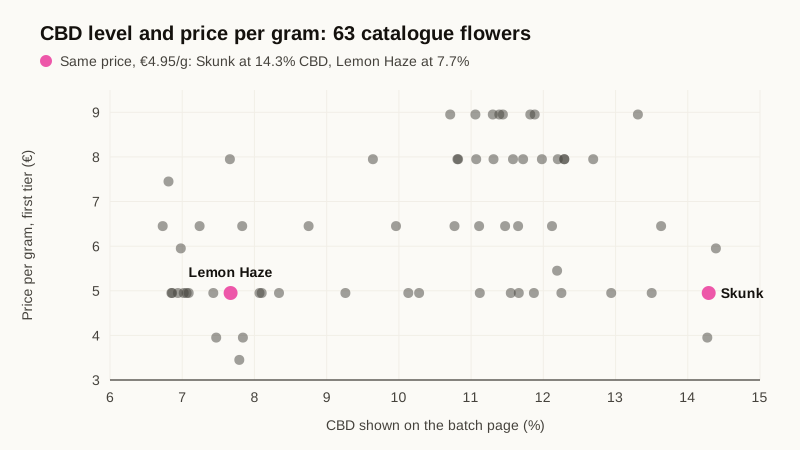
The useful figure is therefore the price of 100 mg of CBD: the price per gram divided by the percentage, then multiplied by ten: 4.95 ÷ 14.3 × 10 = €3.46. The table works it out for five flowers, at the first tier.
| Flower | Batch CBD | Price per gram | Price of 100 mg of CBD |
|---|---|---|---|
| Charlotte's Web | 14.3% | €3.95 | €2.77 |
| Skunk | 14.3% | €4.95 | €3.46 |
| Gelonade | 14.4% | €5.95 | €4.13 |
| Lemon Haze | 7.7% | €4.95 | €6.45 |
| Mango Zkittlez | 7.7% | €7.95 | €10.38 |
Skunk and Lemon Haze cost the same per gram, but the first delivers 1.9 times more CBD. Between the cheapest and the most expensive in the table, the price of 100 mg of CBD varies by a factor of 3.7. The purchase tier matters too: on most pages at €4.95, the gram drops to €1.92 from 50 g, 61% less. Our article on CBD prices in France compares these gaps with the wider market.
The three lines of the certificate that decide
A level on a label is only a statement. The document that counts is the batch certificate of analysis, usually produced by liquid chromatography (HPLC). Three lines are enough to judge a "strong" flower.
| Certificate line | What it tells you | Warning sign |
|---|---|---|
| Total CBD | CBD + CBDA × 0.877, the level after heating | A bare "CBD" figure, without the acid form or the total |
| Total Δ⁹-THC | Legal compliance, 0.30% at most | Line missing, or "not detected" with no detection limit |
| Batch and date | That the analysis describes your bag | A "range" certificate, another batch, an old analysis |
The 0.877 factor comes from chemistry: when heated, CBDA, the acid form the plant makes, loses a carboxyl group and about 12% of its mass. Take two bags labelled "15%". The first certificate shows 3.1% CBD and 12.6% CBDA: its total CBD is 3.1 + 12.6 × 0.877, or 14.2%. The second gives "CBD 15%" with no CBDA, no batch and no date. The first figure is a measurement, the second a claim. Our guide to reading a certificate of analysis covers each line, and the laboratory page describes the methods.
Adulteration and THC: what a flower that looks too good can hide
The risk with a flower sold as "strong" does not come from CBD. It comes from the gap between the label and the contents. A study by the addiction monitoring centres of Paris, Lyon and Montpellier, run with the toxicology laboratory of Lille University Hospital, bought 223 CBD products in July 2022 and April 2023. Two thirds came from websites, the rest from specialist shops, tobacconists, pharmacies and vape shops.
The results apply to all these channels. Only one product in two listed its composition on the label. Among those, 19% had a level within 20% of the label, and 69% contained less CBD than stated. Twenty-eight samples, or 12.5%, exceeded 0.3% THC, reaching up to 1.2%. Twelve, or 5.4%, contained an undeclared semi-synthetic cannabinoid; the full report identifies HHC and H4-CBD among them.
On 19 June 2025, the ANSM and Anses warned of several hundred poisonings since early 2024, linked to products sold as CBD but containing HHC, H4-CBD, a synthetic cannabinoid or too much THC. A flower that gets you "wasted" is therefore not a strong flower: it is a non-compliant one. Our articles on H4CBD and on PTC describe these products.
Two risks remain whatever the level. Smoking exposes you to combustion products, whatever the plant; our article on smoking hemp covers them. And trace THC in a flower can show up in a saliva test, even when the product is legal.
At equal levels, freshness decides
Two flowers at 11% CBD can smell very different. Aroma comes from terpenes, and they are more fragile than cannabinoids. A study published in 2024 in the journal Plants stored flowers for four months at 4 °C: depending on the treatment, some monoterpenes such as β-myrcene lost 19 to 51%, against 4 to 23% for the main cannabinoid.
The batch date therefore also tells you something about the smell. Growing method affects consistency from batch to batch more than the level itself, as our comparison of indoor, outdoor and greenhouse explains. To keep a flower well, see our storage advice. For resins, levels run higher, since sieving concentrates the trichomes: our guide to strong CBD resin continues this one.
Five buying mistakes, and the check that avoids them
- Buying the percentage on the label. In the study cited above, 69% of labelled products contained less CBD than stated. Ask for the batch's measured level.
- Confusing "CBD" with "total CBD". Without the converted CBDA, the figure can be inflated or underestimated.
- Comparing prices per gram. Only the price of 100 mg of CBD compares two flowers with different levels.
- Taking a spectacular level for a bargain. Beyond what raw flowers measure, ask how the figure was obtained.
- Accepting a certificate with no batch number. A generic document describes a different bag from yours.
Frequently asked questions
Which CBD flower is the strongest?
The one with the highest measured level on its batch. Across the 72 flowers checked on 23 September 2026, the highest level shown is 14.4%. A stated level far above that needs an explanation and a batch analysis.
Can a strong CBD flower get you high?
No. CBD does not have THC's psychoactive effect, whether the flower contains 7% or 14%. A flower that makes you intoxicated contains too much THC or a synthetic cannabinoid, and should be reported.
Is a very strong CBD flower legal?
Yes, if it is an authorised hemp variety and the product contains no more than 0.30% Δ⁹-THC. The law sets no limit on the CBD level.
How do you compare the price of two CBD flowers?
Divide the price per gram by the CBD percentage, then multiply by ten: you get the price of 100 mg of CBD. A flower at €4.95 and 14.3% works out at €3.46 per 100 mg; one at the same price and 7.7%, at €6.45.
How can you spot an enriched flower?
A stated level far above what raw flowers measure, an oily or powdery look, and no batch analysis are the signs to watch. A coated flower should say so, as moon rock does.
Written by the Phytogrammes team
Every article in this journal draws on primary sources (ANSM, EFSA, EUR-Lex, peer-reviewed publications) and on the lab's own practice: batch-by-batch HPLC analyses, measured cannabinoid profiles. Our approach.
Article published on . CBD is not a medicine.