Strong CBD resin: 14 hashes measured, 14.8 to 20.5%
A "strong" CBD resin comes down to one figure you can check: the percentage of its dominant cannabinoid, CBD or CBG, measured on the batch. Across the 14 resins in our catalogue checked on 23 September 2026, it ranges from 14.8 to 20.5%, with 0.1 to 0.2% Δ⁹-THC. A figure far above that range raises one question before you buy: which molecule was measured?
Contents
> Key takeaways > > - A resin's strength is read on the batch analysis, not on its name or its colour. > - Across 14 resins in the catalogue, the dominant cannabinoid measures 14.8 to 20.5% and Δ⁹-THC 0.1 to 0.2%. > - In June 2025, the French health agencies ANSES and ANSM warned about CBD products labelled "strong". > - HHC, H4CBD and THCP are classified as narcotics: a resin that contains them is illegal, whatever its CBD content. > - French law requires a website to say whether its customer reviews are checked, and bans fake reviews.
"Strong": what the word can measure
A resin, or hash, is a mass of trichomes, the tiny glands that cover female hemp flowers, detached from the plant and then pressed. A review published in 2021 in Frontiers in Plant Science notes that stalked glandular trichomes are the ones that produce the most cannabinoids. Concentrating these glands means concentrating the flower's cannabinoids.
In a legal hemp resin, the dominant cannabinoid is CBD or CBG, another non-intoxicating cannabinoid and the precursor of CBD in the plant. "Strong" can therefore mean only one measurable thing: a high percentage of one or the other. Aroma, colour and texture tell you nothing about that figure. Our article on resin colour shows what the shade really indicates.
Δ⁹-THC is not a measure of strength but a limit. The French order of 30 December 2021 caps Δ⁹-THC at 0.30% in hemp, its extracts and the products that contain them.
What 14 resins in the catalogue measure
The table gives the profile shown on each product page on 23 September 2026, measured by HPLC, a chromatography method that separates and quantifies each cannabinoid. A new batch may show different figures.
| Resin | Dominant | Measured content | Second cannabinoid | Δ⁹-THC |
|---|---|---|---|---|
| Strawsift CBG/CBD | CBG | 20.5% | CBD 4.7% | 0.2% |
| Rosift CBG/CBD | CBG | 20.2% | CBD 4.6% | 0.2% |
| Hash CBG 90µ | CBG | 19.3% | CBD 4.2% | 0.1% |
| Afghan Hash CBD/CBG | CBG | 18.5% | CBD 4.0% | 0.2% |
| Rosift | CBG | 18.4% | CBD 3.9% | 0.1% |
| Piatella | CBD | 18.0% | CBG 1.4% | 0.2% |
| Strawsift | CBG | 16.3% | CBD 3.1% | 0.2% |
| Bubble Hash | CBD | 16.3% | CBG 1.5% | 0.2% |
| 120u | CBD | 15.9% | CBG 1.3% | 0.2% |
| Caramelo 120u | CBD | 15.5% | CBG 1.2% | 0.2% |
| Dry Sift 90u | CBD | 15.1% | CBG 1.0% | 0.2% |
| Frozen Hash | CBD | 15.0% | CBG 1.0% | 0.2% |
| Hash 3x filtered | CBD | 14.9% | CBG 1.0% | 0.2% |
| Ice-O-Lator 45u | CBD | 14.8% | CBG 0.9% | 0.2% |
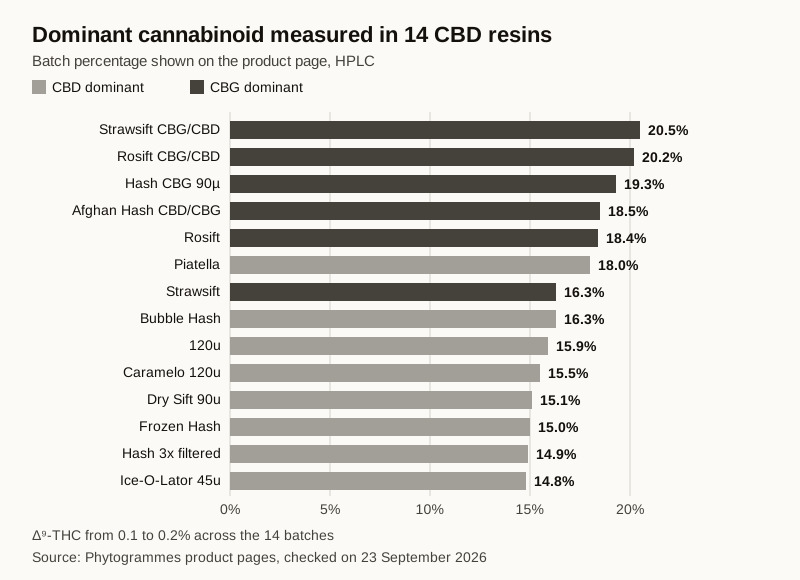
Three observations. The gap between the most and least concentrated resin is 5.7 points, not a doubling. CBG-dominant resins sit at the top of the ranking. And method does not set content: two ice-water hashes, the 120u and the 45u, measure 15.9 and 14.8%. All these products are in the CBD resin and hash category, and our comparison of static, frozen and piatella works out their price per 100 mg of cannabinoid.
Why a very high figure should worry you
A figure far above the rest does not necessarily mean a better resin. It can also hide a molecule that is not CBD. On 19 June 2025, ANSES and ANSM reported a rise in poisonings linked to products sold as CBD, most often caused by THC above 0.3% or by synthetic cannabinoids. Their statement adds that particular attention must be paid to products labelled as "strong", which may be even more dangerous.
The molecules involved are classified as narcotics. The ANSM listed HHC and two derivatives on 12 June 2023, then H4CBD, THCP and other cannabinoids on 3 June 2024. A resin that contains them is illegal, even at 20% CBD. Our article on H4CBD traces how it was banned.
On a lab report, three lines settle it:
- The dominant cannabinoid and its percentage, which must match the product page.
- Δ⁹-THC, at 0.30% at most.
- The batch number of the product sold, and no HHC, H4CBD or THCP when the lab tested for them.
Our guide to the certificate of analysis covers each line, the laboratory page describes the methods, and the article on adulterated hashish lists the signs of a tampered resin.
Hard, crumbly or sticky: what texture tells you
"Hard" and "concentrated" are two different questions: the first is about firmness, the second about content. Texture depends mainly on the separation method, the pressing and the temperature, not on cannabinoid content.
- A dry sift is sieved dry: before pressing, it is a powder of trichomes.
- An ice-o-lator hash is separated in ice water, then dried and pressed.
- A piatella is an ice-water hash cured cold for several weeks.
A hard resin softens with the warmth of your fingers without changing its content, and a sticky resin is not more concentrated. Our article on hash that is too hard or too soft explains how to temper it.
Before you buy: analysis first, reviews second
Customer reviews tell you about service, not about CBD content. Two French texts govern how they are published. Article L111-7-2 of the Consumer Code requires any site that publishes reviews to state whether they are checked and how, and to show the date of each review. Article L121-4 treats publishing fake reviews as misleading, as well as claiming that reviews come from buyers without having checked.
In practice, a useful review describes the product: taste, texture, delivery date, comparison with another purchase. A run of very short reviews posted within a few days tells you little. The reliability criteria are covered in our article on CBD reviews.
A very low price for a very high figure also calls for a look at the analysis. To compare two resins with different contents, work out the price per milligram of cannabinoid, as our guide to hash price per gram suggests.
Frequently asked questions
What CBD content makes a strong resin?
Across 14 resins in our catalogue checked on 23 September 2026, the dominant cannabinoid measures 14.8 to 20.5%. A resin advertised well above that deserves a batch analysis that names the molecule measured and tests for banned cannabinoids.
Is a more concentrated CBD resin more effective?
A higher figure means more cannabinoid per gram, nothing more. No health claim is allowed for a CBD resin, which is not a medicine.
CBD resin or CBG resin: what is the difference?
The dominant cannabinoid changes. In our catalogue, CBG-dominant resins measure 16.3 to 20.5% CBG, with 3.1 to 4.7% CBD. Both molecules fall under the same 0.30% Δ⁹-THC limit.
Can you drive after using CBD resin?
The risk is real. On 21 June 2023, France's Court of Cassation ruled that permission to sell hemp derivatives under 0.30% THC "has no bearing on the offence of driving after drug use". A legal resin contains traces of THC that can make a saliva test positive.
How can you tell whether a CBD shop's reviews are reliable?
Check whether the site explains how it checks its reviews, as the law requires, and whether each review is dated. Favour reviews that describe the product over those that stick to a generic phrase.
Written by the Phytogrammes team
Every article in this journal draws on primary sources (ANSM, EFSA, EUR-Lex, peer-reviewed publications) and on the lab's own practice: batch-by-batch HPLC analyses, measured cannabinoid profiles. Our approach.
Article published on . CBD is not a medicine.