How long does CBD take to kick in? From 3 min to 5 h
Studies do not measure the moment you "feel" CBD. They measure the time until it peaks in the blood (Tmax): 3 to 15 minutes when inhaled, 1 to 4.6 hours for a spray on the lining of the mouth, 3 to 5 hours when swallowed. With repeated doses, blood levels stabilise in about two days. The four-to-six-week window often quoted for judging a product is a convention, not a standard.
Contents
> Key takeaways > > - CBD Tmax: 3 to 15 minutes inhaled, 3 to 5 hours by mouth, according to published human trials. > - A fatty meal multiplies the blood peak of an oral CBD solution by 4.85, without changing its timing. > - Taken morning and evening, CBD reaches a steady state in about 2 days. > - No French authority has validated an onset time or a dose for any CBD product. > - To judge a product, change one thing at a time and write down what you notice.
What studies measure: the blood peak, not the feeling
The most cited reference is a systematic review published in 2018 in Frontiers in Pharmacology. Its authors, Millar and colleagues, kept 24 publications out of 792 that reported pharmacokinetic data in humans. Pharmacokinetics describes the journey of a molecule through the body: absorption, blood peak, elimination.
The number that answers "how long" is called Tmax: the time between intake and the highest blood concentration. It is not the time to a felt effect, which these studies do not measure. The same review notes that no study has measured the absolute bioavailability of swallowed CBD in humans, that is, the share that actually reaches the blood. The only known value concerns smoking: 31%.
Timing by route of intake
| Route | Reported Tmax | Key studies |
|---|---|---|
| Inhalation (smoked) | 3 to 15 minutes | Ohlsson 1986; Schwope 2011 |
| Spray on the lining of the mouth | 1 to 4.6 hours (means) | Sativex trials, including Stott 2013 |
| Oral (capsule, solution) | 3 to 5 hours | Haney 2016; Taylor 2018 |
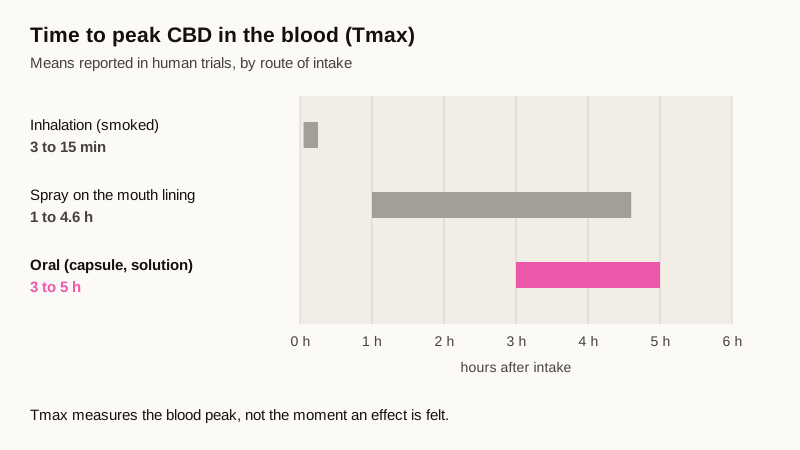
Inhalation is the fastest route: after a cigarette containing 19.2 mg of CBD, the blood peak was recorded 3 minutes after intake. Smoking burns plant matter, though, and produces toxic compounds; our article on vaporisation temperatures explains what changes without combustion.
For oil held under the tongue, the data come mainly from Sativex sprays, applied inside the cheek or under the tongue. Their means range from 1 hour to 4.6 hours depending on the trial. Our guide to the sublingual method describes the technique and its limits.
Swallowed CBD passes through the liver before reaching general circulation, which delays and lowers the peak. In the trial by Taylor and colleagues on an oral solution, Tmax was about 4 to 5 hours. For cosmetics applied to the skin, the 2018 review lists no human pharmacokinetic data.
A fatty meal changes the amount, not the timing
CBD dissolves in fat, not in water. In the phase I trial published in 2018 in CNS Drugs, a high-fat meal multiplied the blood peak by 4.85 and total exposure by 4.2, without changing Tmax.
Another trial cited by Millar found a similar effect with the mouth spray: exposure multiplied by 5 and the peak by 3 after a meal, but with Tmax delayed from 1.4 to 4.0 hours. The practical upshot: if you compare two days of use, compare them under the same meal conditions.
How long CBD stays in the body
Half-life is the time it takes for the blood concentration to fall by half. For CBD it depends heavily on the route and on repeated dosing:
- Mouth spray, single dose: 1.4 to 10.9 hours.
- Oral route, repeated doses: 2 to 5 days, according to an older six-week study.
- Oral solution twice a day: terminal half-life of about 60 hours and "effective" half-life of 10 to 17 hours in the 2018 trial.
The same trial observed a steady state, where blood levels stop rising from one dose to the next, after about 2 days of morning and evening doses. CBD then builds up moderately, 1.8 to 2.6-fold. These measurements used doses of 750 and 1,500 mg, far above those of a shop oil: the order of magnitude holds, not the exact figures.
Why people talk about four to six weeks
Many brands advise waiting four to six weeks before judging a product. That benchmark comes from neither the ANSM nor the HAS, France's medicines and health technology agencies. Pharmacokinetics does not require it either, since blood levels stabilise within a few days. It mainly smooths out day-to-day variation in subjective measures, such as how rested you feel.
If you want an honest picture, set the frame before you start:
- One product and one route, for example a CBD oil always used the same way.
- A stable dose and time of day, under the same meal conditions.
- A few lines of notes each day: time, amount, what you notice in the following hours, a score from 1 to 10 the next day.
- No other change at the same time: no new supplement, no break in your sleep schedule.
At the end of the period, three readings are possible. A clear, repeated trend; no difference, which is a valid answer; or recurring side effects, such as drowsiness or digestive upset, which are a reason to stop. Self-assessment has a known limit: it cannot separate the product's effect from the placebo effect or the ritual. Doubling the dose to "feel something" mainly raises the risk of side effects.
When nothing happens
Feeling nothing is common and not abnormal. The real dose may be low, the route inefficient, or the product weaker than its label: check the certificate of analysis for the batch, which our laboratory page explains how to read. Our article on why you might feel nothing with CBD goes through these leads, and the one on EFSA's reference dose gives quantity benchmarks.
What French rules say
No CBD product sold in shops may claim a therapeutic effect, the French drug policy agency MILDECA reminds sellers, on pain of criminal penalties. The only authorised medicine based on cannabidiol is Epidyolex, prescribed for rare epilepsies.
CBD meant to be swallowed falls under the EU novel food regulation. In a notice published on 20 May 2026, the French Ministry of Agriculture states that foods and food supplements containing CBD are not authorised, and announces checks. Our overview of CBD regulation in 2026 details the situation.
EFSA set on 9 February 2026 a provisional safe intake of 0.0275 mg per kilo per day, about 2 mg for a 70 kg adult. It adds that safety is not established under the age of 25, during pregnancy or breastfeeding, or for people taking medication. France's food safety agency Anses also proposed on 21 March 2025 to classify CBD as presumed toxic for reproduction. If you take any medicine, talk to your doctor: CBD goes through the liver enzymes CYP3A4 and CYP2C19, like many drugs, as our article on CBD drug interactions describes.
Frequently asked questions
How long does CBD oil take to work under the tongue?
Pharmacokinetic studies do not measure the moment you feel something. The available data concern the blood peak: 1 to 4.6 hours for the mouth sprays studied, 3 to 5 hours when the product is swallowed. Data specific to oil held under the tongue are scarce: these two ranges remain the best available benchmarks.
What is the half-life of CBD?
It varies with the route and with repeated use: 1.4 to 10.9 hours after a single spray, 2 to 5 days after repeated oral doses over several weeks. In the 2018 trial, the effective half-life of an oral solution taken twice a day was 10 to 17 hours.
Should CBD be taken with or without food?
A fatty meal multiplies the amount of CBD reaching the blood by more than four, without making the peak come sooner. What matters most is keeping the same conditions from one day to the next, so you can compare.
How many weeks before deciding a product does not suit me?
Brands often quote four to six weeks, but this is not a health standard. Blood levels stabilise within a few days; the longer period mainly smooths out day-to-day variation in how you feel.
Can CBD interact with my medicines?
Yes, it can. CBD is broken down by the liver enzymes CYP3A4 and CYP2C19, which also process many medicines. Talk to your doctor or pharmacist before taking it.
Written by the Phytogrammes team
Every article in this journal draws on primary sources (ANSM, EFSA, EUR-Lex, peer-reviewed publications) and on the lab's own practice: batch-by-batch HPLC analyses, measured cannabinoid profiles. Our approach.
Article published on . CBD is not a medicine.